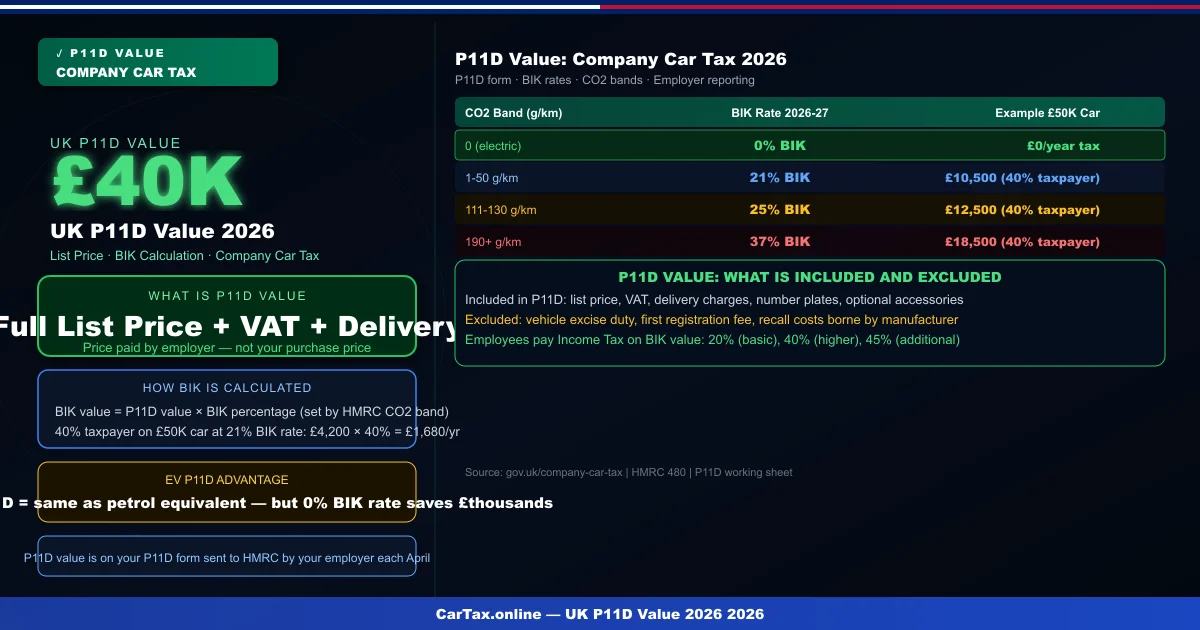
The P11D form is one of the most important documents in the UK company car tax system. Completed by employers for each employee provided with a company car, the P11D records the P11D value of the vehicle and associated benefits, which HMRC then uses to calculate the employee's annual company car tax liability.
The United Kingdom operates one of the most comprehensive vehicle taxation systems in the world. From the moment a car is first registered to the day it reaches historic vehicle status, every stage of ownership carries distinct tax implications. Understanding these P11D Value rules in 2026 enables drivers to budget accurately, identify legitimate savings opportunities, and maintain full legal compliance throughout their vehicle ownership journey.
## Understanding P11D Value in the UK Context
The P11D value of a company car is its full list price when first registered, including the cost of all standard equipment, optional accessories fitted at the factory or by the dealer, delivery charges, and VAT. The value specifically excludes the first registration fee and road fund licence, which the employer pays separately and can treat as a deductible business expense.
## Current P11D Value Rates and Regulations
The BIK rate applied to the P11D value ranges from 0% for pure electric vehicles to 37% for the highest-emitting petrol and diesel cars. The 2026-27 tax year maintains the 0% EV rate that was introduced as a transitional incentive and remains under review for future tax years.
### How BIK Tax Is Calculated From P11D Value
The annual BIK tax liability for a company car is calculated by multiplying the P11D value by the applicable BIK percentage, then applying the employee's marginal Income Tax rate. For a 40% taxpayer with a company car valued at £40,000 and subject to a 21% BIK rate, the calculation is £40,000 times 21% equals £8,400, multiplied by 40% equals £3,360 annual Income Tax charge.
This figure is added to the employee's PAYE tax code and collected through monthly payroll deductions. For higher-rate taxpayers with high-emitting vehicles, the annual charge can exceed £10,000, making the choice of vehicle a significant financial decision.
### Items Included and Excluded from P11D Value
Accessories fitted after the initial vehicle purchase are generally treated separately from the original P11D value. Employer-provided accessories may generate their own BIK liability depending on their value and nature. Private fuel provided by the employer generates a separate fuel BIK charge, calculated using HMRC's fuel-only multipliers and added to the P11D form as an additional benefit.
Equipment specifically designed for the employee's disability, provided at no cost by the employer, is exempt from the P11D benefit-in-kind rules. This makes employer-funded disability driving equipment a valuable tax-free benefit for qualifying employees.
### Reducing P11D Tax Through Vehicle Choice
The most effective strategy for minimising P11D-related tax is to choose the lowest-emission vehicle available in the required category. A pure electric vehicle with a £50,000 P11D value generates the same £0 annual tax charge as a £25,000 electric vehicle, making higher-specification EVs particularly efficient from a tax perspective.
## Frequently Asked Questions
**Does the P11D value change if I take optional extras during the lease?**
For leased vehicles, the P11D value is the manufacturer's list price including all accessories fitted at the point of delivery. Subsequent optional extras added by the employee during the lease period do not normally alter the original P11D value unless specifically included by the lease company.
**Can I reduce my P11D value by contributing to the vehicle cost?**
No. Employee contributions to the capital cost of a company car do not reduce the P11D value. However, employees who pay for private fuel or accessories may affect the calculation of specific BIK components.
**How do I find out my P11D value?**
Your employer is required to provide you with a copy of your completed P11D form by 6 July following the end of the tax year. The vehicle's P11D value can also be obtained from the leasing company or fleet manager.
**What happens to the P11D value when I return the car?**
The P11D value is a fixed figure based on the vehicle's original specification. It does not depreciate or change during the vehicle's use as a company car. The value remains on the P11D form for the full tax year of the vehicle's provision.
Disclaimer: CarTax.online provides general information for guidance purposes only. Tax rules and rates are subject to change. Always verify current rates with gov.uk or HMRC before making financial decisions. This guide was last reviewed in 2026.
Frequently Asked Questions
Q: How much is car tax (VED) in the UK 2026?
Car tax rates in the UK depend on your vehicle's CO2 emissions and list price. Standard rates start from £190 per year for petrol and diesel cars, with zero-rated VED for EVs. First-year rates vary from £0 to £2,605 depending on emissions. Additional premiums apply for vehicles over £40,000.
Q: How do I check if my car is taxed online?
You can check your vehicle's tax status for free on the Gov.uk website at gov.uk/check-vehicle-tax. You'll need your vehicle's registration number (number plate). You can also check via the Motor Insurance Database to verify road tax and insurance status simultaneously.
Q: Can I get a refund on car tax if I sell my vehicle?
Yes — if you sell or scrap your vehicle, you can claim a refund on any full months of remaining road tax. Contact DVLA with the V11 reminder letter or apply online at gov.uk. Refunds are usually processed within 4-6 weeks. Related: Car Scrap Value UK 2026 | Big Car Tax Changes Coming to UK 2026 | 5 Clever Ways to Tax My Car Online and Save Money | Check Car Tax and MOT Status UK.
Q: Is road tax refund available when transferring ownership?
No — road tax does not transfer with the vehicle. When you sell your car, the tax is automatically cancelled and any remaining months are refunded to you by DVLA. The new owner must tax the vehicle immediately. As a buyer, always verify the vehicle's tax status before purchasing.
Q: What is the luxury car tax threshold in the UK 2026?
The additional rate for vehicles over £40,000 (list price) adds £410 per year to standard VED rates for years 2-6 of registration. This surcharge brings the annual cost for high-emission vehicles over £40,000 to around £600-690 per year. Pure EVs under £40,000 pay zero VED.
⚠ Financial & Legal Disclaimer
All information provided in this article is for educational and informational purposes only. The content is synthesized based on verbal communications, extensive internet research, and official government website data as of the date of publishing. Tax laws and insurance policies are subject to frequent changes by the authorities. We strive for accuracy, but we recommend that you consult a qualified professional (CA, CPA, or Tax Consultant) before making any financial decisions. For personalized assistance, you can also connect with our in-house experts through our Contact Us page.
Ready to calculate your car tax?
Use our free calculator to get an instant, accurate estimate for your country and state.
Open Car Tax Calculator →