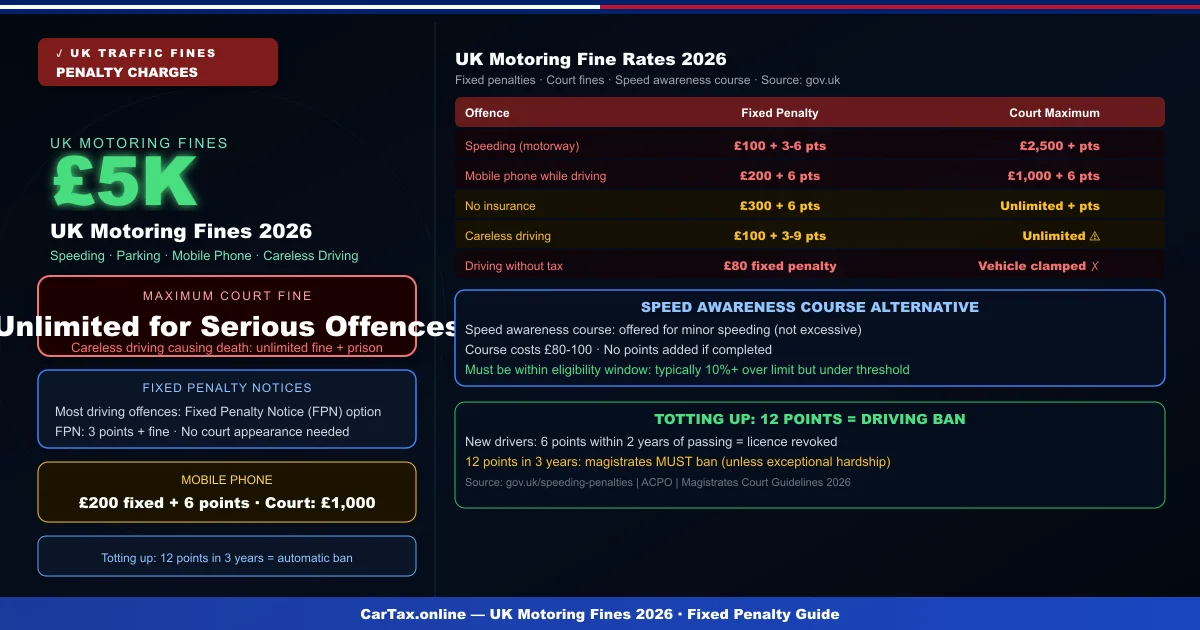
Understanding UK motoring fines is essential for every driver. The penalties for traffic offences range from modest fixed penalty notices resolved by post to potentially unlimited court fines and imprisonment for the most serious driving offences. The 2026 penalty framework applies consistently across England and Wales, with Scotland and Northern Ireland operating their own judicial systems.
UK drivers face a wide range of tax obligations that apply from the moment a vehicle is purchased through to its entire lifespan on British roads. Understanding how UK car tax works in 2026 is essential for budgeting, legal compliance, and making informed decisions about vehicle purchases. Whether you drive a petrol hatchback, a diesel SUV, or a pure electric vehicle, the tax rules affect your wallet directly.
## How Does UK Car Tax Work in 2026?
The primary form of car tax in the United Kingdom is Vehicle Excise Duty (VED), commonly called road tax even though the Road Fund it was originally tied to was abolished in 1937. VED is an annual charge applied to most vehicles registered for use on public roads. The amount you pay depends on several factors including the vehicle type, its CO2 emissions at the point of first registration, its list price, and whether it qualifies for any exemptions.
The standard rate for most cars registered after April 2018 is £190 per year from year two onwards. The first-year rate is calculated based on official CO2 emission grades, ranging from £0 for zero-emission vehicles to £2,605 for the highest-emitting cars. Pure electric vehicles enjoy a significant advantage, paying nothing for the first five years of registration. This makes choosing an electric car one of the most effective ways to reduce motoring costs in the long term.
Different rules apply to other vehicle categories. Motorcycles fall into their own VED bands based on engine size, with rates starting as low as £21 per year for machines under 150cc. Vans are taxed separately from cars, with light goods vehicles currently paying £320 per year. Larger goods vehicles over 3.5 tonnes gross weight are classified as heavy goods vehicles and face different rates including the HGV Road User Levy.
### Fixed Penalty Notices for Driving Offences
The Fixed Penalty system provides a streamlined route for resolving many common motoring offences without court proceedings. Most road traffic offences carry a fixed penalty of £100 plus licence points. Drivers who accept a Fixed Penalty Notice have 28 days to pay and receive the points, avoiding the inconvenience of a court appearance while still accepting the endorsement on their driving licence.
However, not all offences are eligible for the fixed penalty route. Serious driving offences including dangerous driving, drink or drug driving, and offences resulting in death or serious injury must be heard in court regardless of the driver's preference. These offences carry uncapped penalties and the possibility of imprisonment.
The Fixed Penalty system also covers vehicle-related offences that are not directly driving offences. Using a mobile phone while driving carries a £200 fixed penalty and six licence points under current rules, doubled from the previous rate following government crackdowns on distracted driving.
### Speeding Penalties in Detail
Speeding fines follow a graduated structure based on how far over the limit you were driving. On a motorway, the fixed penalty is £100 and three points for the lowest tier of speeding, rising through bands to £1,000 and six points for the most serious excess. Courts can impose fines of up to £2,500 for motorway speeding offences.
Many police forces offer a Speed Awareness Course as an alternative to the fixed penalty for lower-tier speeding offences. This course costs approximately £80 to £100 and, if completed successfully, avoids both the fine and the points on your licence. Eligibility is based on the speed recorded and whether you have attended a similar course recently.
Excessive speeding at 30mph or more above the legal limit, or driving at extreme speeds on any road, will always result in court proceedings. The Sentencing Council guidelines for these cases can result in fines calculated as a percentage of weekly income, plus disqualification periods that may extend to 56 days or longer.
### The Totting-Up System: 12 Points Equals a Ban
The totting-up system is one of the most important concepts in UK motoring law. If you accumulate 12 or more penalty points within a three-year period, you face a totting-up ban at magistrates court. The court must ban you for at least six months unless you can demonstrate exceptional hardship that would outweigh the danger posed by your continued driving.
New drivers are subject to an even stricter version of this rule. Any newly qualified driver who accumulates six or more points within two years of passing their test has their licence automatically revoked, requiring a full reapplication including both theory and practical examinations.
For professional drivers whose livelihoods depend on their driving licence, a totting-up ban can be catastrophic. Specialist road traffic solicitors can advise on challenging the totting-up process or applying for a hearing to argue that the exceptional hardship threshold is met.
## Frequently Asked Questions
**How long do penalty points stay on your licence?**
Penalty points remain on your driving licence for four years from the date of the offence. They are visible to employers and insurers for this period and continue to count toward the totting-up threshold for three years.
**Can you appeal a Fixed Penalty Notice?**
Yes. You can opt for a court hearing rather than accepting the fixed penalty. The case will then be heard before a magistrate who can acquit you, impose the fixed penalty, or vary the penalty as they see fit.
**What is the maximum court fine for careless driving?**
Careless driving heard in court can result in an unlimited fine. The Sentencing Council provides guidelines suggesting fines should be proportionate to income, with the most serious cases resulting in fines of thousands of pounds plus disqualification.
**Does the totting-up ban apply in Scotland?**
Yes. The totting-up system applies across Great Britain. Accumulating 12 points within three years triggers a mandatory ban hearing before Scottish magistrates just as it does in England and Wales.
Disclaimer: CarTax.online provides general information for guidance purposes only. Tax rules and rates are subject to change. Always verify current rates with gov.uk or HMRC before making financial decisions. This guide was last reviewed in 2026.
Frequently Asked Questions
Q: How much is car tax (VED) in the UK 2026?
Car tax rates in the UK depend on your vehicle's CO2 emissions and list price. Standard rates start from £190 per year for petrol and diesel cars, with zero-rated VED for EVs. First-year rates vary from £0 to £2,605 depending on emissions. Additional premiums apply for vehicles over £40,000.
Q: How do I check if my car is taxed online?
You can check your vehicle's tax status for free on the Gov.uk website at gov.uk/check-vehicle-tax. You'll need your vehicle's registration number (number plate). You can also check via the Motor Insurance Database to verify road tax and insurance status simultaneously.
Q: Can I get a refund on car tax if I sell my vehicle?
Yes — if you sell or scrap your vehicle, you can claim a refund on any full months of remaining road tax. Contact DVLA with the V11 reminder letter or apply online at gov.uk. Refunds are usually processed within 4-6 weeks. Related: UK Motoring Costs 2026 | Big Car Tax Changes Coming to UK 2026 | 5 Clever Ways to Tax My Car Online and Save Money | Check Car Tax and MOT Status UK.
Q: Is road tax refund available when transferring ownership?
No — road tax does not transfer with the vehicle. When you sell your car, the tax is automatically cancelled and any remaining months are refunded to you by DVLA. The new owner must tax the vehicle immediately. As a buyer, always verify the vehicle's tax status before purchasing.
Q: What is the luxury car tax threshold in the UK 2026?
The additional rate for vehicles over £40,000 (list price) adds £410 per year to standard VED rates for years 2-6 of registration. This surcharge brings the annual cost for high-emission vehicles over £40,000 to around £600-690 per year. Pure EVs under £40,000 pay zero VED.
⚠ Financial & Legal Disclaimer
All information provided in this article is for educational and informational purposes only. The content is synthesized based on verbal communications, extensive internet research, and official government website data as of the date of publishing. Tax laws and insurance policies are subject to frequent changes by the authorities. We strive for accuracy, but we recommend that you consult a qualified professional (CA, CPA, or Tax Consultant) before making any financial decisions. For personalized assistance, you can also connect with our in-house experts through our Contact Us page.
Ready to calculate your car tax?
Use our free calculator to get an instant, accurate estimate for your country and state.
Open Car Tax Calculator →