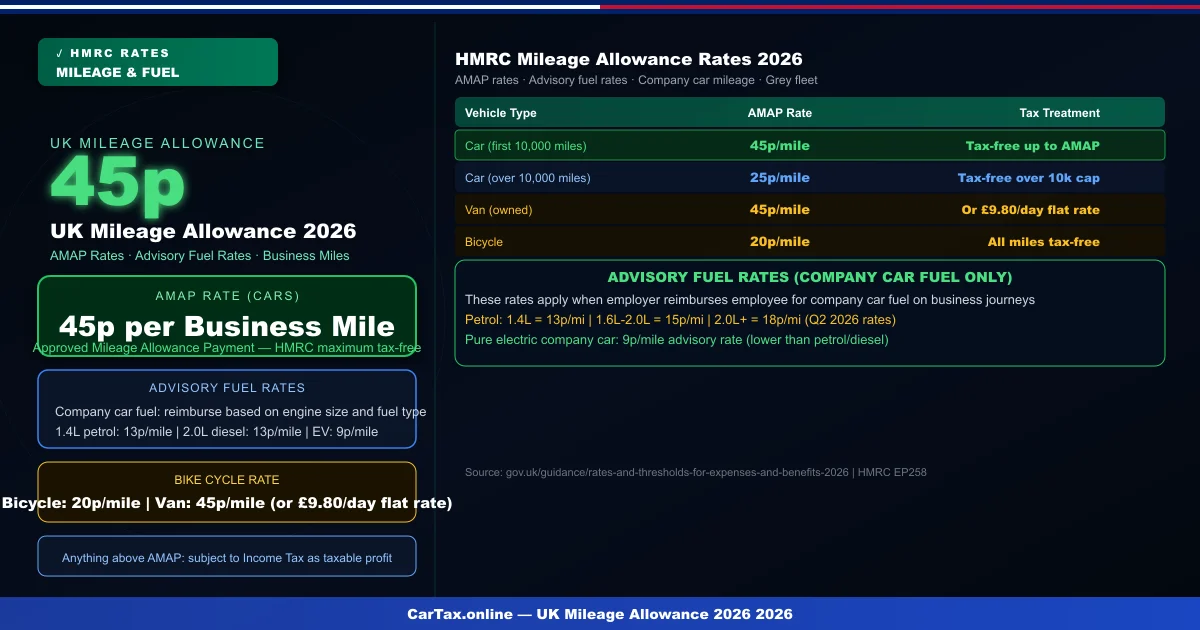
The HMRC mileage allowance system provides the framework through which UK employees and employers handle the financial aspects of business-related driving. Whether you are reimbursed by your employer, claim back expenses, or use your own vehicle for business purposes, the Approved Mileage Allowance Payment rates determine what can be paid tax-free.
The United Kingdom operates one of the most comprehensive vehicle taxation systems in the world. From the moment a car is first registered to the day it reaches historic vehicle status, every stage of ownership carries distinct tax implications. Understanding these Mileage Allowance rules in 2026 enables drivers to budget accurately, identify legitimate savings opportunities, and maintain full legal compliance throughout their vehicle ownership journey.
## Understanding Mileage Allowance in the UK Context
The Approved Mileage Allowance Payment system was introduced to simplify the taxation of business mileage reimbursements. Rather than requiring detailed expense claims for every journey, HMRC sets fixed rates that employers can pay without the employee incurring a tax liability. Any payment above the AMAP rate becomes taxable income.
## Current Mileage Allowance Rates and Regulations
The current AMAP rate for cars is 45 pence per business mile for the first 10,000 miles in a tax year, reducing to 25 pence per mile thereafter. This reduction reflects the assumption that drivers with very high annual mileages incur lower marginal costs per mile due to spreading fixed vehicle costs over a larger base.
### Advisory Fuel Rates for Company Cars
Advisory Fuel Rates are separate from AMAP and apply specifically when an employer provides fuel for a company car and needs to calculate reimbursement for business-only fuel, or when an employee must repay the employer for private fuel included in a company car arrangement.
The current AFR for a typical 1.4-litre petrol car is 13 pence per mile, with higher rates for larger engines and lower rates for electric company cars at 9 pence per mile. These rates are updated quarterly by HMRC to reflect current fuel prices, with the next review anticipated in response to recent pump price movements.
### Using Mileage Allowances as a Tax Planning Tool
For employees who frequently use their personal vehicle for business purposes, ensuring that employer mileage rates meet or exceed AMAP rates is important to avoid an unnecessary tax liability. Some employers pay below AMAP, and in these cases employees can claim the difference between what was paid and the AMAP rate as a deduction against their tax liability using form P87.
For self-employed individuals, the HMRC fixed profit allocation system provides an alternative to claiming actual vehicle expenses. This system applies a fixed mileage rate to business journeys, simplifying record-keeping for sole traders and partners whose vehicle use is primarily for business purposes.
### Grey Fleet Considerations
The term grey fleet refers to employees using their own personal vehicles for business journeys rather than a company-provided vehicle. While grey fleet arrangements avoid the BIK taxation that applies to company cars, they create obligations for both employers and employees to ensure proper insurance coverage, vehicle maintenance, and mileage record-keeping.
## Frequently Asked Questions
**What mileage rate should my employer pay me?**
Employers are not legally required to pay any specific mileage rate. However, paying the AMAP rate (45p/mile) means the payment is completely tax-free for the employee. Paying less allows the employee to claim the shortfall as a tax deduction.
**Can I claim mileage for commuting to my regular place of work?**
No. Commuting between your home and your regular place of work is not a business journey and cannot be claimed as business mileage. Only journeys that start or end at a location that is not your home or regular workplace qualify.
**Do Advisory Fuel Rates apply if I drive an electric company car?**
Yes. HMRC publishes reduced AFR rates for electric vehicles at 9 pence per mile. This reflects the lower fuel cost of charging compared to petrol or diesel consumption.
**What records do I need to keep for mileage claims?**
You should maintain a log of business journeys including date, starting location, destination, purpose of journey, and miles travelled. HMRC can require evidence of business mileage as part of any enquiry into mileage expense claims.
Disclaimer: CarTax.online provides general information for guidance purposes only. Tax rules and rates are subject to change. Always verify current rates with gov.uk or HMRC before making financial decisions. This guide was last reviewed in 2026.
Frequently Asked Questions
Q: What is the current road tax rate for cars in India 2026?
Road tax rates in India vary by state and vehicle category. For new cars, GST is charged at 5% for EVs, 18% for hybrids under 1,200cc, and up to 28% for petrol/diesel SUVs. State road tax is charged separately and varies from Rs3,000-15,000 annually depending on the state's slab system. Check your specific state's RTO website for current rates.
Q: How do I calculate my car road tax online in India?
You can calculate your car road tax using online calculators available on state RTO portals and CarTax.online. The calculation considers your vehicle's ex-showroom price, fuel type, engine capacity, and state of registration. Road tax is payable annually or for the vehicle's lifetime depending on your state's rules.
Q: Is GST included in the road tax for new cars in India?
No — GST and road tax are separate charges. GST is a central tax charged by the vehicle manufacturer at the time of purchase. State road tax is a separate annual or one-time charge levied by your state's transport department. Both apply at the time of first registration, and annual road tax continues for subsequent years. Related: UK Company Mileage Allowance 2026 | UK Business Car Allowance 2026 | UK Car Allowance Rates 2026 | UK Company Car Allowance 2026.
Q: Do electric vehicles get tax benefits in India 2026?
Yes — electric vehicles in India qualify for a reduced GST rate of 5% (down from 28% for petrol cars). Under FAME-III subsidies, EVs may also qualify for additional state-level incentives, reduced road tax, and free registration in many states. The exact benefits vary by state.
Q: What happens if I don't pay my car road tax on time?
If you don't pay road tax, your vehicle's registration can be flagged in the Vahan database, preventing renewal of fitness certificates and creating legal liability during police checks. Penalties range from Rs200-500 per day of default in most states. Road tax is a legal requirement under the Motor Vehicles Act.
⚠ Financial & Legal Disclaimer
All information provided in this article is for educational and informational purposes only. The content is synthesized based on verbal communications, extensive internet research, and official government website data as of the date of publishing. Tax laws and insurance policies are subject to frequent changes by the authorities. We strive for accuracy, but we recommend that you consult a qualified professional (CA, CPA, or Tax Consultant) before making any financial decisions. For personalized assistance, you can also connect with our in-house experts through our Contact Us page.
Ready to calculate your car tax?
Use our free calculator to get an instant, accurate estimate for your country and state.
Open Car Tax Calculator →