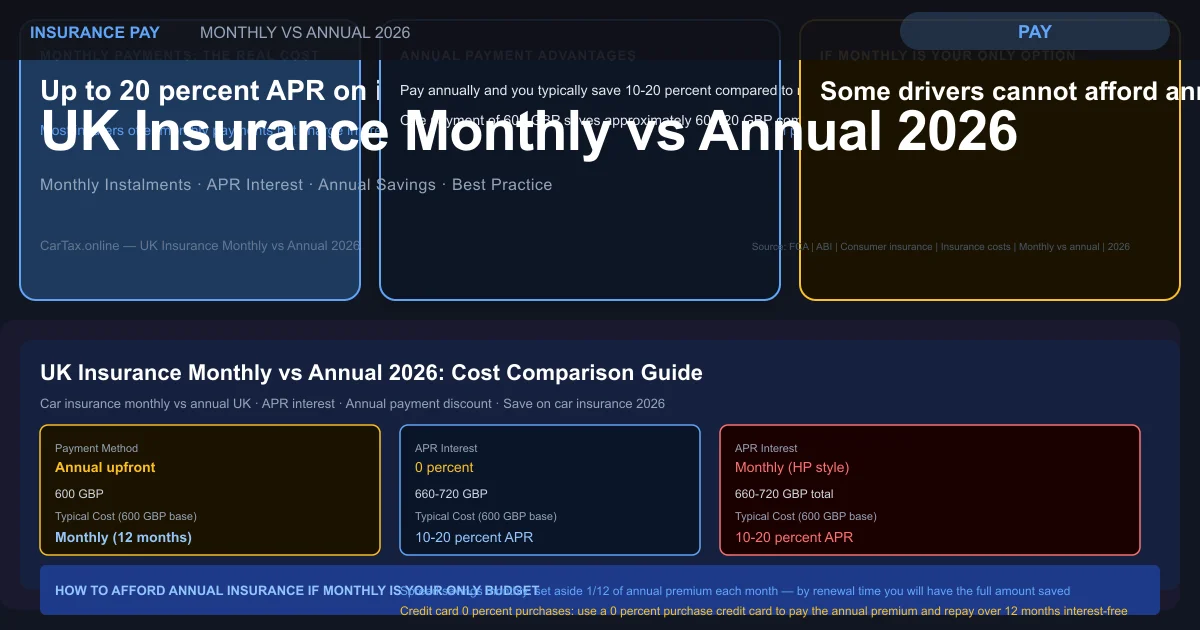
Monthly vs Annual Car Insurance at a Glance
UK car insurance policies can be paid annually or in monthly instalments. Annual payment means you pay the full premium upfront, typically at a lower total cost. Monthly payment spreads the cost but usually carries a significant APR — typically between 12 and 30 percent — which means you pay considerably more overall. Understanding this trade-off is essential before choosing your payment method.
How Monthly Instalment Plans Work
When you choose to pay monthly, most insurers use a premium finance arrangement. You pay an initial deposit — usually equivalent to one or two monthly instalments — and the remaining balance is split over the policy term, which is typically 10 or 11 months. The insurer or a finance partner charges interest on the outstanding balance, and the total premium is higher than the annual equivalent.
Some insurers offer a direct monthly payment option where you pay one-twelfth of the annual premium each month, but this is rare. In most cases, the monthly instalment structure involves a finance arrangement. The APR is clearly disclosed in the quote, though many buyers focus on the lower monthly figure without calculating the true annual cost.
The Real Cost of Monthly Payments
Consider an annual premium of 600 GBP. Paying monthly with an APR of 20 percent over 10 months would cost approximately 66 GBP per month, totalling 792 GBP — 192 GBP more than the annual payment. Even a lower APR of 12 percent still adds around 60 GBP to the annual cost over 10 months. Related: Car GAP Insurance UK 2026 | UK Car Insurance 2026 | Car Modification Insurance UK 2026 | Track Day Insurance UK 2026.
The Financial Conduct Authority (FCA) has required insurers to show both monthly and annual costs clearly in quotes since 2022, specifically to address the problem of consumers choosing monthly payments without understanding the true cost. Despite this transparency requirement, many drivers continue to select monthly instalments based on the lower visible figure.
When Monthly Payment Makes Sense
If you genuinely cannot afford the annual premium upfront, monthly payment is better than driving uninsured. The consequences of driving without insurance — fines of at least 300 GBP, six penalty points, and potential vehicle seizure — far outweigh the cost of instalment interest. In this scenario, paying a higher total for monthly instalments is the financially sensible choice.
Monthly payments can also be advantageous if you are between policies and need short-term cover. Some insurers offer rolling monthly policies that provide flexibility for drivers who do not want to commit to a 12-month term. However, this flexibility comes at a premium — short-term policies are significantly more expensive per month than annual equivalents.
Strategies to Avoid Monthly Payment Interest
Several strategies can help you avoid paying interest on monthly car insurance. The most effective is to build an emergency fund that covers at least three months of car expenses, including insurance. When your policy renews, you can pay the annual premium from savings rather than relying on instalments.
Another approach is to use a 0 percent purchase credit card for the annual premium. If you pay off the balance within the card's interest-free period — typically 12 to 24 months — you pay no interest at all. However, this requires discipline to clear the full balance before the promotional period ends. A third option is to set up a separate savings account specifically for car insurance and contribute a small amount each month.
Direct Debit Cancellation and Early Settlement
If you pay monthly and want to cancel your policy, the insurer will calculate the remaining balance based on a daily pro-rata basis and charge an early termination fee, which can be substantial. Many insurers charge between 50 and 125 GBP for early cancellation. This makes switching insurers during the policy year expensive, effectively locking you into the policy for the full term.
Annual policies are generally more flexible. You can cancel at any time and receive a pro-rata refund of the unused portion of the premium, minus an admin fee that is typically lower than monthly policy cancellation fees. This flexibility is a significant advantage of annual payment that many drivers overlook.
Comparing Quotes: What to Look For
When comparing insurance quotes, always look at the total annual cost, not just the monthly instalment. Most price comparison websites and insurer websites show both figures prominently since the FCA requirement. Pay particular attention to the APR rate disclosed for monthly instalments, as this varies significantly between providers — some charge as low as 12 percent APR while others charge 30 percent.
The excess amount also affects the effective cost of the policy. A lower premium with a higher excess may be more expensive overall if you need to make a claim. Always compare policies with identical excess levels, or calculate the effective cost by adding the excess to the premium before comparing.
Official Resources: GOV.UK Check Vehicle Tax | GOV.UK Vehicle Tax | DVLA Online | MOT Check
Frequently Asked Questions
Q: How much is car tax (VED) in the UK 2026?
Car tax rates in the UK depend on your vehicle's CO2 emissions and list price. Standard rates start from £190 per year for petrol and diesel cars, with zero-rated VED for EVs. First-year rates vary from £0 to £2,605 depending on emissions. Additional premiums apply for vehicles over £40,000.
Q: How do I check if my car is taxed online?
You can check your vehicle's tax status for free on the Gov.uk website at gov.uk/check-vehicle-tax. You'll need your vehicle's registration number (number plate). You can also check via the Motor Insurance Database to verify road tax and insurance status simultaneously.
Q: Can I get a refund on car tax if I sell my vehicle?
Yes — if you sell or scrap your vehicle, you can claim a refund on any full months of remaining road tax. Contact DVLA with the V11 reminder letter or apply online at gov.uk. Refunds are usually processed within 4-6 weeks.
Q: Is road tax refund available when transferring ownership?
No — road tax does not transfer with the vehicle. When you sell your car, the tax is automatically cancelled and any remaining months are refunded to you by DVLA. The new owner must tax the vehicle immediately. As a buyer, always verify the vehicle's tax status before purchasing.
Q: What is the luxury car tax threshold in the UK 2026?
The additional rate for vehicles over £40,000 (list price) adds £410 per year to standard VED rates for years 2-6 of registration. This surcharge brings the annual cost for high-emission vehicles over £40,000 to around £600-690 per year. Pure EVs under £40,000 pay zero VED.