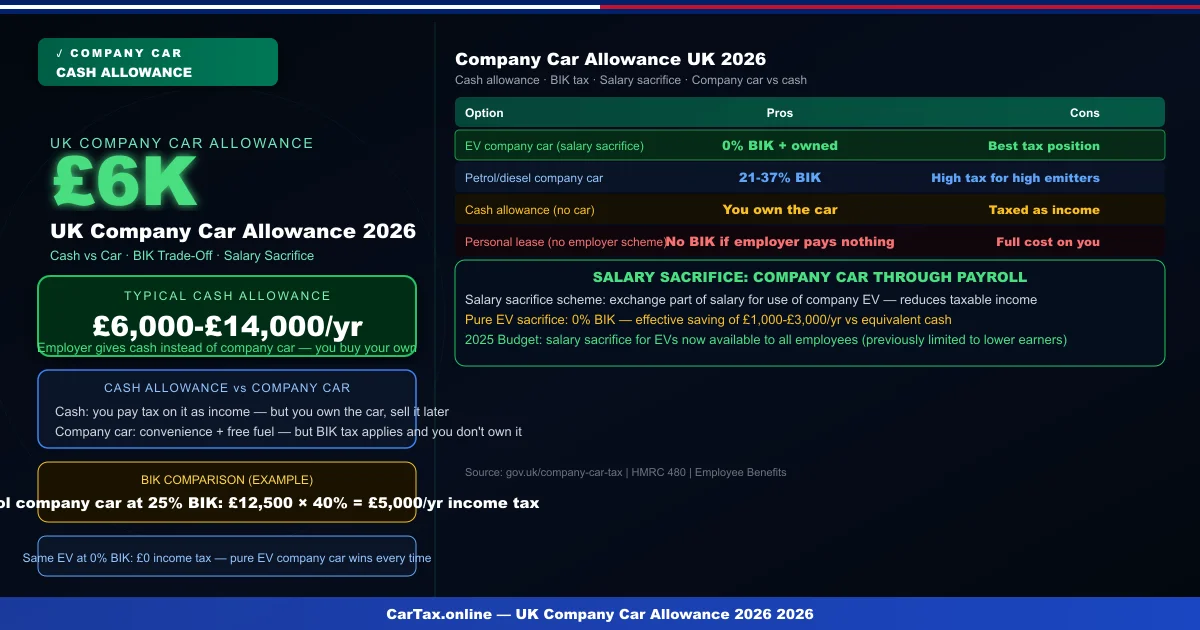
Company car allowance arrangements represent one of the most significant employment benefits available to UK workers, and the choice between taking a cash allowance, a traditional company car, or participating in a salary sacrifice scheme has profound implications for both take-home pay and personal tax liability.
The United Kingdom operates one of the most comprehensive vehicle taxation systems in the world. From the moment a car is first registered to the day it reaches historic vehicle status, every stage of ownership carries distinct tax implications. Understanding these Company Car Allowance rules in 2026 enables drivers to budget accurately, identify legitimate savings opportunities, and maintain full legal compliance throughout their vehicle ownership journey.
## Understanding Company Car Allowance in the UK Context
Employers offering car benefits have several structural options. A traditional company car provides the employee with a fully maintained vehicle for private and business use, with the employer bearing all costs and the employee paying BIK tax on the benefit. A cash allowance gives the employee a regular cash sum to spend on their own vehicle, with the employee retaining full ownership and responsibility for all costs.
## Current Company Car Allowance Rates and Regulations
Cash allowance rates vary widely between employers and sectors, ranging from £3,000 to £20,000 annually depending on the employee's seniority, role requirements, and company policy. The BIK tax on a traditional company car depends on the vehicle's P11D value and CO2 emissions band, with the most efficient option being a pure electric vehicle at 0 percent BIK.
### Salary Sacrifice: The Hybrid Approach
Salary sacrifice car schemes offer a middle ground, allowing employees to exchange a portion of their salary for the use of a company vehicle under a formal sacrifice arrangement. The sacrificed salary reduces the employee's taxable income, while the employer provides and maintains the vehicle.
For electric vehicles, salary sacrifice schemes can be particularly attractive following the removal of restrictions that previously limited EV salary sacrifice to lower earners. A 40 percent taxpayer sacrificing £400 per month saves approximately £160 per month in Income Tax, reducing the effective monthly cost of the vehicle to £240.
However, salary sacrifice arrangements reduce the employee's pension contributions and state pension accrual, as these are calculated on the reduced salary. Employees approaching retirement or with specific financial planning needs should carefully model the pension impact before committing to a salary sacrifice arrangement.
### Comparing Take-Home Pay Across Options
For a 40 percent taxpayer with a £10,000 annual cash allowance, the net annual benefit after tax is £6,000. The employee then bears all vehicle costs including purchase or depreciation, insurance, maintenance, fuel, and VED from this amount.
An equivalent pure electric company car provided under salary sacrifice at £400 per month costs the employee only £240 per month net of tax savings, yet provides access to a substantially higher-specification vehicle than could be purchased outright for £6,000 annually. This comparison demonstrates why electric salary sacrifice schemes have become increasingly popular across UK workplaces.
## Frequently Asked Questions
**Is a company car always better than a cash allowance?**
Not necessarily. For high-mileage drivers who would need to purchase or finance a large vehicle, a company car can offer significant value through employer-funded maintenance and insurance. However, employees who drive very few miles may find a cash allowance more flexible and valuable.
**Do I own the car at the end of a salary sacrifice term?**
Most salary sacrifice arrangements do not transfer ownership to the employee at the end of the term. The employee returns the vehicle to the employer. Some schemes offer a balloon payment purchase option, which can be arranged separately.
**What happens to the company car if I leave my employer?**
The vehicle must be returned to the employer on or before your leaving date. Any outstanding lease obligations or damage charges beyond fair wear and tear may be deducted from your final salary or paid directly.
**Can sole traders and partnerships use salary sacrifice?**
Salary sacrifice applies to employed individuals. Sole traders and business partners are self-employed and cannot enter salary sacrifice arrangements. They can, however, claim capital allowances and business expenses for vehicle use under different tax rules.
Disclaimer: CarTax.online provides general information for guidance purposes only. Tax rules and rates are subject to change. Always verify current rates with gov.uk or HMRC before making financial decisions. This guide was last reviewed in 2026.
Frequently Asked Questions
Q: How much is car tax (VED) in the UK 2026?
Car tax rates in the UK depend on your vehicle's CO2 emissions and list price. Standard rates start from £190 per year for petrol and diesel cars, with zero-rated VED for EVs. First-year rates vary from £0 to £2,605 depending on emissions. Additional premiums apply for vehicles over £40,000.
Q: How do I check if my car is taxed online?
You can check your vehicle's tax status for free on the Gov.uk website at gov.uk/check-vehicle-tax. You'll need your vehicle's registration number (number plate). You can also check via the Motor Insurance Database to verify road tax and insurance status simultaneously.
Q: Can I get a refund on car tax if I sell my vehicle?
Yes — if you sell or scrap your vehicle, you can claim a refund on any full months of remaining road tax. Contact DVLA with the V11 reminder letter or apply online at gov.uk. Refunds are usually processed within 4-6 weeks. Related: UK Company Mileage Allowance 2026 | UK Business Car Allowance 2026 | UK Car Allowance Rates 2026 | Company Car Tax UK 2026.
Q: Is road tax refund available when transferring ownership?
No — road tax does not transfer with the vehicle. When you sell your car, the tax is automatically cancelled and any remaining months are refunded to you by DVLA. The new owner must tax the vehicle immediately. As a buyer, always verify the vehicle's tax status before purchasing.
Q: What is the luxury car tax threshold in the UK 2026?
The additional rate for vehicles over £40,000 (list price) adds £410 per year to standard VED rates for years 2-6 of registration. This surcharge brings the annual cost for high-emission vehicles over £40,000 to around £600-690 per year. Pure EVs under £40,000 pay zero VED.
⚠ Financial & Legal Disclaimer
All information provided in this article is for educational and informational purposes only. The content is synthesized based on verbal communications, extensive internet research, and official government website data as of the date of publishing. Tax laws and insurance policies are subject to frequent changes by the authorities. We strive for accuracy, but we recommend that you consult a qualified professional (CA, CPA, or Tax Consultant) before making any financial decisions. For personalized assistance, you can also connect with our in-house experts through our Contact Us page.
Ready to calculate your car tax?
Use our free calculator to get an instant, accurate estimate for your country and state.
Open Car Tax Calculator →