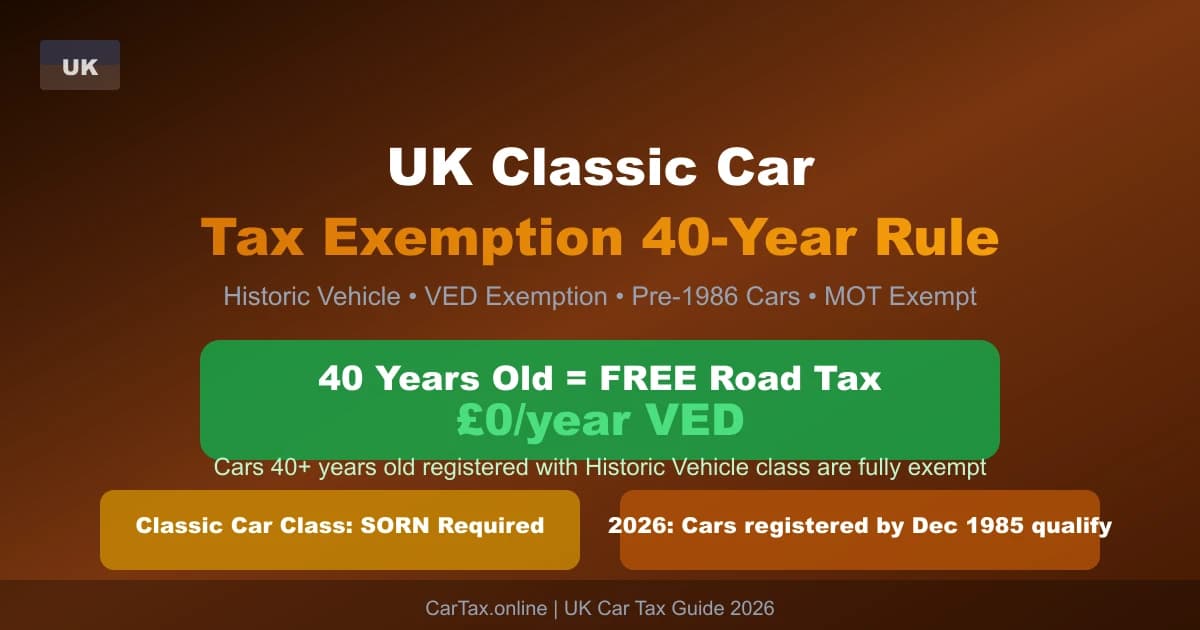
April 26, 2026 in London, United Kingdom — The UK's Historic Vehicle tax class offers one of the most generous tax perks in the automotive world: complete exemption from road tax (VED). As of 2026, any car first registered before January 1, 1986 qualifies — meaning 1985 and earlier vehicles pay exactly £0 in road tax, forever. This guide explains exactly how the system works and how to protect your classic from unnecessary tax.
The 40-Year Historic Vehicle Rule Explained
The UK uses a 40-year rolling cutoff for the Historic Vehicle tax class. Vehicles with a date of first registration 40 or more years ago are eligible for the £0 road tax rate, regardless of their original list price, CO2 emissions, or current market value.
As of April 2026, the qualifying cutoff is cars first registered on or before December 31, 1985. In practical terms, this means:
- 1986 registered cars: Not yet historic (wait until 2026)
- 1985 registered cars: Historic — qualify as of April 2026
- 1984 and earlier: All historic
- 1970s cars: Fully historic, £0 road tax
- 1960s and earlier: Fully historic, £0 road tax
Current Eligible Years for Historic Vehicle Class
| First Registration Year | Status in 2026 | VED Rate | MOT Required? |
|---|---|---|---|
| 2026 | 40 years old — just qualifying | Standard rate applies | Yes |
| 1985 | Historic — qualifies 2026 | £0 | No (historic exempt) |
| 1984 | Historic | £0 | No |
| 1983 | Historic | £0 | No |
| 1980 | Historic | £0 | No |
| 1975 | Historic | £0 | No |
| 1970 | Historic | £0 | No |
| 1965 | Historic | £0 | No |
| 1960 | Historic | £0 | No |
| Pre-1960 | Historic | £0 | No |
How to Register as a Historic Vehicle
To get the £0 road tax rate, your car must be registered in DVLA's Historic Vehicle tax class:
- Check your V5C logbook: Look at the date of first registration field (section B). If it shows a date before January 1, 1986, your car potentially qualifies.
- Apply to DVLA: Use the V55/5 form to apply for first vehicle licensing if you do not have an existing V5C. Alternatively, visit a DVLA local office with your V5C and logbook evidence.
- Provide age evidence: If the V5C does not clearly show date of first registration, provide supporting evidence: old logbook (green slip), previous registration document, or a qualified valuation from a club indicating age.
- DVLA assigns Historic class: Once approved, the V5C will show the Historic Vehicle tax class.
- Tax online at £0: When you tax the vehicle at GOV.UK, it will show £0 road tax. No payment is required.
SORN: When Your Classic Car Is Off the Road
If your classic car is not being driven, you must declare a Statutory Off Road Notification (SORN). This tells DVLA the vehicle is not on a public road and exempts you from road tax. SORN is:
- Free — no charge for declaring SORN
- Online — can be done via GOV.UK
- Automatic renewal — SORN stays in place indefinitely until the vehicle is used or sold
- Requirement — you must have SORN if the car is on a public road without valid tax
Once a SORN is in place for a historic vehicle, it remains active. You do not need to renew it annually — it only ends when you sell the vehicle, tax it, or remove it permanently.
Classic Car Insurance: Tax vs Running Cost
While road tax is £0 for historic vehicles, other costs apply:
| Cost Category | Classic Car (Historic) | Modern Car |
|---|---|---|
| Road Tax (VED) | £0 | £200-£625/year |
| MOT | Exempt (40+ years) | Annual test required |
| Insurance (typical) | £300-800/year | £600-1500/year |
| Fuel (classic) | Road fuel duty applies | Same |
| Maintenance | Specialist, variable | Standard garage |
Modifications That Can Void Historic Status
The Historic Vehicle class is not automatic — it can be lost if significant modifications change the identity of the vehicle. Modifications that may disqualify a car include:
- Engine replacement with a non-original type (e.g., swapping a V8 into an originally 4-cylinder car)
- Chassis/frame replacement with a different type
- Complete body replacement with a different body style
- Significant alteration to the original specification that DVLA determines changes the vehicle's identity
Minor modifications — modern sound systems, improved brakes, electronic ignition — do not affect historic status.
Classic Cars That Almost Qualify (1986-1990 Models)
Cars registered between 1986 and 1990 do not yet qualify as historic. However, some notable 1986-1990 models will become historic soon:
| Year | Models | Becomes Historic |
|---|---|---|
| 1986 | BMW E30, Saab 900 | 2026 |
| 1987 | Volvo 740, Peugeot 405 | 2027 |
| 1988 | BMW E28 M5, Peugeot 205 GTi | 2028 |
| 1989 | Mercedes W124, E30 M3 | 2029 |
| 1990 | BMW E34 M5, Jaguar XJ40 | 2030 |
Conclusion
The UK's 40-year Historic Vehicle rule means any car first registered before January 1, 1986 pays £0 road tax in 2026. The exemption is automatic once the Historic Vehicle class is assigned by DVLA. Combined with MOT exemption for 40+ year old cars, classic car ownership in the UK remains one of the most tax-efficient categories of vehicle ownership. Use our UK Road Tax Calculator for any non-historic vehicle calculations.
Disclaimer: Historic Vehicle class rules based on DVLA guidelines as of April 2026. Confirm eligibility with DVLA before applying. MOT exemption applies to vehicles over 40 years with no substantial modifications.
Official Resources: GOV.UK Historic Vehicles | GOV.UK Vehicle Tax | SORN Guidance