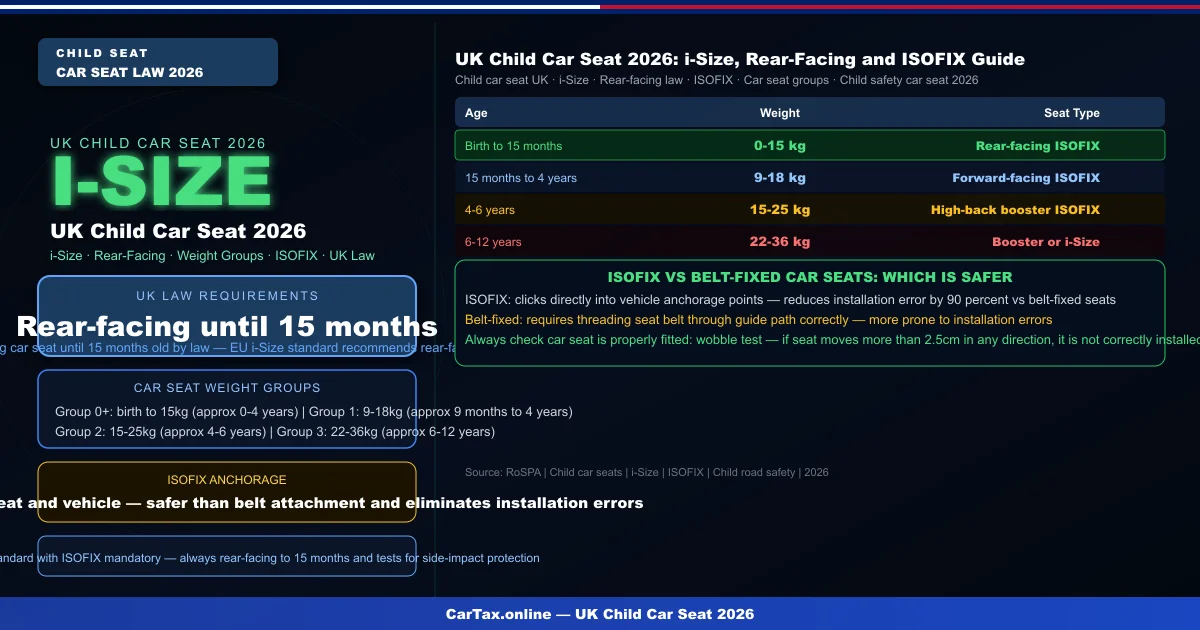
Child car seat safety is a critical consideration for all parents and guardians travelling with children in vehicles. UK law requires all children to use an appropriate car seat until they reach 12 years of age or 135 cm in height, whichever comes first. Understanding the different standards, types and installation methods helps ensure children are as safe as possible on every journey.
UK Car Seat Law Requirements 2026
UK law requires all children under 12 years old or under 135 cm tall to use an appropriate child car seat when travelling in a vehicle. Children must use a rear-facing seat until they are at least 15 months old (i-Size standard recommends rear-facing to 15 months minimum). Seatbelt-only travel is only legal once the child exceeds the height or age threshold.
It is illegal to use a child car seat in a vehicle without a working seatbelt for that seating position. Children must not travel in a rear-facing car seat in a position protected by an active frontal airbag unless the airbag has been deactivated.
Car Seat Weight Groups and Types
Car seats are categorised by weight groups rather than age, as children develop at different rates. Group 0+ covers birth to approximately 15 kg (approximately birth to 4 years), typically rear-facing infant carriers. Group 1 covers 9 to 18 kg (approximately 9 months to 4 years), typically forward-facing toddler seats. Group 2 covers 15 to 25 kg (approximately 4 to 6 years), typically high-back booster seats. Group 3 covers 22 to 36 kg (approximately 6 to 12 years), typically backless or high-back boosters. Related: Car Tax and Child Seats UK 2026 | Car Tax and Child Seats UK 2026 | Andhra Pradesh Road Tax Calculator 2026 — AP Vehicle Rates | ATO Tax Deduction Car Australia 2026.
i-Size Standard Explained
i-Size (UN R129) is a newer European car seat standard that supersedes the older ECE R44/04 standard. i-Size seats must be installed using ISOFIX anchorage points (eliminating installation errors associated with belt-fixed seats), require rear-facing travel to at least 15 months of age, and include mandatory side-impact protection testing. i-Size seats are widely available from all major manufacturers and are considered the safer choice for new purchases.
ISOFIX vs Belt-Fixed Seats
ISOFIX seats click directly into dedicated anchorage points built into the vehicle, eliminating the risk of incorrect seatbelt threading that affects belt-fixed seats. Research shows that ISOFIX reduces the risk of incorrect installation by approximately 90 percent compared to belt-fixed seats. All i-Size seats are ISOFIX-compatible and most new cars have ISOFIX points in at least the outer rear seats.
Belt-fixed seats remain valid under UK law and are the only option for vehicles without ISOFIX points or for rear-facing use in middle seats without ISOFIX. When correctly installed, belt-fixed seats provide equivalent safety to ISOFIX in frontal impacts, though ISOFIX performs better in some side-impact scenarios.
Frequently Asked Questions
How long must a child remain rear-facing in the UK? UK law requires rear-facing until at least 15 months old. i-Size recommends rear-facing to 15 months minimum, and many child safety organisations recommend rear-facing for as long as possible (up to 4 years) as it provides significantly better protection in frontal impacts.
Can a child use a car seat without ISOFIX? Yes. Belt-fixed car seats remain legal and safe when correctly installed. The critical requirement is correct installation: a wobble test should show the seat moving no more than 2.5 cm in any direction when correctly secured.
Official Resources: GOV.UK Check Vehicle Tax | GOV.UK Vehicle Tax | DVLA Online | MOT Check
Frequently Asked Questions
Q: How much is car tax (VED) in the UK 2026?
Car tax rates in the UK depend on your vehicle's CO2 emissions and list price. Standard rates start from £190 per year for petrol and diesel cars, with zero-rated VED for EVs. First-year rates vary from £0 to £2,605 depending on emissions. Additional premiums apply for vehicles over £40,000.
Q: How do I check if my car is taxed online?
You can check your vehicle's tax status for free on the Gov.uk website at gov.uk/check-vehicle-tax. You'll need your vehicle's registration number (number plate). You can also check via the Motor Insurance Database to verify road tax and insurance status simultaneously.
Q: Can I get a refund on car tax if I sell my vehicle?
Yes — if you sell or scrap your vehicle, you can claim a refund on any full months of remaining road tax. Contact DVLA with the V11 reminder letter or apply online at gov.uk. Refunds are usually processed within 4-6 weeks.
Q: Is road tax refund available when transferring ownership?
No — road tax does not transfer with the vehicle. When you sell your car, the tax is automatically cancelled and any remaining months are refunded to you by DVLA. The new owner must tax the vehicle immediately. As a buyer, always verify the vehicle's tax status before purchasing.
Q: What is the luxury car tax threshold in the UK 2026?
The additional rate for vehicles over £40,000 (list price) adds £410 per year to standard VED rates for years 2-6 of registration. This surcharge brings the annual cost for high-emission vehicles over £40,000 to around £600-690 per year. Pure EVs under £40,000 pay zero VED.