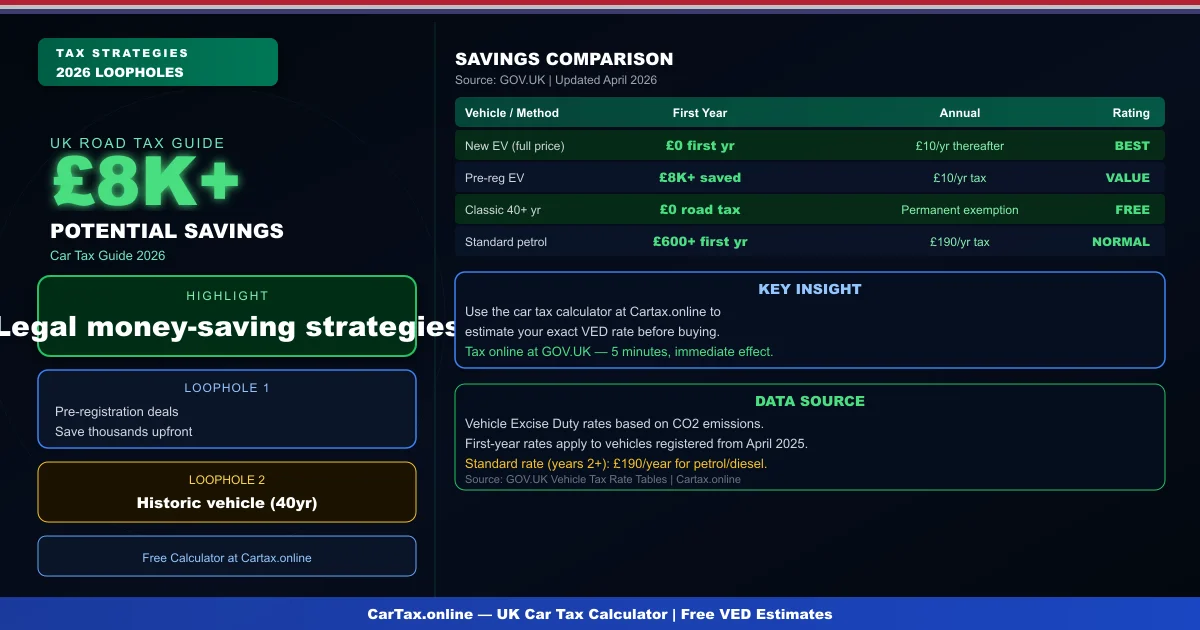
While fraudulent car tax avoidance is a criminal offence, there are several legitimate strategies that UK drivers can use to minimise or eliminate their Vehicle Excise Duty liability. These are not loopholes in the illegal sense but rather intended features of VED legislation that prudent vehicle owners can take advantage of.
UK drivers face a wide range of tax obligations that apply from the moment a vehicle is purchased through to its entire lifespan on British roads. Understanding how UK car tax works in 2026 is essential for budgeting, legal compliance, and making informed decisions about vehicle purchases. Whether you drive a petrol hatchback, a diesel SUV, or a pure electric vehicle, the tax rules affect your wallet directly.
## How Does UK Car Tax Work in 2026?
The primary form of car tax in the United Kingdom is Vehicle Excise Duty (VED), commonly called road tax even though the Road Fund it was originally tied to was abolished in 1937. VED is an annual charge applied to most vehicles registered for use on public roads. The amount you pay depends on several factors including the vehicle type, its CO2 emissions at the point of first registration, its list price, and whether it qualifies for any exemptions.
The standard rate for most cars registered after April 2018 is £190 per year from year two onwards. The first-year rate is calculated based on official CO2 emission grades, ranging from £0 for zero-emission vehicles to £2,605 for the highest-emitting cars. Pure electric vehicles enjoy a significant advantage, paying nothing for the first five years of registration. This makes choosing an electric car one of the most effective ways to reduce motoring costs in the long term.
Different rules apply to other vehicle categories. Motorcycles fall into their own VED bands based on engine size, with rates starting as low as £21 per year for machines under 150cc. Vans are taxed separately from cars, with light goods vehicles currently paying £320 per year. Larger goods vehicles over 3.5 tonnes gross weight are classified as heavy goods vehicles and face different rates including the HGV Road User Levy.
### The Pure Electric Vehicle Exemption
The most impactful legitimate car tax saving available to UK drivers is purchasing a pure electric vehicle. Battery electric cars registered from April 2018 onwards pay £0 VED for five consecutive years from the date of first registration. This represents a saving of £950 over five years compared to the standard £190 annual rate.
Beyond VED, electric vehicles used as company cars attract a 0% Benefit in Kind rate, saving 40% taxpayers thousands of pounds annually in Income Tax compared to equivalent petrol or diesel company cars. When combined with salary sacrifice arrangements, the total tax savings for switching to an electric company car can exceed £5,000 per year for higher-rate taxpayers.
The EV exemption is established government policy, not a workaround. It is designed to incentivise the adoption of zero-emission vehicles and represents the most straightforward legitimate method of eliminating road tax.
### The Classic Car VED Exemption
Vehicles over 40 years old are permanently exempt from Vehicle Excise Duty under current legislation. This means a classic car registered in 1986 or earlier can be driven on UK roads tax-free for the remainder of its life. This exemption applies to any vehicle over 40 years old regardless of its value, make, or engine size.
For classic car enthusiasts, this creates a compelling long-term ownership case. A driver purchasing a 38-year-old classic car today will find that VED costs disappear entirely once the vehicle crosses the 40-year threshold, making the annual cost of ownership decline over time.
### Timing Your Luxury Car Purchase
The premium VED rate of £325 per year applies only during years two through six of a vehicle's life, calculated from its original date of first registration. Any vehicle that is already more than six years old at the time of purchase will attract only the standard £190 annual rate regardless of its original list price.
A strategic buyer purchasing a high-value luxury car in its seventh year or later avoids the premium VED period entirely. This timing strategy is particularly relevant for buyers of prestige vehicles that hold their value well in the used market, where seven-year-old examples may be available at significantly reduced prices while remaining in excellent condition.
## Frequently Asked Questions
**Is timing a luxury car purchase to avoid premium VED legal?**
Yes. There is no legal restriction on the age of a vehicle at the time of purchase. The premium rate applies based on the vehicle's age at first registration, not your purchase date.
**Do all electric cars qualify for the VED exemption?**
Only pure battery electric vehicles (BEVs) qualify. Plug-in hybrids with both a battery and an internal combustion engine do not qualify for the zero-rate first-year VED in the same way and are taxed according to their CO2 emissions.
**Can I claim the 40-year exemption for a rebuilt classic car?**
The 40-year rule is based on the vehicle's original date of first registration, not the date of reconstruction or restoration. A rebuilt vehicle retains its original registration number and age for VED purposes.
**Does the salary sacrifice car tax saving apply to all employers?**
Salary sacrifice schemes must meet specific HMRC qualifying conditions and are subject to employer discretion. Not all employers offer these schemes, and eligibility criteria may apply.
Disclaimer: CarTax.online provides general information for guidance purposes only. Tax rules and rates are subject to change. Always verify current rates with gov.uk or HMRC before making financial decisions. This guide was last reviewed in 2026.
Frequently Asked Questions
Q: How much is car tax (VED) in the UK 2026?
Car tax rates in the UK depend on your vehicle's CO2 emissions and list price. Standard rates start from £190 per year for petrol and diesel cars, with zero-rated VED for EVs. First-year rates vary from £0 to £2,605 depending on emissions. Additional premiums apply for vehicles over £40,000.
Q: How do I check if my car is taxed online?
You can check your vehicle's tax status for free on the Gov.uk website at gov.uk/check-vehicle-tax. You'll need your vehicle's registration number (number plate). You can also check via the Motor Insurance Database to verify road tax and insurance status simultaneously.
Q: Can I get a refund on car tax if I sell my vehicle?
Yes — if you sell or scrap your vehicle, you can claim a refund on any full months of remaining road tax. Contact DVLA with the V11 reminder letter or apply online at gov.uk. Refunds are usually processed within 4-6 weeks. Related: UK Road Tax Loophole 2026 | Big Car Tax Changes Coming to UK 2026 | 5 Clever Ways to Tax My Car Online and Save Money | Check Car Tax and MOT Status UK.
Q: Is road tax refund available when transferring ownership?
No — road tax does not transfer with the vehicle. When you sell your car, the tax is automatically cancelled and any remaining months are refunded to you by DVLA. The new owner must tax the vehicle immediately. As a buyer, always verify the vehicle's tax status before purchasing.
Q: What is the luxury car tax threshold in the UK 2026?
The additional rate for vehicles over £40,000 (list price) adds £410 per year to standard VED rates for years 2-6 of registration. This surcharge brings the annual cost for high-emission vehicles over £40,000 to around £600-690 per year. Pure EVs under £40,000 pay zero VED.
⚠ Financial & Legal Disclaimer
All information provided in this article is for educational and informational purposes only. The content is synthesized based on verbal communications, extensive internet research, and official government website data as of the date of publishing. Tax laws and insurance policies are subject to frequent changes by the authorities. We strive for accuracy, but we recommend that you consult a qualified professional (CA, CPA, or Tax Consultant) before making any financial decisions. For personalized assistance, you can also connect with our in-house experts through our Contact Us page.
Ready to calculate your car tax?
Use our free calculator to get an instant, accurate estimate for your country and state.
Open Car Tax Calculator →