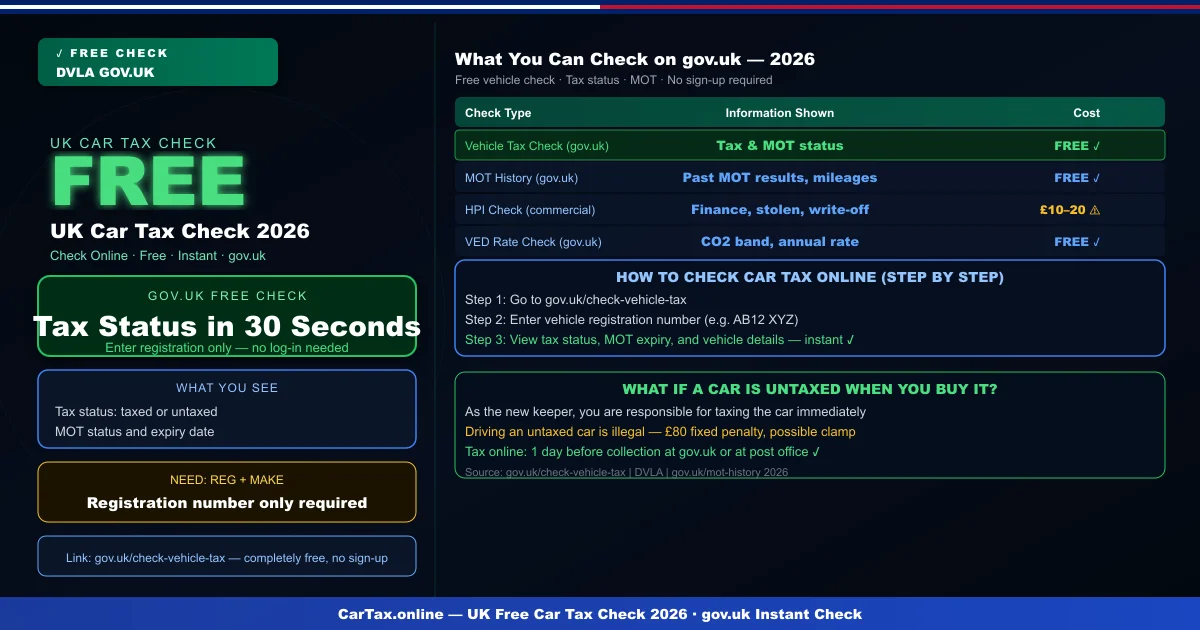
Before buying any used car in the UK, performing a car tax check is one of the most important steps you can take. An untaxed vehicle carries serious legal and financial risks, and the good news is that the DVLA provides a completely free, instant online check that takes less than a minute. No account creation, no payment, and no guesswork. This guide walks you through exactly how to use this free tool and what to do with the results.
What the Free DVLA Car Tax Check Tells You
The official gov.uk/check-vehicle-tax tool provides three key pieces of information about any registered UK vehicle:
- Vehicle tax status: The system instantly tells you whether the car is currently taxed or untaxed. This is the single most important check before purchasing a used vehicle.
- MOT expiry date: You can see when the vehicle's current MOT certificate expires, giving you a clear picture of upcoming maintenance obligations.
- Annual VED rate: The tool displays the standard annual Vehicle Excise Duty rate that applies to the vehicle, which helps you budget for ongoing ownership costs.
Note that the free DVLA check does not provide the first-year VED rate or indicate whether a vehicle qualifies for the premium rate for high-value cars. For that level of detail, you need the full V5C document or a paid history check.
Step-by-Step: How to Do a Free Car Tax Check Online
Performing a car tax check using the DVLA's official tool is straightforward. Follow these steps:
- Navigate to gov.uk/check-vehicle-tax
- Enter the vehicle's registration number (number plate) in the search field
- Click "Check Vehicle" to submit your query
- Review the results immediately on screen
The entire process takes under 60 seconds. You do not need to create a government gateway account, provide any personal information, or pay any fee. The DVLA database is updated in real time, so the information reflects the current tax status of the vehicle.
You can check any UK-registered vehicle, regardless of whether you are the registered keeper. This makes the tool invaluable for buyers researching a car before purchase, sellers preparing documentation, or anyone verifying a vehicle's status.
What to Do If a Car Is Untaxed When You Are Buying It
Discovering that a used car is untaxed during your purchase enquiry is a red flag, but it is not necessarily a dealbreaker if handled correctly. Here is what you need to know and do.
Ask the Seller to Tax It Before Purchase
The simplest solution is to ask the current registered keeper to tax the vehicle before you complete the purchase. Once the vehicle is taxed in the seller's name, you can then tax it in your own name immediately after ownership transfers. The tax does not transfer between owners, so you will need to tax it yourself regardless.
Check Why It Is Untaxed
An untaxed vehicle could mean the previous keeper let the tax lapse, the vehicle is SORN (Statutory Off Road Notification), or there is an outstanding issue with the registration. Ask the seller for the V5C document and check section D to confirm the registered keeper's name matches the seller's identification.
Tax It Immediately After Purchase
As soon as you become the new registered keeper, you must tax the vehicle before driving it on any public road. You can do this online at gov.uk/vehicle-tax using the V5C, your MOT certificate, and proof of insurance. Do not drive the car home untaxed, even across a short distance.
Driving an Untaxed Car: The Legal and Financial Risks
Driving a vehicle without valid road tax is one of the most common motoring offences in the UK. The penalties are substantial and can escalate quickly.
Automatic £80 Fixed Penalty Notice
If the DVLA's automatic number plate recognition (ANPR) cameras identify your vehicle as untaxed, you will receive a Fixed Penalty Notice for £80. This is issued automatically with no warning. If you pay within 28 days, the fine is reduced to £40. If you ignore it, the penalty increases and enforcement action follows.
Vehicle Clamping and Removal
Persistent failure to tax a vehicle results in DVLA enforcement action, including clamping of the vehicle at the owner's expense. Removal and disposal of the vehicle may follow, with the owner liable for all costs plus the original tax debt.
Prosecution Risk
In serious cases of deliberate tax evasion, the DVLA can prosecute drivers through the courts. Conviction can result in fines of up to £1,000 or even more for aggravated offences, along with a criminal record.
The risk extends beyond the fixed penalty. If an untaxed vehicle you own is involved in an accident, your insurance may be invalidated, leaving you personally liable for all damages and third-party costs.
DVLA Free Check vs Paid HPI Check: What Is the Difference?
It is important to distinguish between the free DVLA car tax check and comprehensive paid vehicle history checks offered by services like HPI, Experian, or Autoprotect. These serve different purposes and provide different levels of information.
DVLA Free Check vs Paid HPI Check
| Feature | DVLA Free Check | Paid HPI Check (£10-20) |
|---|---|---|
| Current tax status | Yes | Yes |
| MOT status | Yes | Yes |
| Finance outstanding | No | Yes |
| Stolen vehicle check | No | Yes |
| Write-off status | No | Yes |
| Mileage history | No | Yes |
| Previous keeper count | No | Yes |
| Annual VED rate | Yes | Yes |
| Cost | Free | £10-20 per check |
The DVLA free check is ideal for quickly verifying tax and MOT status. However, for a comprehensive vehicle history, a paid check is strongly recommended before buying any used car, particularly from a private seller or unfamiliar dealer. The cost of a paid check is negligible compared to the potential loss from buying a car with outstanding finance, reported stolen, or declared a write-off.
Check MOT History Separately
For a deeper dive into a vehicle's MOT history, the DVLA provides a separate free tool at gov.uk/check-mot-history. Enter the vehicle registration and you can see:
- Current MOT status and expiry date
- Mileage recorded at each MOT test
- MOT test results for previous years
- Advisory notices issued at MOT tests
- Reasons for MOT failure if applicable
Consistently increasing mileage readings are a good sign. Sudden drops in mileage between tests suggest clocking, which is illegal and could invalidate insurance. Multiple MOT failures for similar issues indicate ongoing mechanical problems that will require attention.
Using the Car Tax Check When Selling Your Vehicle
If you are selling a car, being able to show a potential buyer that the vehicle is currently taxed adds credibility and transparency to your sale. You can demonstrate the tax status live using the gov.uk tool during a phone conversation or in-person viewing.
Remember that your road tax is not transferable to the new owner. Notify the DVLA of the sale by completing section 2 of the V5C and sending it to DVLA, Swansea, SA99 1AR. This removes your liability for the vehicle and ensures the new owner can tax it properly in their name.
Calculate Your Annual Road Tax in Advance
Once you have confirmed a vehicle's tax status and VED band, you can use our UK car tax calculator to estimate your annual ownership costs, including any premium rate for high-value vehicles or discounts for electric models.
Frequently Asked Questions
Can I tax a car if I only have a temporary V5C?
Yes. If you are waiting for your new-style V5C to arrive by post, you can tax the vehicle using the 21-digit reference number from the green "New Keeper" slip you received when you bought the car. This temporary reference is valid for a limited period while you wait for the full V5C document.
What information do I need to tax a car online?
To tax your vehicle online, you need the V5C registration certificate (log book), a valid MOT certificate (if the vehicle is over 3 years old), and proof of insurance. You will also need a debit or credit card to make the payment.
Does the car tax check work for Northern Ireland vehicles?
Yes. The DVLA online check covers all UK-registered vehicles, including those with Northern Ireland registration prefixes such as Z, AA-01, and similar. NI vehicles use the same tax system as GB-registered cars.
Can I check if a vehicle has outstanding fines or penalties?
The free DVLA check does not show unpaid parking fines, congestion charge penalties, or speed camera tickets. For a full picture of outstanding obligations, you would need to check with the specific enforcement body or use a paid vehicle history service.
How quickly does the DVLA update tax status after payment?
Online tax payments are processed immediately by the DVLA. Your vehicle's tax status in the database updates within minutes, and you can immediately drive the vehicle legally on public roads. If you pay by direct debit, allow a few days for the first payment to clear.
Is there a car tax check by registration only?
Yes. The DVLA's gov.uk/check-vehicle-tax tool requires only the vehicle registration number. No other personal or vehicle details are needed, making it a completely anonymous and free check.
Disclaimer: This article provides general information about free and paid vehicle checks in the UK. The DVLA online tool is provided by the UK government and is subject to change. Always verify vehicle tax and MOT status directly through official government channels before purchasing a vehicle. For comprehensive vehicle history, consider a paid check from a reputable provider. This article does not constitute legal or financial advice.