Car modifications can have significant tax implications in the UK, affecting both Vehicle Exercise Duty (VED, commonly called road tax) and requiring formal approval through the Individual Vehicle Approval (IVA) test in more serious cases. Understanding these requirements before modifying a vehicle is essential to avoid fines, failed MOTs and invalid insurance.
How Modifications Affect VED Road Tax
Any modification that changes a vehicle's official CO2 emissions rating can change its VED band, resulting in higher or lower annual road tax. The most common scenario is an engine swap where the replacement engine has different CO2 emissions, which DVLA must be notified of and which may reclassify the vehicle into a different tax band.
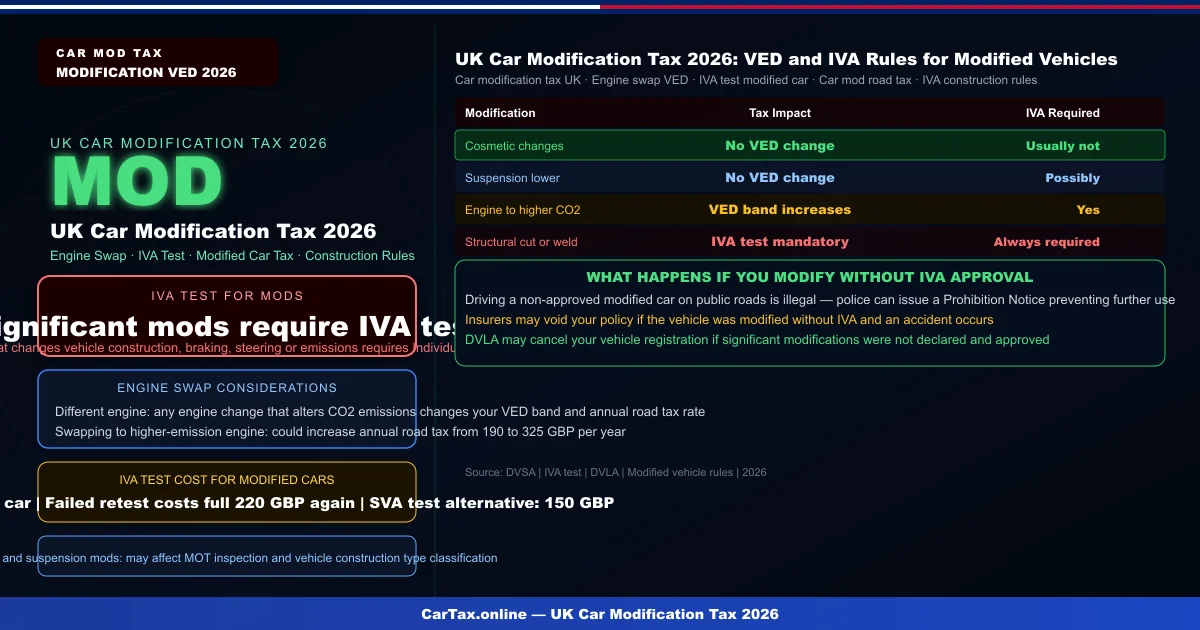
Swapping to a higher-emission engine could increase annual road tax from the standard 190 GBP band for average petrol cars to 325 GBP or more in the highest bands. Conversely, swapping to a lower-emission engine could reduce road tax or potentially make the car exempt from VED entirely.
When Is an IVA Test Required
The Individual Vehicle Approval (IVA) test is required for significant modifications that change the vehicle's construction, braking system, steering, emissions or structure. This applies to private vehicles that have been substantially modified after their original manufacture and now need to be registered or re-registered with DVLA. Related: Car Tax and Vehicle Modifications UK 2026 | UK IVA Test Car 2026 | Car Tax and Vehicle Modifications UK 2026 | Andhra Pradesh Road Tax Calculator 2026 — AP Vehicle Rates.
Examples of modifications that typically require IVA testing include structural cuts or welds to the chassis or body, engine swaps that change the vehicle's characteristics significantly, changes to the number of axles or wheels, and modifications that affect the vehicle's gross weight rating. The cost of an IVA test for a private car is 220 GBP, with a full retest required if the vehicle fails.
Body Kit and Suspension Modifications
Non-structural cosmetic modifications such as body kits, spoilers and standard aftermarket alloy wheels typically do not require IVA testing or VED reclassification, provided they do not alter the vehicle's official specifications recorded with DVLA. Lowering or raising suspension height by modest amounts within the vehicle's design tolerances also generally requires no notification.
However, significant suspension modifications that alter the vehicle's geometry or approach angle, or extreme wheel arch modifications that change the vehicle's overall width, may require IVA inspection and could affect MOT testing standards. Insurers must always be informed of any modification, as failure to declare modifications can void insurance coverage.
Legal Consequences of Unapproved Modifications
Driving a vehicle on public roads that has been modified without the required IVA approval is illegal. Police can issue a Prohibition Notice preventing further road use until the issue is resolved. Insurers may void your policy and refuse to pay claims if the vehicle was modified without required approvals and an accident occurs. DVLA may cancel your vehicle registration if significant modifications were not declared and approved.
Frequently Asked Questions
Do I need to tell DVLA if I modify my car? Yes, you must notify DVLA if a modification changes the vehicle's CO2 emissions, engine size, number of seats, maximum weight or any other technical characteristic recorded on the V5C registration certificate.
How much does an IVA test cost? The IVA test for a private car costs 220 GBP. If the vehicle fails, a full retest at the full 220 GBP fee is required before re-presentation.
Can I swap my engine without IVA testing? Engine swaps that do not change the vehicle's construction, emissions category or identification may not require IVA. However, you must notify DVLA of the engine change and it may affect your VED band. Substantial engine swaps that change vehicle characteristics may require IVA.
Official Resources: Parivahan Portal | Vahan Road Tax | India GST Portal | FAME-III Scheme
Frequently Asked Questions
Q: What is the current road tax rate for cars in India 2026?
Road tax rates in India vary by state and vehicle category. For new cars, GST is charged at 5% for EVs, 18% for hybrids under 1,200cc, and up to 28% for petrol/diesel SUVs. State road tax is charged separately and varies from Rs3,000-15,000 annually depending on the state's slab system. Check your specific state's RTO website for current rates.
Q: How do I calculate my car road tax online in India?
You can calculate your car road tax using online calculators available on state RTO portals and CarTax.online. The calculation considers your vehicle's ex-showroom price, fuel type, engine capacity, and state of registration. Road tax is payable annually or for the vehicle's lifetime depending on your state's rules.
Q: Is GST included in the road tax for new cars in India?
No — GST and road tax are separate charges. GST is a central tax charged by the vehicle manufacturer at the time of purchase. State road tax is a separate annual or one-time charge levied by your state's transport department. Both apply at the time of first registration, and annual road tax continues for subsequent years.
Q: Do electric vehicles get tax benefits in India 2026?
Yes — electric vehicles in India qualify for a reduced GST rate of 5% (down from 28% for petrol cars). Under FAME-III subsidies, EVs may also qualify for additional state-level incentives, reduced road tax, and free registration in many states. The exact benefits vary by state.
Q: What happens if I don't pay my car road tax on time?
If you don't pay road tax, your vehicle's registration can be flagged in the Vahan database, preventing renewal of fitness certificates and creating legal liability during police checks. Penalties range from Rs200-500 per day of default in most states. Road tax is a legal requirement under the Motor Vehicles Act.