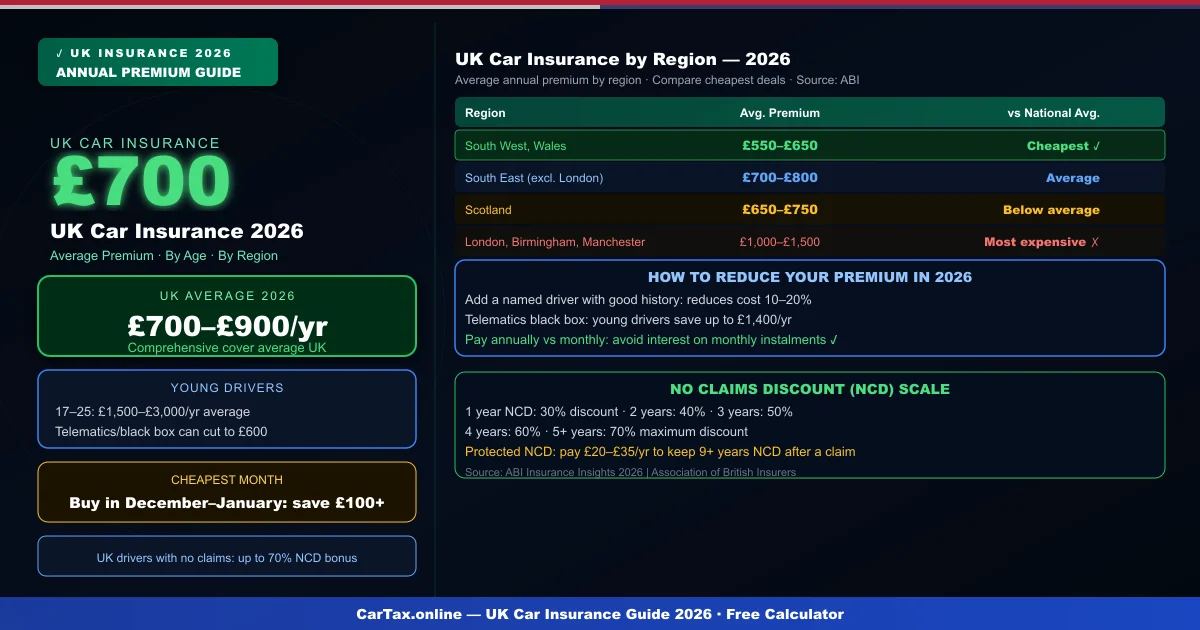
For millions of UK drivers, car insurance represents one of the most significant annual costs of vehicle ownership. Whether you are insuring your first car, renewing an existing policy, or searching for better rates, understanding how premiums are calculated and where you can make real savings has never been more important. The market is constantly shifting, and what seemed like a good deal twelve months ago may no longer be competitive today.
This comprehensive guide walks you through everything you need to know about car insurance costs in the UK in 2026. We cover average premiums by region and age group, explain how telematics policies work, break down the no-claims discount system, and provide practical tips to reduce what you pay without sacrificing essential cover. You can also use our UK Car Tax Calculator to estimate your total vehicle running costs, including road tax and insurance considerations.
Average Car Insurance Premiums in the UK 2026: What Are Drivers Paying?
The Association of British Insurers (ABI) reports that the average annual car insurance premium in the UK now sits at approximately £650–£750 for comprehensive cover. However, this national average masks significant variation depending on where you live, your age, the type of car you drive, and your claims history. Understanding these factors is the first step to finding a better deal.
For third-party, fire and theft cover, the average is considerably lower at around £350–£450 annually, though this level of cover provides significantly less protection in the event of an accident. According to data from the Association of British Insurers (ABI), premium costs have stabilised after years of consistent increases, though regional disparities remain pronounced.
Regional Premium Breakdown: Where Is Car Insurance Most Expensive?
Location plays a major role in determining your car insurance premium. Insurers assess risk based on local factors including crime rates, accident frequency, population density, and even the cost of repairs in your area. Here is how average annual premiums break down across UK regions in 2026:
| Region | Average Annual Premium (£) | vs National Average |
|---|---|---|
| London (Inner) | £900–£1,100 | +35–45% |
| London (Outer) | £780–£920 | +20–30% |
| South East England | £720–£850 | +15–20% |
| West Midlands | £680–£800 | +5–15% |
| North West England | £620–£750 | Average |
| Yorkshire & Humber | £580–£700 | -5–10% |
| South West England | £560–£680 | -10–15% |
| Scotland | £480–£600 | -20–25% |
| Wales | £520–£650 | -15–20% |
| Northern Ireland | £600–£720 | -5–10% |
Figures are approximate averages for comprehensive cover, standard risk profile (30–50 years old, clean licence, group 1–10 car). Use a comparison site like GoCompare or Confused.com for personalised quotes.
London consistently tops the charts as the most expensive region for car insurance, driven by higher accident rates, elevated vehicle crime, and denser traffic. Conversely, Scottish drivers benefit from some of the lowest premiums in the UK, partly due to lower accident frequency and more cautious driving patterns. Interestingly, urban areas in any region tend to cost more than rural locations within the same postcode area.
How Age Affects Car Insurance Premiums
Age remains one of the single biggest factors influencing car insurance costs. Insurers use statistical data to assess risk, and certain age groups are statistically more likely to make claims than others. Here is the breakdown:
| Age Group | Average Annual Premium (£) | Notes |
|---|---|---|
| 17–19 | £1,800–£3,000+ | Highest risk group; consider telematics |
| 20–24 | £1,200–£2,000 | Still elevated; named driver tricks help |
| 25–29 | £750–£1,200 | Significant drop from early 20s |
| 30–39 | £550–£850 | Peak affordability window |
| 40–49 | £500–£780 | Often lowest premiums available |
| 50–59 | £480–£750 | Stable; some insurers offer mature driver discounts |
| 60–69 | £500–£800 | Generally good rates if in good health |
| 70+ | £600–£950 | May increase; medical disclosure required |
Young Driver Car Insurance: Why It Is So Expensive and How to Cut Costs
For drivers aged 17–24, car insurance costs can feel prohibitive. The combination of inexperience, statistically higher accident rates, and a shorter driving history means insurers price this demographic at the top end of the market. A fully comprehensive policy for a new 18-year-old driver can easily exceed £2,000 annually, and for certain postcodes or high-performance vehicles, premiums can surpass £4,000.
The good news is that there are proven strategies to reduce these costs significantly. Adding a responsible older driver (such as a parent) as a named driver can sometimes lower premiums, though it is important to note that you cannot falsely claim the older driver is the main user if that is not the case. Passing your driving test as soon as possible removes the learner driver premium. Choosing a lower insurance group car makes a substantial difference — a Volkswagen Polo (group 5–8) will cost considerably less to insure than a Ford Fiesta ST (group 30+).
Telematics and Black Box Insurance: Can It Save You Money?
Telematics insurance, often referred to as black box insurance, has transformed the market for young drivers and those with shorter driving histories. Rather than pricing risk based solely on demographic factors, telematics policies use a small device (or smartphone app) to monitor your actual driving behaviour in real time.
These devices record data including:
- Speed patterns and adherence to limits
- Braking habits and smoothness of cornering
- Time of day you typically drive (night driving carries higher risk)
- Total mileage driven
- Frequency and duration of journeys
Insurers offering telematics policies, such as major telematics providers, typically offer initial discounts of 10–30% off standard premiums. Drivers who consistently demonstrate safe habits — smooth acceleration, gentle braking, staying within speed limits, and avoiding late-night driving — can save up to 40–50% over subsequent policy years.
| Policy Type | Initial Saving | Potential Ongoing Saving | Best For |
|---|---|---|---|
| Standard telematics (plug-in) | 10–20% | Up to 35% | Young drivers, low-mileage drivers |
| Smartphone app telematics | 10–15% | Up to 25% | Tech-savvy drivers, new drivers |
| Pay-per-mile policies | 15–25% | Highly variable | Low-mileage drivers (under 6,000 miles/year) |
| Behaviour-based rewards | 5–10% | Up to 20% | Safe drivers with established history |
Pay-per-mile telematics insurance is particularly attractive for drivers who genuinely do not use their car frequently. Some policies charge a low daily base rate plus a per-mile rate, meaning if you only drive 4,000 miles a year, you could pay significantly less than a standard policyholder driving 10,000 miles. Leading providers in this space include clever devices that plug into your car's OBD port and sync with smartphone apps.
Understanding No Claims Discount (NCD) and How to Protect It
The no claims discount (NCD), also called a no claims bonus, is one of the most valuable assets a driver can build. It rewards policyholders who go years without making a claim by offering progressively larger discounts on renewal premiums. Here is how the typical NCD scale works in the UK:
| Years Without a Claim | NCD Level | Typical Discount (%) | Approximate Saving (£) |
|---|---|---|---|
| 1 year | NCD 1 | 0–10% | £0–£65 |
| 2 years | NCD 2 | 15–20% | £100–£130 |
| 3 years | NCD 3 | 25–30% | £165–£195 |
| 4 years | NCD 4 | 35–40% | £230–£260 |
| 5+ years | NCD 5+ | 40–60% | £260–£390 |
These percentages are applied to the base premium before any other discounts. A driver with a 5-year NCD on a £700 policy could save up to £420 annually compared to someone with no NCD. This is why switching insurers requires careful attention — not all insurers will fully recognise your NCD earned elsewhere, and some have a maximum NCD cap below what you may have built up.
Protecting Your NCD: No Claims Discount Protection
Most insurers offer an optional no claims discount protection add-on, typically costing £20–£50 per year. This allows you to make one (or sometimes two) claims within a policy year without losing your NCD level. Without this protection, even a minor claim — a windscreen chip, a parking dent — can reset your discount, resulting in significantly higher premiums for several years.
Whether the protection is worth it depends on your risk profile and the value of your NCD. If you have a 5-year NCD worth £350+ in annual savings and you drive in a busy urban area, the protection is almost always worth the small additional cost. For a lower-risk driver with a smaller NCD, the maths may not work out favourably.
Practical Tips to Reduce Your Car Insurance Premium
Beyond the structural factors like age and location, there are numerous actionable steps you can take to lower your car insurance costs in 2026:
1. Shop Around Every Renewal
Loyalty rarely pays in the insurance market. Insurers offer their best prices to new customers, and renewal prices can jump significantly. Using comparison platforms like MoneySuperMarket, Compare the Market, or Confused.com takes minutes and can save hundreds of pounds. Set a calendar reminder 3–4 weeks before your renewal date and start comparing.
2. Increase Your Voluntary Excess
The voluntary excess is the amount you agree to pay towards any claim before the insurer covers the rest. By increasing your voluntary excess from £150 to £500, you can typically reduce your premium by 10–20%. However, ensure the excess amount is affordable — you do not want to be unable to claim because you cannot afford the excess.
3. Pay Annually Rather Than Monthly
Monthly premium payments often include interest charges of 10–20% APR, meaning a £700 annual policy paid monthly could cost £750–£800 in total. Paying annually removes this financing cost and immediately reduces your overall car insurance expenditure.
4. Reduce Annual Mileage Accurately
Overestimating your annual mileage slightly might seem harmless, but it increases your premium. Conversely, significantly underestimating is fraudulent and could invalidate your policy. Be honest and accurate — if you drive 8,000 miles per year, do not claim 12,000 to seem like a heavier user.
5. Consider a Higher Security Vehicle
Cars with advanced security features — alarm systems, immobilisers, GPS tracking, and Thatcham Category 1 approval — attract lower premiums. If you are buying a new car, checking its insurance group and security rating before purchase can save money for years. Using a garage or secure overnight parking also reduces risk in the insurer's assessment.
6. Build Your Driving History
Every year without a claim adds to your NCD. Every year oflicence holding (even without a car) can sometimes be used as experience. Young drivers aged 17–19 who complete the Pass Plus scheme, a practical post-test training programme, can sometimes qualify for additional discounts from participating insurers.
The Impact of Car Type on Insurance Premiums
The vehicle itself is a major pricing factor. Insurers assign every car model an insurance group from 1 (cheapest) to 50 (most expensive), based on factors including repair costs, parts prices, performance, security, and theft risk. A Group 1 car like a Vauxhall Corsa will cost considerably less to insure than a Group 40 BMW M3, even for the identical driver profile.
For 2026, the following trends are notable:
- Electric and hybrid vehicles are increasingly competitive on insurance premiums as repair networks improve and parts become more standardised.
- Performance SUVs continue to attract high premiums due to repair complexity and theft risk.
- Family hatchbacks like the Ford Focus, Vauxhall Astra, and Volkswagen Golf offer the best balance of affordability and low group ratings.
- Modified cars — even cosmetic modifications — must be declared to your insurer and typically increase premiums.
Before purchasing a vehicle, always check its insurance group using the Thatcham Research insurance group ratings. This single step can prevent costly surprises.
Car Insurance and Road Tax: Understanding the Full Cost of Vehicle Ownership
When budgeting for a car, car insurance is just one component alongside road tax (Vehicle Excise Duty), fuel, maintenance, and depreciation. Our UK Car Tax Calculator helps you estimate all these costs together, giving you a realistic picture of what your vehicle actually costs per month and per year. Many buyers focus only on the purchase price or monthly financing cost and are caught off guard by annual insurance and tax bills.
Frequently Asked Questions
What is the average car insurance cost in the UK for 2026?
The average annual comprehensive car insurance premium in the UK for 2026 is approximately £650–£750, according to ABI data. However, this varies significantly by region (ranging from £480 in Scotland to £1,000+ in inner London), age (with 17–24-year-olds paying £1,200–£3,000+), and vehicle type. Using a comparison site for personalised quotes is the most accurate way to find your specific rate.
Does car insurance cost more for young drivers in the UK?
Yes. Drivers under 25 pay the highest car insurance premiums of any age group, with 17–19-year-olds facing averages of £1,800–£3,000+ per year. This is due to statistical risk factors including inexperience and higher accident rates. Telematics policies, choosing a low insurance group car, and adding a named driver can help reduce these costs substantially.
How does a no claims discount work?
A no claims discount (NCD) rewards drivers for every year they do not make an insurance claim. Typically, each claim-free year adds another NCD level, with discounts ranging from 10% after year one up to 40–60% after five or more years. The discount is applied to your base premium at renewal. NCD can be protected for an additional fee, allowing you to make a limited number of claims without losing your discount.
Is telematics insurance worth it?
Telematics or black box car insurance is worth it for young drivers, new drivers, and anyone who genuinely drives carefully and under average mileage. Initial savings of 10–30% are common, and careful drivers can earn ongoing discounts of up to 40–50%. However, aggressive driving habits, frequent night driving, or high mileage may result in no saving or even a higher premium compared to a standard policy.
What is the best way to reduce car insurance costs?
The most effective ways to reduce car insurance costs include: shopping around at every renewal rather than auto-renewing, paying annually instead of monthly, increasing your voluntary excess within affordable limits, accurately declaring your annual mileage, choosing a car in a lower insurance group, installing approved security devices, and building your no claims discount over time. Comparing at least three to five insurers using comparison sites typically uncovers the best deals.
Do I need car insurance to tax my car in the UK?
Yes. To tax your vehicle (renew Vehicle Excise Duty) at a Post Office or online via the DVLA website, you must have at least third-party car insurance. The Motor Insurance Database is checked when you tax a vehicle, and uninsured vehicles are automatically flagged. Driving without valid insurance is illegal and can result in fixed penalties, vehicle seizure, and prosecution.
How does where I live affect my car insurance premium?
Your postcode is a significant rating factor in car insurance. Insurers assess local crime rates (especially vehicle theft and vandalism), accident frequency, population density, and repair costs in your area. Inner city postcodes typically cost 30–50% more than rural areas in the same region. Even moving a few streets from one postcode to another can change your premium. Always update your insurer if you change address, as failing to do so could invalidate your policy.
Conclusion: Taking Control of Your Car Insurance Costs in 2026
The UK car insurance market in 2026 offers more options than ever for drivers willing to shop around and demonstrate good risk behaviour. Whether you are a young driver struggling with high premiums, a cautious motorist looking to protect your hard-earned no claims discount, or a low-mileage driver interested in pay-per-mile telematics options, the tools and products exist to find genuinely affordable cover.
Start by checking your current premium against the market using a comparison site. Then review your policy details — mileage estimates, voluntary excess, payment method — and make targeted adjustments. If you are buying a new car, check its insurance group before committing. And if you have built up several years of no claims, consider protecting that discount before your next renewal.
For a complete picture of vehicle ownership costs, use our UK Car Tax Calculator to budget accurately for insurance, road tax, and all the other expenses that come with running a car in the UK.
Disclaimer: The premium figures, regional data, and savings estimates provided in this article are based on publicly available industry data and are intended for informational purposes only. Actual car insurance quotes will vary based on individual circumstances including driving history, claims record, vehicle specification, and insurer criteria. Always obtain a personalised quote before making any purchasing decision. The authors and publisher accept no liability for decisions made based on the information provided herein.