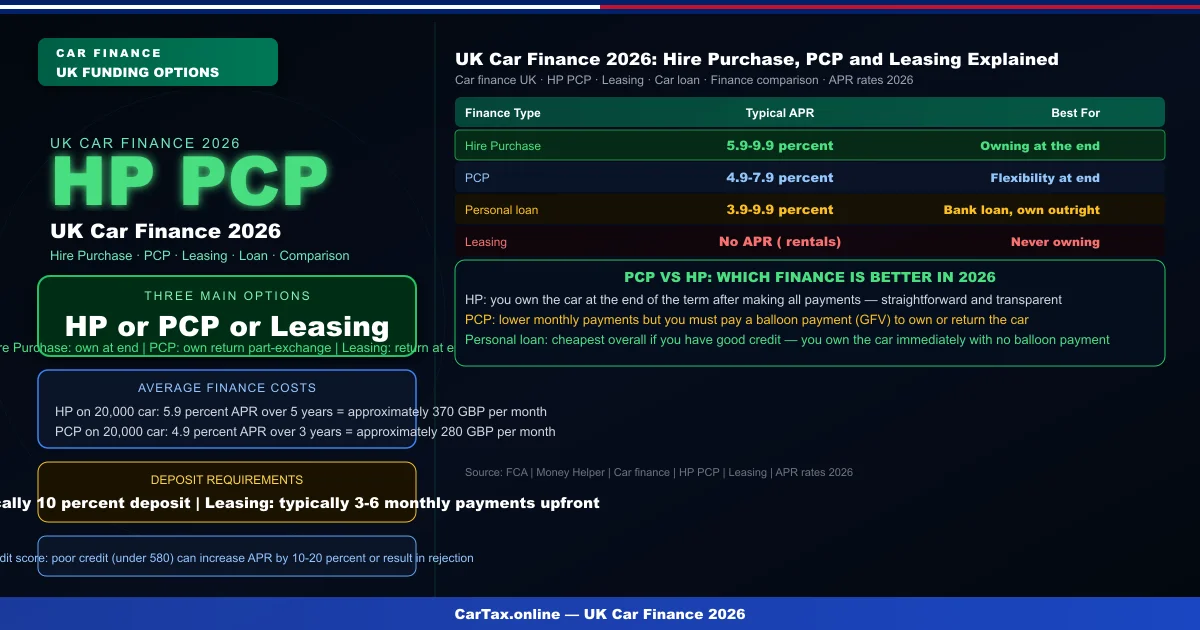
Car finance UK in 2026 offers multiple routes to vehicle ownership or use, each with distinct financial structures, risks and benefits. Understanding the differences between personal contract purchase (PCP), hire purchase (HP), personal contract hire (PCH) and traditional car loans is essential before signing any agreement. This guide explains every major option clearly.
Types of Car Finance Available in the UK 2026
The UK car finance market expanded significantly through the 2010s and 2020s, with most new cars now sold on some form of finance rather than outright purchase. The four main options each serve different buyer circumstances.
Personal Contract Purchase (PCP)
PCP remains the most popular car finance product in the UK, accounting for the majority of new car finance agreements. You pay a deposit (typically 10 percent of the car's list price), make monthly payments over two to four years, and have three options at the end: pay a Guaranteed Minimum Future Value (GMFV, also called balloon payment) to own the car, hand the car back with nothing further to pay, or use any positive equity as a deposit on a new PCP.
Monthly PCP payments are lower than HP because you are only paying for the vehicle's depreciation during the agreement term, not its full value. The GMFV is set at the start based on an estimate of what the car will be worth at the end of the contract, assuming a certain mileage is maintained. Related: Pcp Vs Lease Uk | Car Tax and Leased Vehicles UK 2026 | Car Tax and Vehicle Finance UK 2026 | Car Tax and Vehicle Finance UK 2026.
Hire Purchase (HP)
HP is a straightforward loan to purchase the vehicle. You pay a deposit (usually 10 percent), then equal monthly payments covering the full value of the car plus interest, over one to five years. At the end of the term you own the car outright. HP is simpler than PCP, has no mileage restrictions and no wear-and-tear conditions, but monthly payments are higher because they cover the full vehicle cost.
Personal Contract Hire (PCH)
PCH is a long-term rental agreement, not a purchase option. You pay an initial rental advance (typically three months), then monthly rentals for two to four years. You return the car at the end with no option to buy. PCH includes road tax and often a maintenance package. It is purely a usage arrangement with no ownership pathway.
Traditional Car Loan
A personal loan from a bank or credit union used to purchase a car outright is an alternative to dealer finance. You own the car from day one, can sell it at any time, and there are no mileage restrictions. Interest rates vary based on credit score, with rates from 6 to 15 percent APR in 2026 for most borrowers.
How Much Does Car Finance Cost in 2026
On a typical 25,000 GBP family car in 2026, a PCP agreement might require a 2,500 GBP deposit with monthly payments of 250 to 350 GBP over 48 months and a GMFV of approximately 8,000 to 10,000 GBP. HP on the same car would cost 380 to 420 GBP per month over 60 months with the same deposit. PCH rentals might be 280 to 380 GBP per month including road tax.
Credit Scores and Car Finance Approval
Car finance providers conduct a hard credit check. A credit score above 700 (Experian scale) typically qualifies for the best rates. Those with scores below 580 may face rejection or very high APR rates of 15 to 25 percent. Declining credit can increase the total cost of finance significantly over the term of the agreement.
Deposits and Their Impact
Larger deposits reduce monthly payments across all finance types. On a PCP, a 20 percent deposit instead of 10 percent can reduce monthly payments by 15 to 20 percent. Some dealers offer zero-deposit PCP deals, but these carry higher monthly costs and greater overall interest charges.
Mileage Limits and Excess Charges
PCP and PCH agreements set annual mileage limits, typically 8,000 to 12,000 miles per year. Exceeding the limit incurs excess mileage charges of 5 to 15 pence per mile on PCP, and similar or higher charges on PCH. Excess wear-and-tear charges on PCP returns can add 500 to 2,000 GBP to the final settlement cost.
Switching and Settling Early
PCP and HP agreements are regulated by the Consumer Credit Act, giving you the right to settle early. The settlement figure reduces over time as you pay down the balance. PCH agreements can be terminated early but typically incur early termination fees of 50 percent of remaining rentals.
Frequently Asked Questions
What is the best car finance option for a first-time buyer in 2026? PCP is popular with first-time buyers because lower monthly payments are more manageable, but HP provides full ownership at the end and may work out cheaper in total cost if you can afford higher payments.
Can I get car finance with bad credit in 2026? Specialist subprime car finance providers offer agreements to those with poor credit, but APR rates of 15 to 30 percent are common and total costs are substantially higher. Improving your credit score before applying is strongly advisable.
Is it worth paying off car finance early? Early settlement can save on future interest charges, but check your agreement's settlement figure. In the first half of a PCP or HP term, the settlement figure may still exceed the car's market value.
What mileage should I set on a PCP agreement? Set your genuine expected mileage plus a buffer of 2,000 to 3,000 miles per year to avoid excess charges, but do not over-estimate as you will pay for miles you do not use.
Can I change cars before my PCP ends? Yes, through a voluntary termination (after 50 percent of total amount payable) or early settlement, but early termination fees apply and may be substantial.
Key Takeaways for Car Finance UK 2026
PCP suits drivers who want a new car every three to four years, are comfortable with mileage limits and want lower monthly payments. HP suits those who want to own the car outright at the end and can afford higher monthly payments. PCH suits company car drivers and those who simply want the convenience of a new car with no ownership responsibility. Personal loans suit cash buyers who want outright ownership from the start. Always compare total cost of credit (representative APR) across providers before committing, and check your credit report first to understand what rates you are likely to qualify for.
Official Resources: GOV.UK Check Vehicle Tax | GOV.UK Vehicle Tax | DVLA Online | MOT Check
Frequently Asked Questions
Q: How much is car tax (VED) in the UK 2026?
Car tax rates in the UK depend on your vehicle's CO2 emissions and list price. Standard rates start from £190 per year for petrol and diesel cars, with zero-rated VED for EVs. First-year rates vary from £0 to £2,605 depending on emissions. Additional premiums apply for vehicles over £40,000.
Q: How do I check if my car is taxed online?
You can check your vehicle's tax status for free on the Gov.uk website at gov.uk/check-vehicle-tax. You'll need your vehicle's registration number (number plate). You can also check via the Motor Insurance Database to verify road tax and insurance status simultaneously.
Q: Can I get a refund on car tax if I sell my vehicle?
Yes — if you sell or scrap your vehicle, you can claim a refund on any full months of remaining road tax. Contact DVLA with the V11 reminder letter or apply online at gov.uk. Refunds are usually processed within 4-6 weeks.
Q: Is road tax refund available when transferring ownership?
No — road tax does not transfer with the vehicle. When you sell your car, the tax is automatically cancelled and any remaining months are refunded to you by DVLA. The new owner must tax the vehicle immediately. As a buyer, always verify the vehicle's tax status before purchasing.
Q: What is the luxury car tax threshold in the UK 2026?
The additional rate for vehicles over £40,000 (list price) adds £410 per year to standard VED rates for years 2-6 of registration. This surcharge brings the annual cost for high-emission vehicles over £40,000 to around £600-690 per year. Pure EVs under £40,000 pay zero VED.