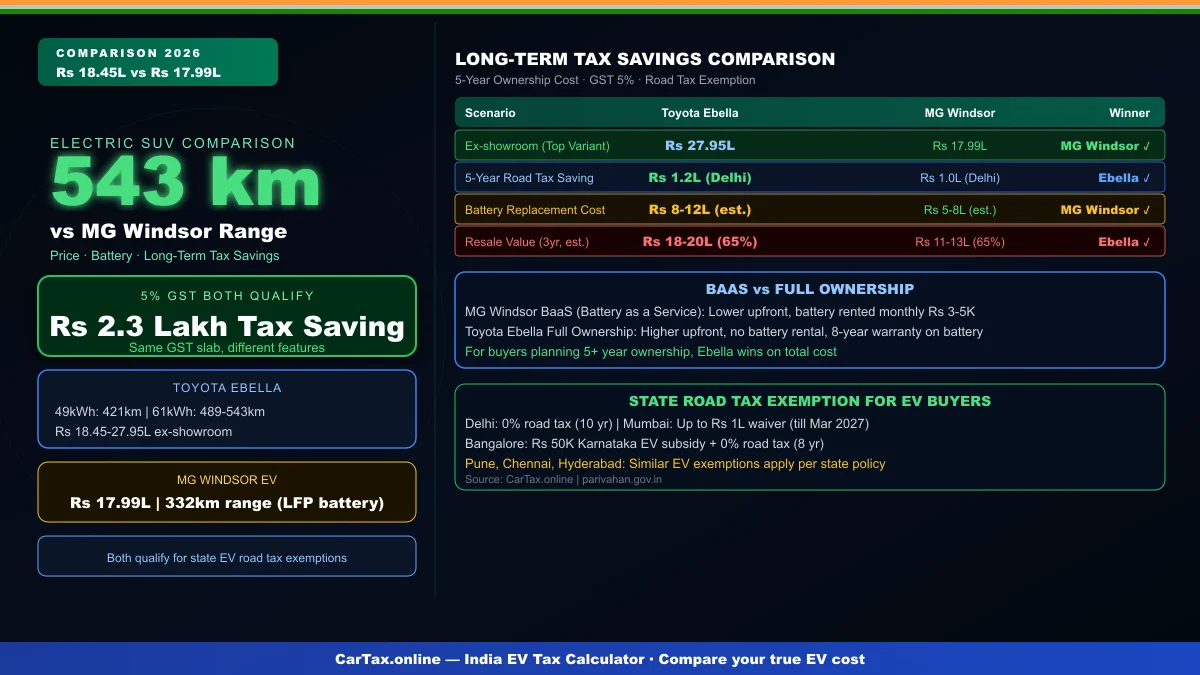
The Toyota Ebella vs MG Windsor EV comparison has become the defining question for Indian buyers in the Rs 17-28 lakh electric SUV segment. Toyota launched the Ebella at Rs 18.45 lakh with a commanding 543km range, while MG positioned the Windsor EV at Rs 17.99 lakh with an innovative battery subscription model that reduces the upfront cost. Both vehicles qualify for 5% GST and state EV road tax exemptions, making the long-term tax savings comparison as important as the sticker price. For buyers evaluating their options in April 2026, understanding which vehicle delivers better value over 5 years of ownership requires a detailed analysis of range, battery ownership model, service network, and total cost of ownership.
On paper, the Toyota Ebella's 543km range versus the MG Windsor EV's 332km range seems like an overwhelming advantage for Toyota. But the MG Windsor EV's Battery as a Service (BaaS) model fundamentally changes the value calculation — reducing the upfront cost to approximately Rs 14-15 lakh while spreading battery costs across monthly rentals. This makes the Windsor EV accessible to buyers who may not have the budget for a Rs 18 lakh vehicle but can comfortably manage a Rs 3,000-5,000 monthly battery rental. The question is not just which vehicle is better — it is which vehicle is better for your specific driving pattern, ownership duration, and financial situation.
Toyota Ebella vs MG Windsor EV: Price and Variant Breakdown
The Toyota Ebella and MG Windsor EV occupy similar price brackets but approach pricing differently. Toyota offers the Ebella in four variants with a conventional full-ownership battery model, while MG offers the Windsor EV with an optional BaaS programme that separates the vehicle cost from the battery cost.
Toyota Ebella pricing (ex-showroom pan-India):
- Ebella G (49kWh) — Rs 18.45 lakh: 421km range, 150kW motor, Level-1 ADAS, 10.2-inch touchscreen
- Ebella V (49kWh) — Rs 21.45 lakh: 421km range, Level-2 ADAS, 12.9-inch infotainment, wireless CarPlay
- Ebella VX (61kWh) — Rs 24.95 lakh: 489km range, 14-inch floating touchscreen, panoramic roof, Level-2+ ADAS
- Ebella ZX (61kWh Long Range) — Rs 27.95 lakh: 543km range, all VX features plus heads-up display, traffic jam assist
MG Windsor EV pricing (ex-showroom):
- Windsor EV Excite (BaaS) — Rs 14.99 lakh (battery excluded) + Rs 3,299/month battery rental
- Windsor EV Excite (Full Ownership) — Rs 17.99 lakh: 332km range, LFP battery, 134bhp motor
- Windsor EV Essence (Full Ownership) — Rs 19.99 lakh: 332km range, premium features, 360-degree camera
The MG Windsor EV BaaS model is particularly relevant for buyers who want to upgrade within 3-5 years — the battery rental structure means they never own a degrading battery, and the lower upfront cost makes the vehicle accessible at a lower monthly financial commitment.
Range Comparison: 543km vs 332km — Does It Matter?
The Toyota Ebella's 543km range versus the MG Windsor EV's 332km range is the most debated aspect of this comparison. The real-world perspective is nuanced: for urban buyers with daily commutes under 50km, the Windsor EV's 332km range covers 4-5 days of driving before requiring a charge. For buyers who regularly undertake 200km+ highway journeys, the Ebella's 543km range eliminates range anxiety almost entirely.
The Ebella's 61kWh NMC battery pack delivers its superior range but requires careful thermal management — fast charging in summer heat (above 40 degrees Celsius ambient) can accelerate battery degradation over time. The MG Windsor EV's LFP battery chemistry is more thermally stable, can be charged to 100% regularly without significant degradation, and is better suited to India's varied climate conditions. For buyers in hot climate cities like Delhi, Hyderabad, and Pune, the Windsor EV's LFP chemistry may offer practical advantages beyond just the range figure.
5% GST Advantage: Both EVs Qualify — What It Means for Your Wallet
Both the Toyota Ebella and MG Windsor EV benefit from the 5% GST applicable to electric vehicles in India. This is a significant advantage over equivalent petrol vehicles in the same price range, which attract 18-28% GST depending on engine capacity and vehicle type.
Comparing the GST advantage: a comparable petrol SUV priced at Rs 18 lakh would attract 18% GST (Rs 3.24 lakh), while both the Ebella and Windsor EV attract only 5% GST (Rs 90,000). This single factor saves buyers approximately Rs 2.34 lakh at the time of purchase — enough to cover insurance for 2 years or a major service package.
State road tax exemptions further enhance the savings. Delhi offers 0% road tax for EVs for the first 10 years, effectively saving Rs 1-1.5 lakh versus a petrol vehicle registration. Maharashtra's EV road tax exemption (until March 2027) saves Rs 55,000-1.4 lakh depending on the vehicle variant. Karnataka provides a Rs 50,000 subsidy for the first 10,000 EV buyers. These state-level incentives make both the Toyota Ebella and MG Windsor EV significantly cheaper to own in EV-friendly states compared to their petrol equivalents.
BaaS vs Full Ownership: The Hidden Cost Comparison
The MG Windsor EV's Battery as a Service model introduces a variable cost that does not exist in the Toyota Ebella's full ownership model. Understanding this cost is essential for an accurate comparison.
Under the BaaS model, the MG Windsor EV Excite at Rs 14.99 lakh requires a monthly battery rental of Rs 3,299 (approximately). Over 5 years, this totals Rs 1,97,940 — making the effective 5-year cost of the BaaS variant approximately Rs 16.97 lakh (vehicle) + Rs 1.98 lakh (battery rental) = Rs 18.95 lakh. This effectively matches the full-ownership cost of the MG Windsor EV Essence at Rs 19.99 lakh over 5 years.
The Toyota Ebella at Rs 18.45 lakh (G variant) has no ongoing battery rental — the full ownership model means a one-time purchase cost of Rs 18.45 lakh with an 8-year battery warranty. Over 5 years, the total cost is Rs 18.45 lakh + Rs 0 in battery rentals = Rs 18.45 lakh. However, the 61kWh variants (Rs 24.95-27.95 lakh) offer significantly more range and features, making the total cost of ownership comparison variant-specific.
Service Network and Long-Term Reliability
Toyota's service network in India is substantially deeper than MG's — with 500+ authorised service centres versus MG's 350+. For buyers in Tier-2 and Tier-3 cities, this network difference is a critical factor. Toyota's reputation for rock-solid reliability and low maintenance costs further strengthens its case for buyers planning to hold the vehicle for 7-10 years.
MG's advantage lies in its aggressive technology features and the connected car experience — the Windsor EV's iSmart connected platform offers more sophisticated remote control features than Toyota's Connected app. However, MG's relatively shorter track record in India and smaller service network means post-warranty service costs could be less predictable.
Which Should You Buy: Toyota Ebella or MG Windsor EV?
Choose the Toyota Ebella if: you prioritise range (need 400km+ real-world range), value Toyota's brand reliability and deep service network, plan to own the vehicle for 7+ years, and primarily drive on highways or inter-city routes.
Choose the MG Windsor EV if: you have a strict Rs 15 lakh upfront budget and can manage Rs 3,300/month battery rental, your daily commute is under 50km (requiring charging every 4-5 days), you prefer the latest connected car technology, and you plan to upgrade within 3-5 years.
For accurate total cost of ownership calculations including 5% GST, state road tax exemptions, battery rental costs, and residual value estimates, use the CarTax.online EV comparison calculator — updated with April 2026 pricing and state EV incentives for both Toyota Ebella and MG Windsor EV.
Official Resources: Toyota India | MG Motor India | Parivahan Portal | India GST Portal