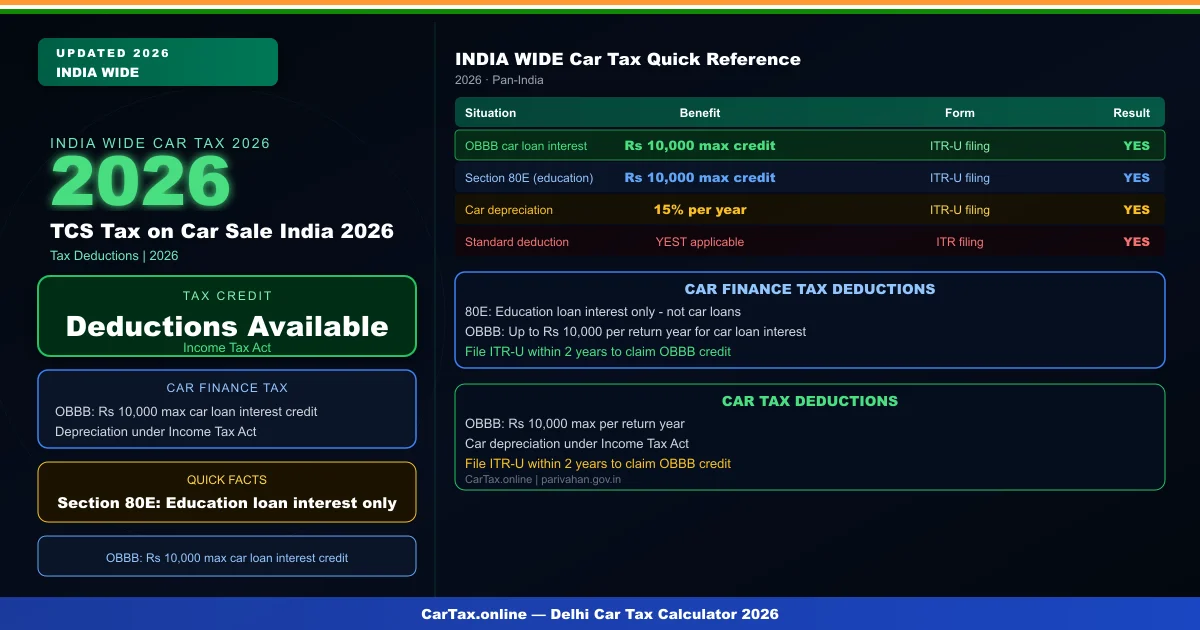
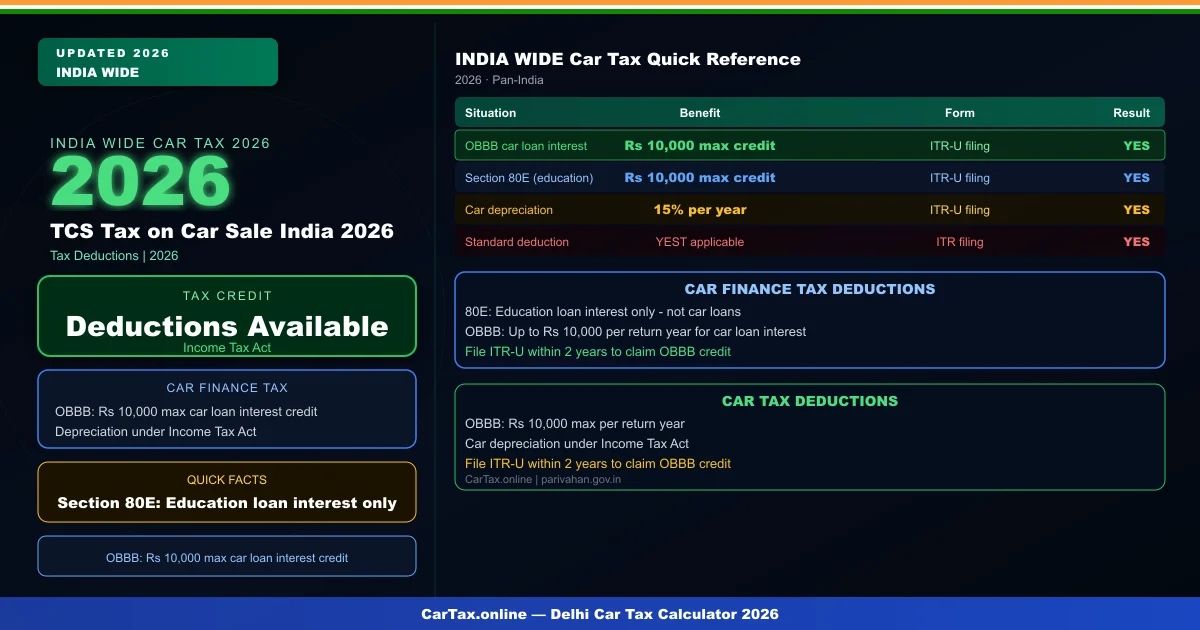
TCS Tax on Car Sale India 2026 — Understanding the 1% Rule
The TCS tax on car sale India 2026 rules apply to every sale transaction above a threshold. Tax Collected at Source (TCS) is an obligation placed on the seller to collect tax from the buyer and remit it to the government. As of April 2026, TCS on the sale of motor vehicles above INR 10 lakh is mandatory under Section 206C(1) of the Income Tax Act.
Who Must Collect TCS on Car Sale
The seller of a motor vehicle is responsible for collecting TCS. This applies to all motor vehicles including cars, SUVs, and other passenger vehicles. The seller must obtain the buyer's PAN card details before collecting TCS. If the buyer does not provide a PAN, TCS must be collected at twice the normal rate.
Dealers selling new cars from a showroom, individual owners selling used cars, and any entity brokering vehicle sales all fall under the TCS obligation if the sale consideration exceeds INR 10 lakh. The TCS applies on the entire sale consideration, not just the amount above the threshold.
TCS Rate and Calculation
The TCS rate on car sale above INR 10 lakh is 1% under normal circumstances. For a car sold at INR 15 lakh, TCS amounts to INR 15,000 (1% of INR 15 lakh). This amount must be collected from the buyer in addition to the sale price and remitted to the government by the 7th of the following month. The buyer effectively pays the full sale price plus the TCS amount.
If the buyer fails to provide their PAN, the TCS rate doubles to 2%. The seller must still remit this amount to the government. The buyer's PAN is mandatory for TCS compliance, making it one of the first things a seller should request when negotiating a car sale above the INR 10 lakh threshold.
Seller Obligations and TCS Certificate
Sellers must issue a TCS certificate (Form 27D) to the buyer within the prescribed timeframe. This certificate details the amount of TCS collected and remitted. Sellers must also file quarterly TCS returns (Form 27EQ) detailing all transactions during the quarter and the TCS collected and remitted.
The seller must deposit the TCS amount electronically through the TCS collection account. Challan 281 is used for this purpose, with the tax categorized under the relevant TDS/TCS nature code. Failure to collect or remit TCS attracts interest and penalties under the Income Tax Act.
Buyer Responsibilities Under TCS Rules
Buyers purchasing cars above INR 10 lakh must provide their PAN to the seller before or at the time of the transaction. Without a valid PAN, the buyer pays double TCS at 2% instead of 1%. The TCS amount collected by the seller can be claimed as credit when filing the buyer's income tax return, reducing the effective tax burden.
Buyers should retain the Form 27D TCS certificate from the seller as proof of TCS paid. This certificate is essential when claiming the TCS credit. If buying from multiple sellers in a financial year, the total TCS credit across all certificates can be claimed against total tax liability.
TCS on Used Car Sales
The TCS on car sale India 2026 rules also apply to used car transactions above INR 10 lakh. Individual sellers must collect TCS from buyers and remit it to the government. This has significant implications for the used car market, where transactions frequently exceed INR 10 lakh for well-maintained premium vehicles.
Many individual sellers are unaware of this obligation, creating compliance risk. Car dealers and marketplaces facilitate TCS compliance by collecting and remitting TCS on behalf of sellers. Buyers purchasing through organized dealers typically receive proper TCS certificates. Private sales require the individual seller to understand and comply with TCS rules.
TCS Exemptions and Special Cases
TCS does not apply to car sales below INR 10 lakh. Sales of two-wheelers, auto-rickshaws, and commercial vehicles below the motor vehicle category have different thresholds. Cars purchased by foreign buyers for export have separate provisions. Government entities and specified organizations may have exemption certificates.
Dealers registered under GST with proper documentation have streamlined TCS compliance through their accounting software. Many car brands' finance and insurance arms handle TCS as part of the purchase documentation process, making it seamless for buyers.
Frequently Asked Questions
What is TCS on car sale and when does it apply?
For the most accurate information about tcs tax on car sale, visit the official Income Tax portal or your CA. Tax rules, rates, and exemptions are updated periodically by government authorities, so always verify current information before making financial decisions.
Do I need PAN for buying a car above INR 10 lakh?
For the most accurate information about tcs tax on car sale, visit the official Income Tax portal or your CA. Tax rules, rates, and exemptions are updated periodically by government authorities, so always verify current information before making financial decisions.
Can I claim TCS paid on car purchase?
For the most accurate information about tcs tax on car sale, visit the official Income Tax portal or your CA. Tax rules, rates, and exemptions are updated periodically by government authorities, so always verify current information before making financial decisions.
What happens if seller does not collect TCS?
For the most accurate information about tcs tax on car sale, visit the official Income Tax portal or your CA. Tax rules, rates, and exemptions are updated periodically by government authorities, so always verify current information before making financial decisions.
How do I get TCS certificate for car purchase?
For the most accurate information about tcs tax on car sale, visit the official Income Tax portal or your CA. Tax rules, rates, and exemptions are updated periodically by government authorities, so always verify current information before making financial decisions.
Conclusion
The TCS tax on car sale India 2026 rules require sellers to collect 1% TCS on cars sold above INR 10 lakh. Buyers must provide PAN to avoid the higher 2% rate. Sellers must remit TCS monthly and file quarterly returns. The TCS credit is claimable in the buyer's income tax return. Always request and retain the Form 27D TCS certificate for compliance and credit purposes.
Frequently Asked Questions
Q: What is the TCS rate on car sale above INR 10 lakh?
The TCS rate on car sale above INR 10 lakh is 1% of the total sale consideration. If the buyer does not provide a PAN, the rate doubles to 2%. The seller collects this from the buyer and remits it to the government by the 7th of the following month.
Q: How is TCS calculated on a INR 20 lakh car sale?
For a car sold at INR 20 lakh, TCS at 1% equals INR 20,000. The buyer pays INR 20,20,000 total (sale price plus TCS). The seller remits INR 20,000 to the government and issues Form 27D to the buyer for claiming the credit.
Q: Is TCS applicable on used car sales by individuals?
Yes. TCS on car sale India 2026 applies to all motor vehicle sales above INR 10 lakh, regardless of whether the seller is a dealer or an individual. Individual sellers must comply with TCS collection and remittance requirements or face penalties.
Q: How do I claim TCS credit on car purchase?
TCS paid on car purchase appears in Form 26AS (annual tax statement) based on seller's quarterly TCS return. You can claim this credit while filing your income tax return for the relevant financial year. Retain the Form 27D certificate as supporting documentation.
Q: What are the penalties for non-compliance with TCS rules?
Failure to collect TCS attracts interest at 1% per month on the uncollected amount. Failure to remit TCS attracts interest at 1.5% per month. Deliberate non-compliance can result in penalties equal to the amount of tax that should have been collected and remitted.