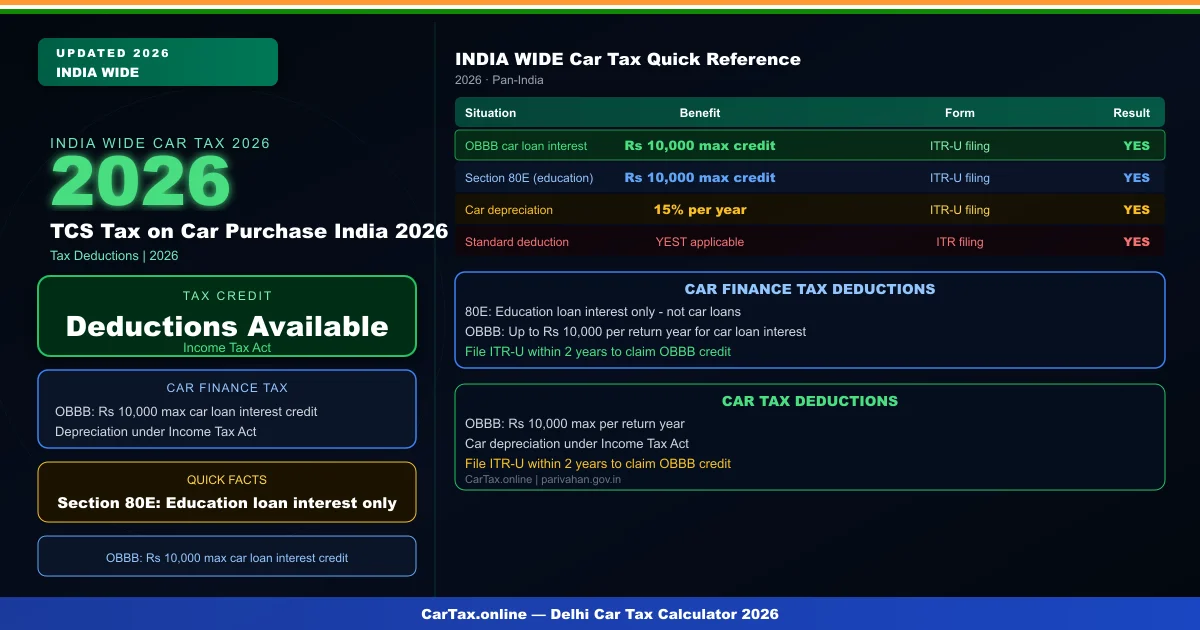
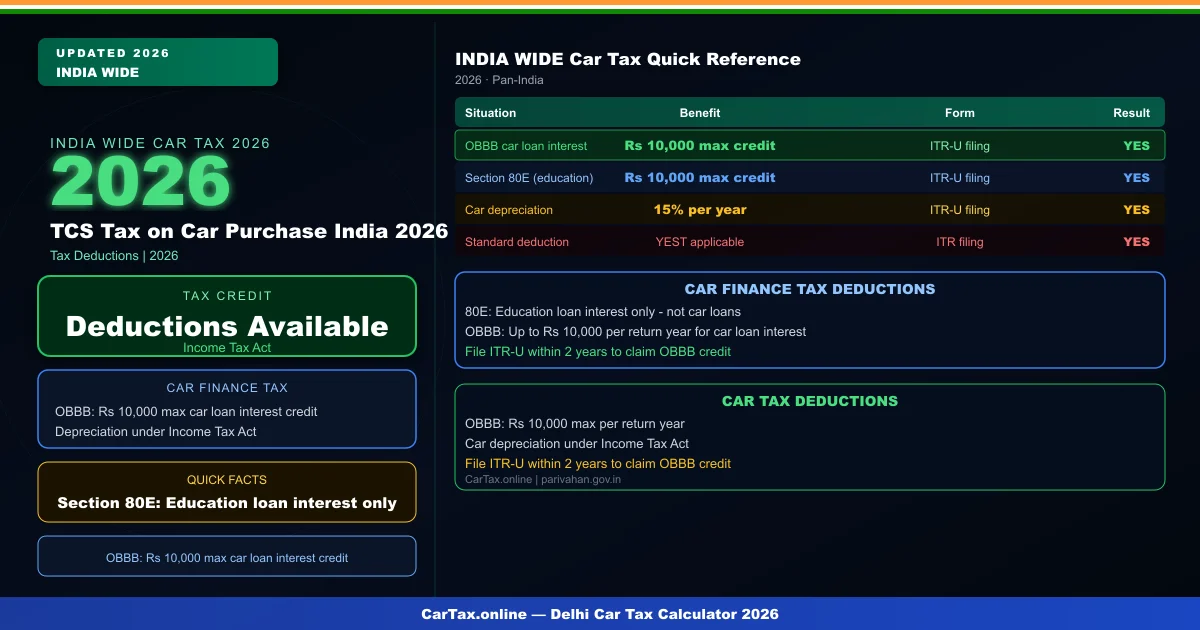
TCS Tax on Car Purchase India 2026 — 1% TCS Rules Explained
Tax Collected at Source (TCS) is an important consideration for anyone buying or selling a car in India above the value threshold of INR 10 lakh. Under the TCS provisions of the Income Tax Act, sellers of cars above this threshold must collect 1% TCS from the buyer and remit it to the government. This additional tax collected at source has been in effect for vehicle transactions and was significantly clarified in March 2026 with updated compliance guidelines.
For buyers, understanding TCS means knowing that the total amount you pay for a car above INR 10 lakh will include an additional 1% that the seller is required to collect and remit as TCS. For sellers — whether dealers or private individuals — understanding TCS means knowing your compliance obligations and the documentation requirements for remitting and issuing TCS certificates to buyers.
When Does 1% TCS Apply on Car Purchases
The 1% TCS on car sales applies when the sale price of the car exceeds INR 10 lakh. This threshold applies per transaction — if a car is sold for INR 10 lakh or more, TCS at 1% of the sale price must be collected by the seller and remitted to the government. There is no upper limit — a car sold for INR 1 crore attracts TCS of INR 1 lakh at 1%.
The TCS applies to all car sales above the INR 10 lakh threshold, regardless of whether the seller is a car dealer or a private individual. Both new cars from authorised dealers and used cars sold by previous owners are subject to the same 1% TCS if the sale price exceeds INR 10 lakh. The rules are the same regardless of the vehicle's age, make, or model — the determining factor is solely the sale price relative to the INR 10 lakh threshold.
For a practical example: if you are buying a used luxury car at INR 18 lakh from a private seller, the seller must collect INR 18,000 (1% of INR 18 lakh) as TCS from you. This INR 18,000 is in addition to the INR 18 lakh sale price and must be paid by you as part of the total transaction. The seller then remits this INR 18,000 to the government and issues you a TCS certificate for the amount.
Seller Obligations Under TCS Rules
Sellers of cars above INR 10 lakh have three primary TCS compliance obligations. First, they must collect TCS at 1% of the sale price from the buyer at the time of the transaction. Second, they must remit the collected TCS to the government through their TAN (Tax Deduction and Collection Account Number) using the TCS return form. Third, they must issue a TCS certificate (Form 27D) to the buyer, enabling the buyer to claim credit for the TCS paid.
The TCS must be remitted to the government by the 7th of the month following the month in which the collection was made. For example, if a car is sold in April 2026 and TCS is collected, the seller must remit the TCS by May 7, 2026. Sellers who fail to remit TCS are liable for penalties including interest on the delayed remittance and potential prosecution for deliberate non-compliance.
For car dealers who regularly sell vehicles above INR 10 lakh, maintaining proper TCS records and timely remittance is an essential compliance function. Dealers typically build the TCS process into their sales workflow — the 1% amount is included in the total payment amount communicated to the buyer, and the TCS certificate is issued as part of the handover documentation package.
Buyer PAN Requirements for TCS
A critical compliance requirement for buyers is providing their PAN (Permanent Account Number) to the seller at the time of purchasing a car above INR 10 lakh. The PAN is mandatory for the seller to issue a valid TCS certificate, and the buyer needs the TCS certificate to claim credit for the TCS paid against their income tax liability.
If a buyer does not have a PAN, they must apply for one immediately before completing the car purchase transaction. The TCS rules require the seller's TCS return to include the buyer's PAN, and without it, the seller cannot correctly report the TCS transaction and the buyer cannot claim the credit. For buyers who are not income tax filers (and therefore may not have a PAN), obtaining a PAN specifically for the car transaction is necessary.
The TCS credit can be claimed by the buyer as a tax credit when filing their income tax return. The TCS amount paid on the car purchase is subtracted from the buyer's total tax liability for that financial year. For buyers in high tax brackets, this can represent a meaningful reduction in their overall tax liability for the year, effectively reducing the net cost of the TCS component of the car purchase.
TCS Certificate — Form 27D
The TCS certificate that sellers must issue to buyers is Form 27D, which is the official TCS certificate format under the Income Tax Rules. The certificate must contain the seller's TAN, the buyer's PAN, the amount of the car sale, the TCS rate (1%), the TCS amount collected, the date of collection, and the details of the challan through which the TCS was remitted to the government.
Form 27D must be issued to the buyer within the timelines prescribed under the Income Tax Act — typically within 15 days of the end of the month in which the TCS was collected. The buyer uses Form 27D to claim TCS credit when filing their income tax return for the relevant financial year. Without a valid Form 27D, the buyer cannot claim the TCS credit, which effectively means paying the 1% TCS without any tax benefit.
Buyers should therefore insist on receiving Form 27D from the seller before completing the transaction and verify that all details on the certificate are correct. Errors on Form 27D (such as an incorrect buyer's PAN or an incorrect TCS amount) can cause issues when claiming the TCS credit, requiring correction procedures that can be time-consuming.
TCS Credit — How Buyers Benefit
While the 1% TCS adds to the upfront cost of a car purchase, buyers can recover this amount as a tax credit when filing their income tax return. The TCS paid on the car purchase is treated as tax already paid, and it is credited against the buyer's total income tax liability for that financial year.
For a buyer in the 30% income tax bracket who purchases a INR 20 lakh car and pays INR 20,000 in TCS, the INR 20,000 TCS credit reduces their total tax liability for that year by INR 20,000. This means the net cost of the TCS component to the buyer is effectively zero from a tax perspective — they paid INR 20,000 as TCS but will claim it back as a credit. The practical effect is that the 1% TCS on car purchases is a timing mechanism for tax payment rather than an additional cost for buyers who are regular income tax filers.
However, for buyers who do not file income tax returns or whose total tax liability is less than the TCS amount, the credit may not be fully recoverable. In such cases, the TCS becomes an actual additional cost of the car purchase. This is particularly relevant for non-resident buyers or buyers with minimal taxable income.
Frequently Asked Questions
When does 1% TCS apply on car purchase in India?
1% TCS applies on car purchase in India when the sale price of the car is above INR 10 lakh. This applies to all car sales above the threshold — both new cars from dealers and used cars from private sellers. The seller is required to collect 1% of the sale price as Tax Collected at Source and remit it to the government. For example, a car sold for INR 15 lakh attracts TCS of INR 15,000, which is in addition to the INR 15 lakh sale price. The TCS threshold and rate apply uniformly across all car types and all states in India.
What are the seller's obligations for TCS on car sales?
The seller of a car above INR 10 lakh has three primary obligations: collect 1% TCS from the buyer at the time of the transaction; remit the collected TCS to the government by the 7th of the following month using their TAN; and issue a Form 27D TCS certificate to the buyer enabling them to claim the credit. Failure to collect, remit, or issue a certificate can result in penalties, interest on delayed remittance, and potential prosecution for deliberate non-compliance. Sellers must also file TCS returns (Form 27Q) with details of all TCS collections during the quarter.
Is PAN mandatory for car buyers subject to TCS?
Yes. The buyer's PAN is mandatory when purchasing a car above INR 10 lakh subject to TCS. The seller must record the buyer's PAN on the TCS return and the Form 27D certificate. Without a PAN, the seller cannot correctly report the TCS transaction and the buyer cannot claim the TCS credit. If you do not have a PAN, apply for one before completing the car purchase transaction. The PAN application can be done online through the Protean (formerly NSDL) or UTITSL portals and typically takes 15-20 business days, though an acknowledgment number can sometimes be used provisionally.
How does the buyer claim TCS credit from car purchase?
The buyer claims TCS credit by including the TCS amount in their income tax return for the relevant financial year. When filing the return, the buyer reports the TCS amount in the appropriate schedule, and it is credited against their total tax liability. Form 27D received from the seller is the supporting document for claiming this credit. The TCS credit reduces the buyer's overall income tax payable for that year. For buyers with sufficient tax liability, the TCS credit fully offsets the 1% paid at the time of purchase, making the TCS a timing mechanism rather than an additional cost.
Can TCS be avoided by structuring the car sale below INR 10 lakh?
Attempting to structure a car sale below INR 10 lakh to avoid TCS would constitute tax evasion and is not legally permissible. The INR 10 lakh threshold is based on the actual sale price of the car. If the fair market value of a car is INR 10 lakh or more, splitting the transaction into multiple smaller transactions or undervaluing the car on paper does not change the tax obligations and can create legal liability for both buyer and seller. TCS rules apply based on the true consideration for the transaction, and tax authorities have provisions to address undervaluation and artificial structuring of transactions to evade tax.