Tax on Second Hand Cars in India — What You Need to Know
India's used car market is massive and growing, but the tax implications of buying and selling second hand cars are widely misunderstood. In April 2026, multiple tax rules apply to used car transactions — TDS for buyers, capital gains for sellers, and road tax transfer rules that can catch both parties off guard.
The key principle is simple: road tax is linked to the vehicle, not the owner. But the practical application of this principle varies depending on whether you are buying and selling in the same state or across state lines.
TDS on Second Hand Car Purchases
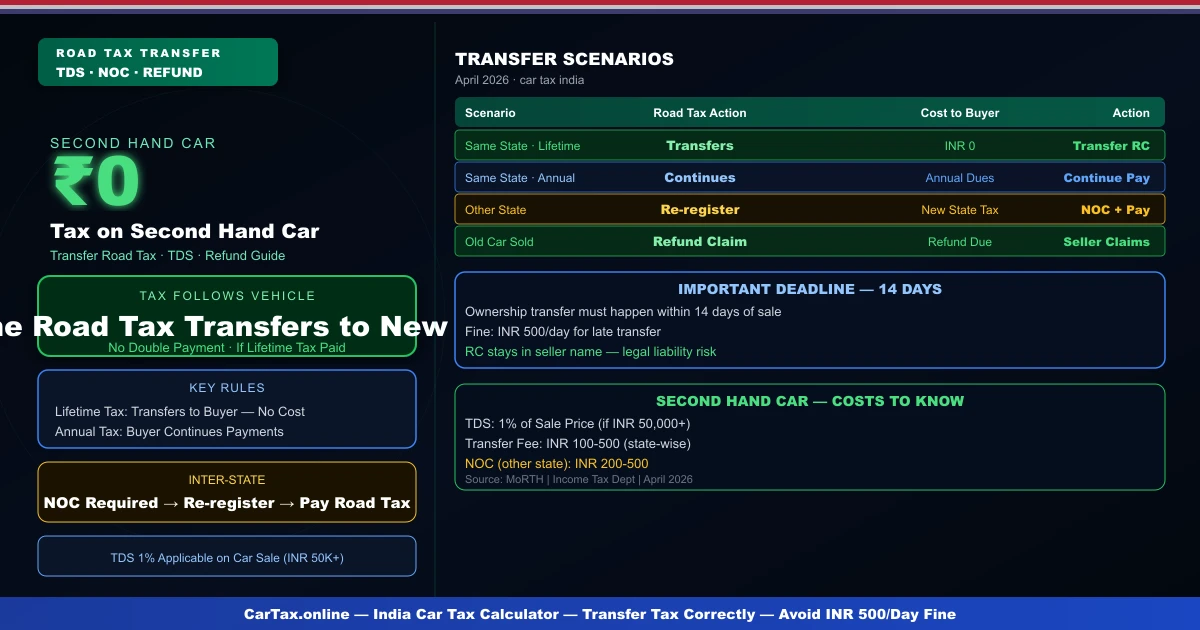
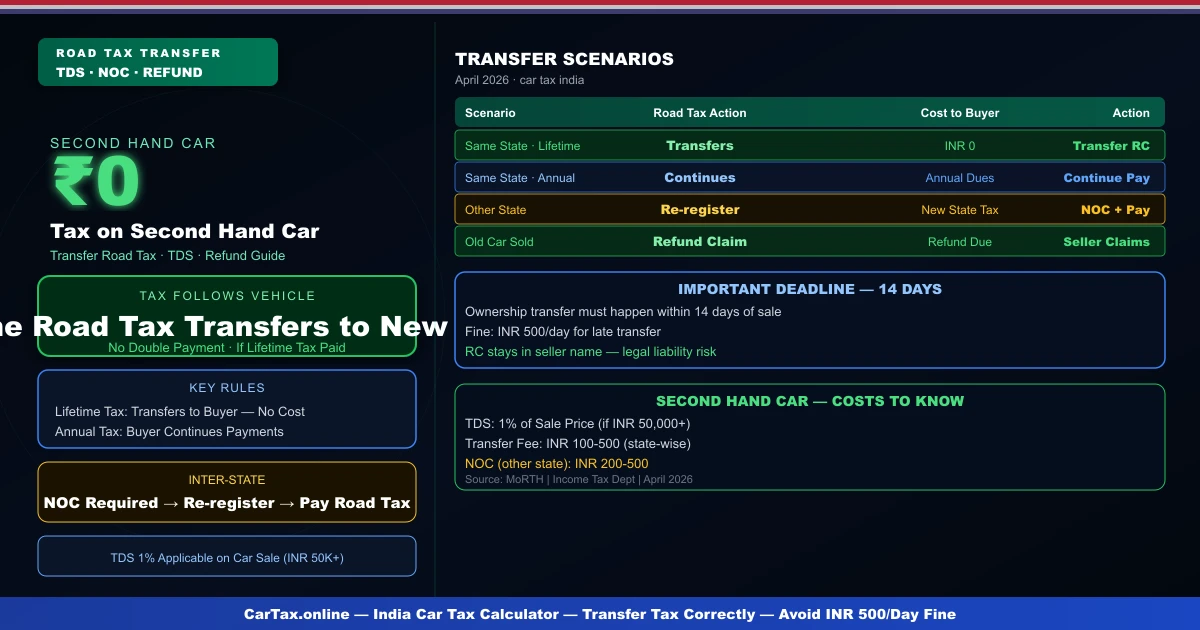
Under Section 194Q of the Income Tax Act, if you buy a used car from a dealer or individual and the sale consideration exceeds INR 50,000, the buyer must deduct TDS (Tax Deducted at Source) at 1% of the purchase price and deposit it with the Income Tax Department. This rule applies to both dealer transactions and private sales.
The TDS certificate (Form 16A) must be issued to the seller by the buyer. For sellers, the TDS deducted is advance tax against their potential capital gains liability on the sale. If the car was used for personal purposes and sold for less than the original purchase price, the seller typically has no capital gains tax liability, and the TDS can be claimed as a refund when filing income tax returns.
Road Tax Transfer — Same State vs Different State
When buying a second hand car in the same state where it is already registered, the road tax situation depends on what the previous owner paid. If the previous owner paid lifetime road tax, no additional road tax is due from you — the remaining period transfers automatically when ownership is transferred at the RTO. If the previous owner paid annual road tax, you simply continue the annual payment cycle from wherever it left off.
When buying a second hand car registered in a different state, you must obtain a No Objection Certificate (NOC) from the original registering authority and re-register the vehicle in your home state. This involves paying road tax in your home state based on the vehicle's current depreciated value. This effectively means paying road tax twice — once indirectly through the NOC clearance at the old RTO and again when re-registering in the new state.
Road Tax Refund for Sellers
If you paid lifetime road tax on your car and sell it, you can claim a proportional refund of the unused road tax period from your state RTO. The refund is calculated from the date of sale to the end of the paid registration period.
To claim the refund, apply at the RTO with the NOC issued to the buyer, the sale deed, your original road tax payment receipts, and the vehicle's deregistration certificate. Refund processing typically takes 30-60 working days depending on the state.
Capital Gains Tax on Selling a Second Hand Car
For individual sellers, selling a car at a profit may attract capital gains tax under the Income Tax Act. However, personal-use vehicles are considered "personal effects" and are generally exempt from capital gains tax when sold — provided the proceeds are used to purchase another vehicle. If you sell a personal car and do not purchase a replacement, the gain may be taxable as income from other sources.
For dealers and businesses selling vehicles from their commercial fleet, the transaction is treated as a business transaction and taxed accordingly under business income rules.
Transfer Deadline — 14 Days
Whether buying or selling, ownership transfer must be completed at the RTO within 14 days of the sale. Failure to do so results in fines starting at INR 500 per day of default under the Motor Vehicles Act. More importantly, if the vehicle is involved in an accident or traffic violation while the RC is still in the seller's name, the seller bears legal liability — making timely transfer critical for both parties.
Frequently Asked Questions
Do I pay TDS when buying a used car in India?
For the most accurate information about tax on second hand car, visit the official Parivahan portal or your nearest Regional Transport Office. Tax rules, rates, and exemptions are updated periodically by government authorities, so always verify current information before making financial decisions.
Do I need to pay road tax again when buying a second hand car?
For the most accurate information about tax on second hand car, visit the official Parivahan portal or your nearest Regional Transport Office. Tax rules, rates, and exemptions are updated periodically by government authorities, so always verify current information before making financial decisions.
How do I claim a road tax refund when selling my car?
For the most accurate information about tax on second hand car, visit the official Parivahan portal or your nearest Regional Transport Office. Tax rules, rates, and exemptions are updated periodically by government authorities, so always verify current information before making financial decisions.
What happens if I don't transfer car ownership within 14 days?
For the most accurate information about tax on second hand car, visit the official Parivahan portal or your nearest Regional Transport Office. Tax rules, rates, and exemptions are updated periodically by government authorities, so always verify current information before making financial decisions.
Do I pay capital gains tax when selling my personal car?
For the most accurate information about tax on second hand car, visit the official Parivahan portal or your nearest Regional Transport Office. Tax rules, rates, and exemptions are updated periodically by government authorities, so always verify current information before making financial decisions.
Conclusion
Tax on second hand car transactions involves TDS for buyers, potential capital gains for sellers, and critical road tax transfer rules. Complete ownership transfer within 14 days, deduct TDS on purchases over INR 50,000, and claim any road tax refunds you are entitled to as a seller. Understanding these rules prevents unexpected costs and legal complications on both sides of the transaction.
Frequently Asked Questions
Q: What is the current road tax rate for cars in India 2026?
Road tax rates in India vary by state and vehicle category. For new cars, GST is charged at 5% for EVs, 18% for hybrids under 1,200cc, and up to 28% for petrol/diesel SUVs. State road tax is charged separately and varies from Rs3,000-15,000 annually depending on the state's slab system. Check your specific state's RTO website for current rates.
Q: How do I calculate my car road tax online in India?
You can calculate your car road tax using online calculators available on state RTO portals and CarTax.online. The calculation considers your vehicle's ex-showroom price, fuel type, engine capacity, and state of registration. Road tax is payable annually or for the vehicle's lifetime depending on your state's rules.
Q: Is GST included in the road tax for new cars in India?
No — GST and road tax are separate charges. GST is a central tax charged by the vehicle manufacturer at the time of purchase. State road tax is a separate annual or one-time charge levied by your state's transport department. Both apply at the time of first registration, and annual road tax continues for subsequent years.
Q: Do electric vehicles get tax benefits in India 2026?
Yes — electric vehicles in India qualify for a reduced GST rate of 5% (down from 28% for petrol cars). Under FAME-III subsidies, EVs may also qualify for additional state-level incentives, reduced road tax, and free registration in many states. The exact benefits vary by state.
Q: What happens if I don't pay my car road tax on time?
If you don't pay road tax, your vehicle's registration can be flagged in the Vahan database, preventing renewal of fitness certificates and creating legal liability during police checks. Penalties range from Rs200-500 per day of default in most states. Road tax is a legal requirement under the Motor Vehicles Act.