Tax on Imported Cars in India 2026 — Complete Breakdown
Understanding the tax on imported cars in India 2026 is essential before committing to any international vehicle purchase. The Indian import tax regime for vehicles is one of the most complex in the world, layering customs duty, GST, and cess on every imported vehicle. As of April 2026, these rates remain among the highest globally.
Basic Customs Duty on Imported Cars
Basic customs duty is the primary levy on imported vehicles. For CBU (Completely Built Unit) car imports, the basic customs duty stands at 100% of the assessable value. This means if a car costs INR 30 lakh CIF (Cost, Insurance, Freight) at the port of entry, customs duty alone adds another INR 30 lakh — instantly doubling the cost before any other taxes apply.
The assessable value for customs purposes includes the transaction value of the vehicle, international freight, insurance, and other charges incurred up to the port of landing in India. For luxury vehicles, the CIF value itself is often contested, with customs authorities scrutinizing invoices and global pricing data to establish the correct assessable value.
GST on Imported Cars
GST applies on the aggregate value of imported goods, which includes the CIF value plus customs duty plus any additional levies. The standard GST rate on passenger cars is 28% of this aggregate value. For large SUVs and luxury sedans with engine capacity above 1,500cc, the 28% rate applies and is often the largest single component of the import tax.
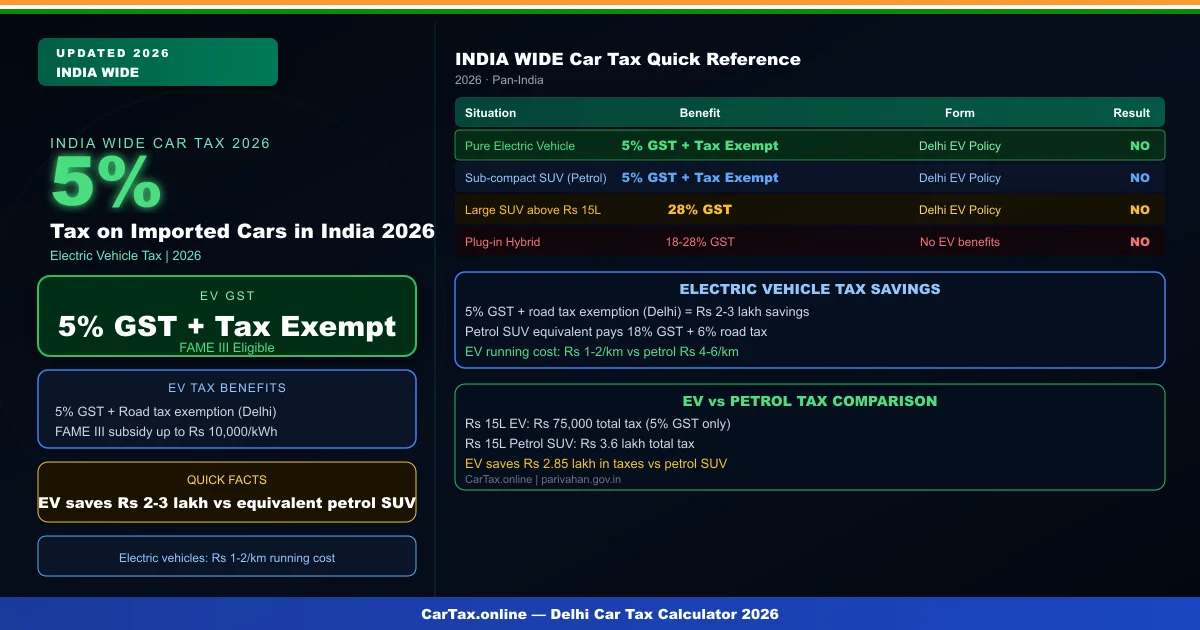
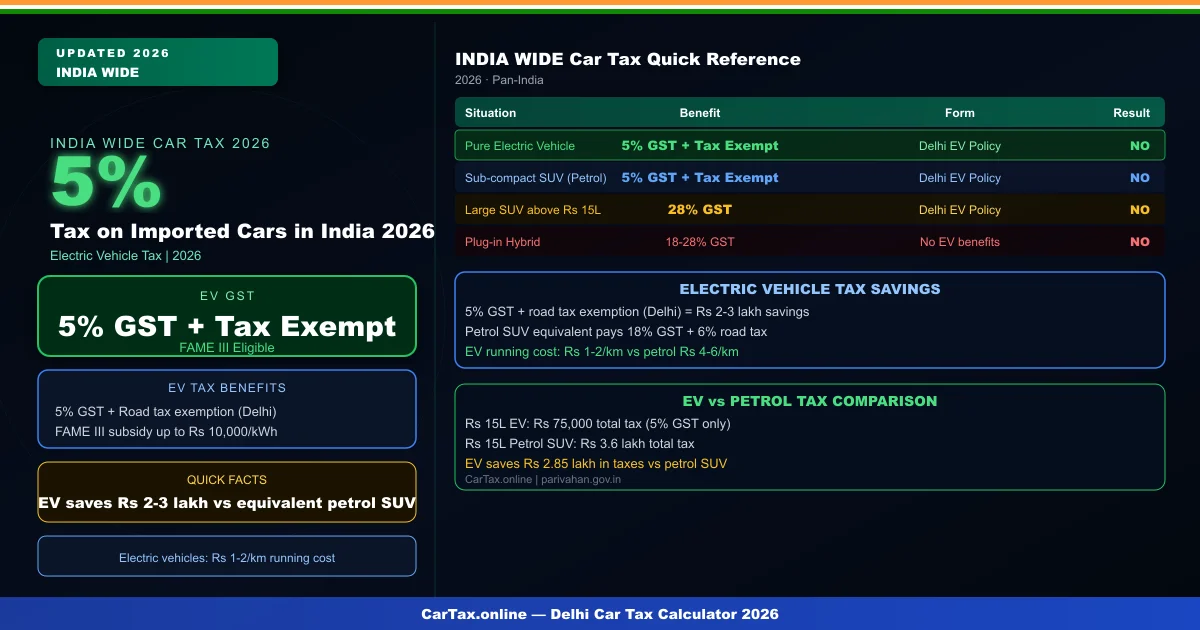
Electric imported cars currently attract 5% GST with no additional cess, making EVs the most tax-efficient category for imported vehicles. However, most luxury EVs still carry a total tax burden that significantly exceeds the vehicle's foreign market price.
Luxury Car Tax and Compensation Cess
Beyond basic customs duty and GST, the tax on imported cars in India 2026 includes a compensation cess. This cess was introduced to compensate states for revenue losses under the GST regime and varies by vehicle category. Large SUVs and luxury sedans attract cess of up to 22% in addition to the 28% GST rate.
The combined effect means some imported luxury SUVs face a total central tax (customs duty + GST + cess) exceeding 150% of the CIF value. A luxury SUV with a CIF value of INR 2 crore faces approximately INR 2 crore in customs duty, INR 1.12 crore in GST, and INR 44 lakh in cess — totaling over INR 3.56 crore in central taxes alone, before state road tax and registration fees.
Additional Charges on Imported Cars
Beyond the main taxes, imported cars incur several ancillary charges: port handling and customs broker fees (INR 50,000-2 lakh), AAI (Airports Authority of India) development fees, anti-dumping duty (for vehicles from certain countries), and state road tax at the time of first registration (varying by state from 3-15% of the vehicle's value).
Imported cars also face higher third-party insurance premiums due to the higher replacement cost of parts. Many luxury brands require mandatory manufacturer-backed service packages that add to the annual cost of ownership.
How Import Tax Compares Across Vehicle Types
For the tax on imported cars in India 2026 comparison: a standard sedan with INR 30 lakh CIF costs approximately INR 1.08 crore total (100% customs + 28% GST). An SUV with INR 50 lakh CIF costs approximately INR 1.78 crore total (100% customs + 28% GST + 20% cess). An electric car with INR 40 lakh CIF costs approximately INR 64 lakh total (100% customs + 5% GST, no cess). A CKD kit with INR 30 lakh CIF assembled in India costs approximately INR 46 lakh total (15% customs + 18% GST).
Tax Exemptions and Concessions
Certain categories of imported cars receive partial or full exemption from import taxes. Diplomatic imports by authorized embassies and consulates under bilateral agreements enjoy duty-free import privileges. UN agencies and specified international organizations similarly receive concessions. Import for research and testing purposes by recognized institutions may qualify for duty exemption under certain conditions.
Individual NRIs and returning residents can import one car under transfer of residence rules, but even these imports require payment of GST and applicable cess. The exemptions are limited to basic customs duty in most cases, and the vehicle must meet age and ownership conditions.
Frequently Asked Questions
What is the customs duty rate on imported cars in India?
For the most accurate information about tax on imported cars in india, visit the official CBIC portal or your nearest customs office. Tax rules, rates, and exemptions are updated periodically by government authorities, so always verify current information before making financial decisions.
Is GST charged on imported cars in India?
For the most accurate information about tax on imported cars in india, visit the official CBIC portal or your nearest customs office. Tax rules, rates, and exemptions are updated periodically by government authorities, so always verify current information before making financial decisions.
What is luxury car cess in India?
For the most accurate information about tax on imported cars in india, visit the official CBIC portal or your nearest customs office. Tax rules, rates, and exemptions are updated periodically by government authorities, so always verify current information before making financial decisions.
Can I avoid import duty by bringing a car as personal baggage?
For the most accurate information about tax on imported cars in india, visit the official CBIC portal or your nearest customs office. Tax rules, rates, and exemptions are updated periodically by government authorities, so always verify current information before making financial decisions.
How much tax will I pay to import a INR 1 crore car?
For the most accurate information about tax on imported cars in india, visit the official CBIC portal or your nearest customs office. Tax rules, rates, and exemptions are updated periodically by government authorities, so always verify current information before making financial decisions.
Conclusion
The tax on imported cars in India 2026 structure is deliberately protectionist, with import taxes often exceeding the vehicle's foreign price. CBU imports face 100% customs duty plus 28% GST plus cess totaling 130-150% above CIF value. GST and cess apply on the aggregate of CIF plus customs duty. Only electric vehicle imports receive significantly lower GST at 5%. Domestic assembly through CKD reduces but does not eliminate the tax burden. Factor in all taxes and charges before evaluating any import.
Frequently Asked Questions
Q: What is the total tax on importing a luxury car to India 2026?
For CBU luxury SUVs, total central tax (customs duty + GST + cess) can exceed 150% of the CIF value. For a INR 2 crore car, taxes alone can total INR 3+ crore. State road tax, registration, and handling charges add further to the total landed cost.
Q: Are imported electric cars taxed differently?
Yes. Imported electric cars attract only 5% GST (compared to 28% for petrol/diesel cars) and no compensation cess. This makes EVs significantly cheaper to import from a tax perspective, though the 100% customs duty still applies on CBU imports.
Q: What is the penalty for undervaluing an imported car?
Customs authorities can re-assess the value of imported vehicles based on global price databases, dealer invoices, and market surveys. Undervaluation can result in additional duty demands, penalties, and confiscation of the vehicle in extreme cases.
Q: Do imported cars need BS6 certification?
Yes. All cars imported into India must comply with BS6 (Bharat Stage VI) emission standards as of April 2020. Imported vehicles must have type approval from ARAI (Automotive Research Association of India) before registration.
Q: Can I import car parts instead of a complete car?
CKD (Completely Knocked Down) kits for assembly in India face significantly lower customs duty (15-30%) compared to CBU (100%). This is the route most automotive brands use to bring vehicles to the Indian market at more competitive prices.