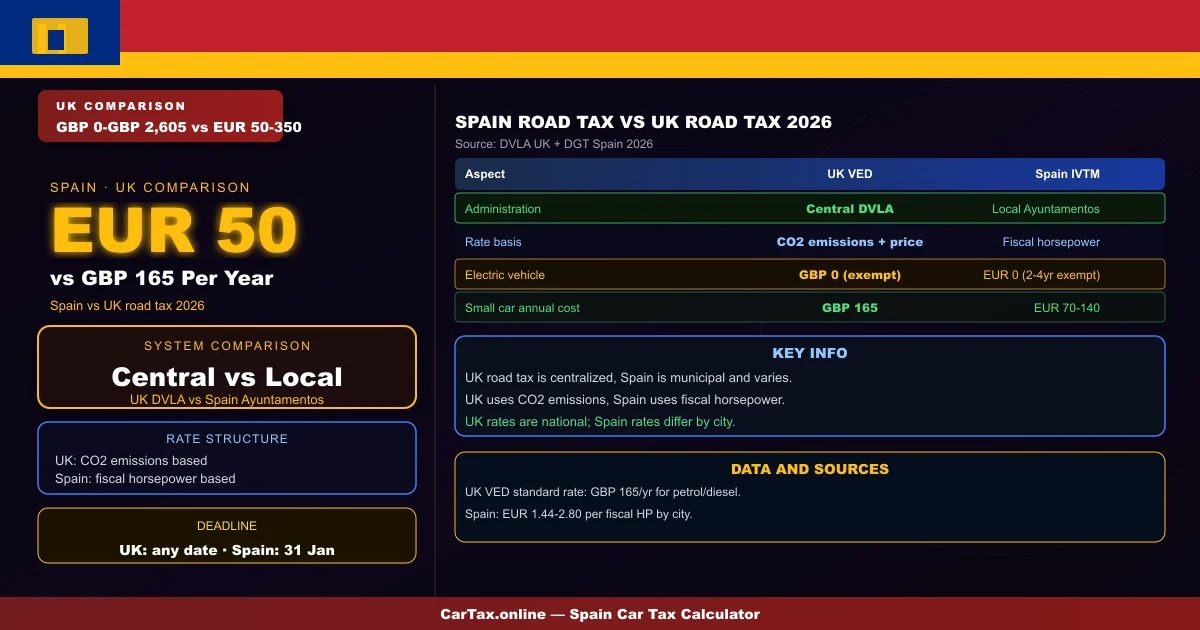
Spain Road Tax vs UK Road Tax: Understanding the Differences
If you are moving between Spain and the UK, or simply trying to understand how these two systems compare, the differences can be significant. Both countries levy annual tax on vehicle ownership, but the philosophy, administration, and costs differ substantially. ITV.es and DGT.
This guide breaks down the key differences between Spain's Impuesto de Circulacion and the UK's Vehicle Excise Duty (VED) to help you understand what to expect in each country.
Overview of Both Systems
UK Vehicle Excise Duty (VED)
The UK system is centralized. Road tax (technically called Vehicle Excise Duty or VED) is administered by the DVLA and applies to all vehicles registered in the UK. There is a standard national rate structure that applies regardless of where you live in the country. The rates are primarily based on CO2 emissions, with a complex first-year rate system and a standard annual rate thereafter.
Spain's Impuesto de Circulacion
Spain's system is decentralized. Road tax is a local municipal tax, collected by each Ayuntamiento (town hall). The national government sets the framework, but individual municipalities determine their own rates within that framework. This means the same vehicle could pay different amounts depending on which Spanish city it is registered in.
How Rates Are Calculated
UK VED Calculation
UK road tax uses CO2 emissions as the primary factor:
First-year rate: Based on CO2 emissions and vehicle list price
- GBP 0 for vehicles with 0 g/km CO2 (electric)
- Up to GBP 2,605 for vehicles emitting over 255 g/km CO2
Standard annual rate (from year 2):
- GBP 0 for zero-emission vehicles
- GBP 165 for petrol/diesel vehicles under 50,000 kg
- GBP 15 for alternative fuel vehicles
- GBP 20 supplement for vehicles over GBP 40,000 (years 2-5 only)
The DVLA uses a grid of CO2 bands and vehicle categories to determine exact rates.
Spain's Fiscal Horsepower System
Spain uses fiscal horsepower (caballos fiscales) as the primary calculation factor:
Your vehicle's fiscal horsepower is calculated using:
- Engine displacement in cc
- Maximum power output in kW
- Vehicle weight
- Fuel type and cylinder count
The resulting figure is multiplied by your municipality's rate per fiscal horsepower. Rates typically range from EUR 1.44 to EUR 2.80 per fiscal horsepower depending on the city.
Example comparisons:
| Vehicle Type | UK VED (annual) | Spain (Madrid) | Spain (Barcelona) |
|--------------|-----------------|----------------|------------------|
| Small petrol (1.0L) | £165 | EUR 70-100 | EUR 100-140 |
| Medium petrol (1.6L) | £165 | EUR 110-140 | EUR 150-200 |
| Large diesel (2.0L) | £190 | EUR 150-200 | EUR 200-280 |
| Electric | £0 | EUR 0 (exempt) | EUR 0 (exempt) |
Administration and Payment
UK System
Centralized administration: All road tax is paid to and managed by the DVLA. Payment is handled through a single national system, either online, by phone, or at post offices.
Payment methods:
- Monthly direct debit (12-month road tax spread)
- Annual payment in full
- 6-month payment option for some vehicles
Vehicle licensing: Road tax is tied to the vehicle's registration. The tax disc (now digital) must be displayed on the vehicle. The DVLA database tracks all road tax status.
Spanish System
Localized administration: Each municipality collects its own road tax. Your payment goes to your local Ayuntamiento, not a central authority.
Payment methods:
- Online through the Ayuntamiento portal
- In person at municipal offices
- Bank transfer
- Some municipalities offer direct debit
Vehicle documentation: Road tax is tracked through the municipal database and shared with the DGT. The ITV (vehicle inspection) certificate is the main proof of compliance.
Deadlines and Penalties
UK Road Tax
Annual deadline: No specific calendar deadline. Road tax is paid for a 12-month period from the date you choose to tax the vehicle. You can start or renew at any time.
Penalties: Driving with no road tax (no valid vehicle licence) carries an immediate fine of £80, reduced to £40 if paid within 30 days. Persistent non-payment can lead to prosecution and fines up to £5,000.
Enforcement: Automatic number plate recognition (ANPR) cameras constantly scan vehicles. If your vehicle has no road tax, you will be caught.
Spain's Impuesto de Circulacion
Annual deadline: 31 January for the calendar year's tax.
Penalties:
- 5% surcharge within first month
- 10% within 1-3 months
- 15% within 3-6 months
- 20%+ after 6 months
Enforcement: The Ayuntamiento reports unpaid tax to the DGT database. This can affect ITV inspections and vehicle transfers but does not result in immediate on-the-spot fines.
Exemptions and Reductions
UK VED Exemptions
- Electric and zero-emission vehicles: 100% exemption
- Vehicles over 40 years old: 100% exemption
- Disabled drivers (mobility component): exemption or reduction
- Agricultural vehicles: exemption
- Some specialist vehicles
Spain Exemptions
- Electric vehicles: typically 100% for 2-4 years
- Historic vehicles (over 25 years): varies by municipality
- Disabled drivers: full or partial exemption
- Agricultural tractors: exemption
- Emergency vehicles: exemption
Transferring Vehicles Between Countries
Bringing a UK Vehicle to Spain
Post-Brexit, UK vehicles are treated as non-EU vehicles:
1. Short-term visitors (tourists): Can use UK plates for up to 6 months
2. Residents over 30 days: Must register the vehicle in Spain
3. Registration requires: Spanish NIE, proof of address, vehicle documentation, ITV inspection, payment of customs duty (for post-Brexit imports), and annual road tax
Bringing a Spanish Vehicle to the UK
If you import a Spanish-registered vehicle to the UK:
1. You must register it with the DVLA and pay UK road tax
2. Vehicles originally registered in Spain may face different first-year VED rates
3. The vehicle must pass UK MOT (similar to ITV) before registration
4. CO2 emissions data from the Spanish registration is used for VED calculation
Which System Costs More?
For typical family vehicles:
- Small cars (1.0-1.4L): Spain tends to be cheaper, particularly in Madrid where rates are moderate
- Medium cars (1.5-2.0L): Roughly similar, with variation depending on fuel type and emissions
- Large/performance vehicles: UK can be significantly more expensive due to CO2-based higher bands
- Electric vehicles: Both countries offer near-complete exemption
The decentralized Spanish system means your exact location matters significantly. Living in Madrid versus Barcelona can mean paying 30-50% more for the same vehicle's road tax.
Key Takeaways
1. UK road tax is simpler: national rates, single payment system, no location variation
2. Spanish road tax varies by municipality: always check your Ayuntamiento's specific rate
3. Spain's deadline is fixed (31 January); UK has no specific annual deadline
4. Penalties in both countries can escalate quickly for non-payment
5. Exemptions exist in both systems for similar categories (electric, disabled, historic)
Whether you are in Spain or the UK, the fundamental principle is the same: owning a vehicle means paying annual road tax. The details differ, but the obligation is universal.
Official Resources: ITV.es - ITV Booking | DGT - Direccion General de Trafico