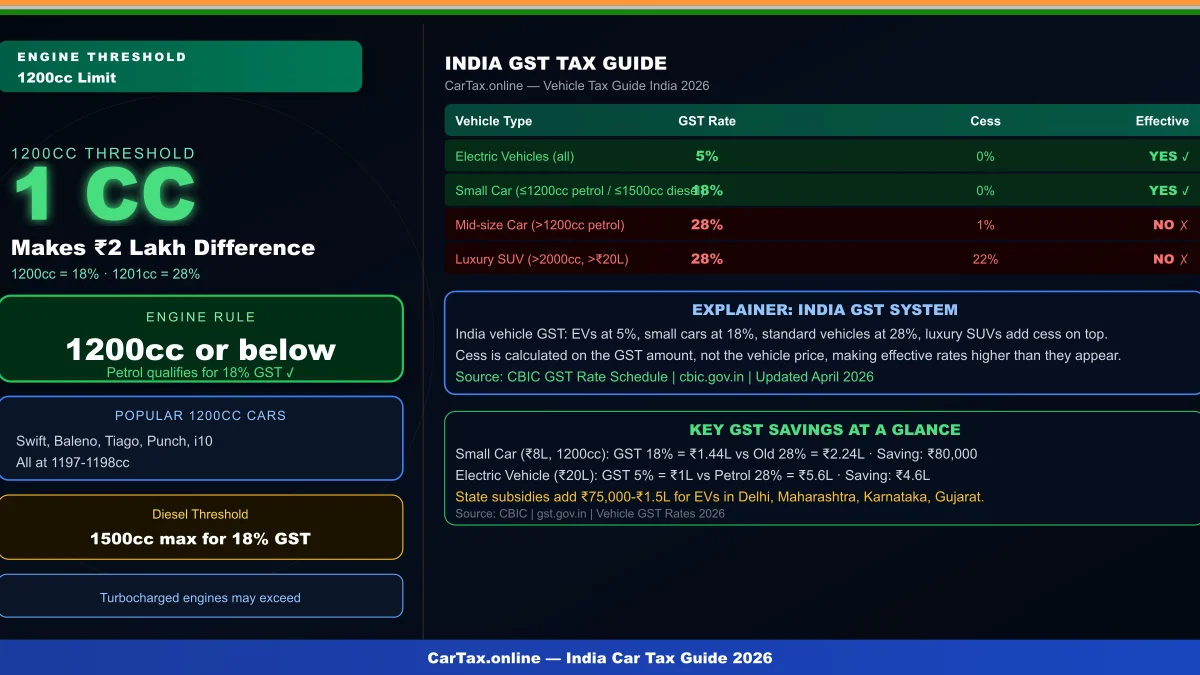
India's small car definition based on 1200cc engine displacement creates confusion for buyers navigating tax brackets and eligibility for various government benefits. Understanding this classification directly impacts your purchase decisions and potential savings.
The Legal Definition of Small Cars in India
Indian tax law defines small cars based on engine displacement thresholds that determine GST rates and eligibility for various incentives. Passenger cars with engines up to 1200cc for petrol-powered vehicles and up to 1500cc for diesel-powered vehicles qualify for the lower 18% GST bracket. This classification creates significant price advantages, as vehicles exceeding these thresholds fall into the 28% GST bracket with higher cess components. The engine size threshold also determines eligibility for certain government schemes, subsidies, and tax benefits that can substantially impact the overall purchase economics.
Impact on Vehicle Pricing and Choice
The small car definition directly influences how manufacturers position their vehicles in the Indian market. Most entry-level and mid-segment vehicles from manufacturers like Maruti, Hyundai, and Tata target the sub-1200cc petrol category to offer competitive pricing with lower tax burdens. Vehicles like the Maruti Swift, Baleno, and Hyundai i20 predominantly sell with 1.2-liter engines to maintain their small car classification and price advantage. However, manufacturers offering higher-powered variants in the same model line often face challenging positioning decisions, as upgrading to larger engines can increase prices substantially due to higher tax brackets and reduced demand.
Petrol vs Diesel Classification Differences
The diesel vehicle threshold of 1500cc creates an interesting distinction from petrol vehicles, reflecting historical market patterns where diesel cars traditionally offered better fuel economy and torque for similar displacement ranges. This 300cc advantage for diesel vehicles allows manufacturers to offer more powerful diesel engines while maintaining small car classification and lower GST rates. However, the narrowing price gap between petrol and diesel fuel, combined with BS6 Phase 2 emission requirements increasing diesel vehicle costs, has reduced the historical price advantage of diesel small cars. Buyers comparing petrol and diesel variants in the sub-1200cc petrol and sub-1500cc diesel categories should calculate total cost of ownership to determine the most economical choice. Related: Andhra Pradesh Road Tax Calculator 2026 — AP Vehicle Rates | Bangalore Road Tax Calculator 2026 — Karnataka Vehicle Guide | Car Insurance Tax India 2026 — GST & Income Tax Benefits | Car Tax Changes India 2026 — Latest Updates & New Rules.
Policy Implications for Buyers
The small car tax classification creates strategic opportunities for buyers willing to optimize their vehicle selection around these thresholds. Purchasing the highest-specification variant available within the small car category often provides better value than upgrading to a larger engine in a different vehicle category. Understanding these thresholds helps buyers negotiate with dealers and compare pricing across different vehicle options with similar specifications. Government subsidies for small cars, including scrappage incentives and state-specific registration benefits, further amplify the importance of small car classification for total purchase economics.
Evolution of the Small Car Definition
The small car definition has evolved over successive GST reforms, with historical thresholds including both engine displacement and vehicle length criteria. Earlier frameworks included length requirements of 4 meters or less alongside engine restrictions, though current policy primarily relies on engine displacement for passenger vehicle classification. This evolution reflects changing government priorities around vehicle pollution, fuel efficiency, and domestic manufacturing competitiveness. Future policy changes may shift toward emission-based classification that could reshape the current small car framework entirely.
Frequently Asked Questions
What engine size qualifies as a small car in India for tax purposes?
Small cars qualify for the lower 18% GST bracket with petrol engines up to 1200cc or diesel engines up to 1500cc, providing significant price advantages over larger vehicles.
Why do diesel cars have a higher engine displacement threshold?
Diesel engines have a 1500cc threshold compared to 1200cc for petrol, reflecting the traditional fuel efficiency and torque advantages of diesel technology and historical market patterns.
How much tax savings does small car classification provide?
Small car classification provides GST savings of approximately 10% compared to larger vehicles in the 28% bracket, potentially saving ₹50,000-3,00,000 depending on vehicle price.
Are there other benefits for small car buyers beyond GST?
Small car buyers often qualify for government subsidies, scrappage incentives, and state-specific registration benefits that further enhance the economics of purchasing within these thresholds.
Could the small car definition change in future tax reforms?
Future GST reforms may shift toward emission-based classification, potentially changing how small car thresholds apply to vehicle taxation in India.
Official Resources: Parivahan Portal | Vahan Road Tax | India GST Portal | FAME-III Scheme
Frequently Asked Questions
Q: What is the current road tax rate for cars in India 2026?
Road tax rates in India vary by state and vehicle category. For new cars, GST is charged at 5% for EVs, 18% for hybrids under 1,200cc, and up to 28% for petrol/diesel SUVs. State road tax is charged separately and varies from Rs3,000-15,000 annually depending on the state's slab system. Check your specific state's RTO website for current rates.
Q: How do I calculate my car road tax online in India?
You can calculate your car road tax using online calculators available on state RTO portals and CarTax.online. The calculation considers your vehicle's ex-showroom price, fuel type, engine capacity, and state of registration. Road tax is payable annually or for the vehicle's lifetime depending on your state's rules.
Q: Is GST included in the road tax for new cars in India?
No — GST and road tax are separate charges. GST is a central tax charged by the vehicle manufacturer at the time of purchase. State road tax is a separate annual or one-time charge levied by your state's transport department. Both apply at the time of first registration, and annual road tax continues for subsequent years.
Q: Do electric vehicles get tax benefits in India 2026?
Yes — electric vehicles in India qualify for a reduced GST rate of 5% (down from 28% for petrol cars). Under FAME-III subsidies, EVs may also qualify for additional state-level incentives, reduced road tax, and free registration in many states. The exact benefits vary by state.
Q: What happens if I don't pay my car road tax on time?
If you don't pay road tax, your vehicle's registration can be flagged in the Vahan database, preventing renewal of fitness certificates and creating legal liability during police checks. Penalties range from Rs200-500 per day of default in most states. Road tax is a legal requirement under the Motor Vehicles Act.