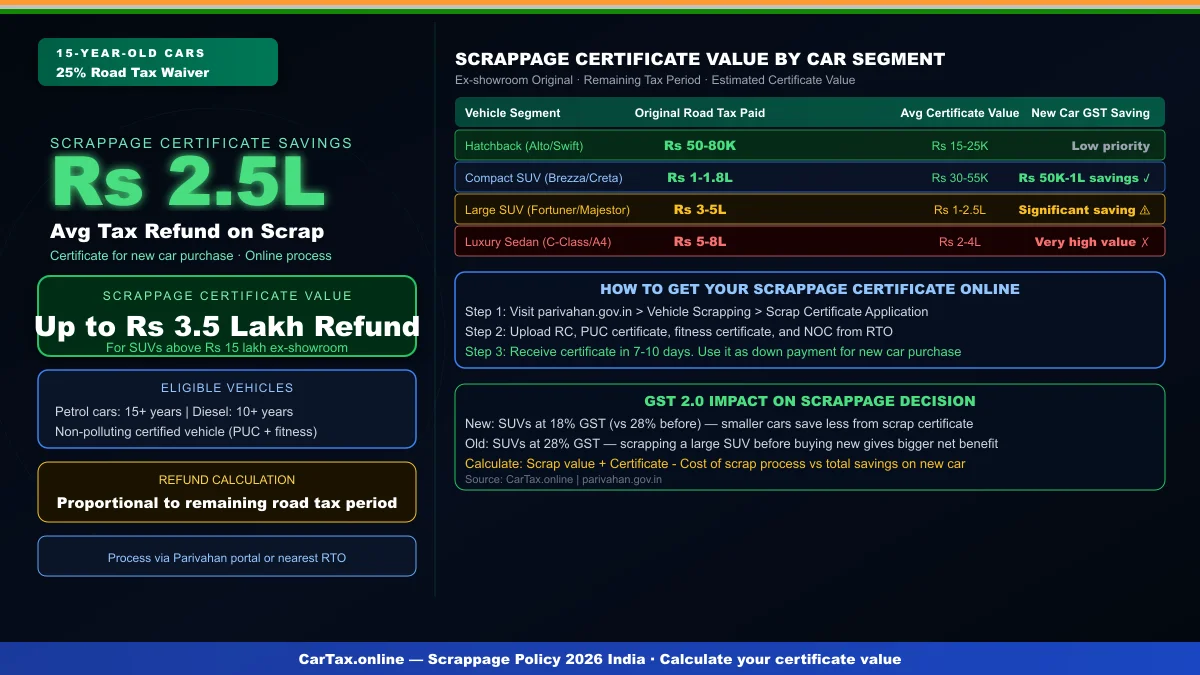
The vehicle scrappage policy in India has entered a decisive phase in 2026, with enforcement of older vehicle restrictions tightening across major metropolitan areas and state RTOs. For owners of 15-year-old petrol cars and 10-year-old diesel vehicles, the decision to scrap or renew is no longer just a financial calculation — it is increasingly a compliance matter. The scrappage certificate, which represents the remaining road tax value of your vehicle, can be worth Rs 15,000 for an entry-level hatchback to Rs 3-4 lakh for a luxury sedan. Used as a down payment for a new vehicle purchase, the scrappage certificate transforms an old liability into a tangible financial asset. In April 2026, with new car prices reflecting the GST 2.0 reform benefits and dealer exchange bonuses at their seasonal peak, scrapping your old vehicle and using the certificate as a down payment makes more financial sense than ever before.
The scrappage certificate value calculation is straightforward in principle: it represents the unexpired portion of the road tax you paid when registering your vehicle. If you paid Rs 1 lakh in road tax for a 15-year registration and your vehicle is 10 years old, the remaining 5 years of road tax value belongs to you — and the scrappage certificate is the official document that proves this claim. In practice, the certificate value varies dramatically by vehicle segment, making the decision to scrap particularly impactful for owners of large SUVs and luxury sedans who face the highest road tax burdens.
Who Must Scrap Their Vehicle in 2026?
The mandatory scrappage requirements in 2026 apply to specific vehicle categories and regions:
Delhi-NCR Region: All diesel vehicles above 10 years old registered in Delhi, Gurgaon, Faridabad, Noida, and Ghaziabad are required to be scrapped. The March 31, 2026 deadline for mandatory deregistration has passed, and enforcement of this requirement continues through RTO fitness certificate checks at toll plazas and during traffic stops. Driving a non-compliant vehicle in Delhi-NCR after the deadline carries fines of Rs 5,000-10,000 per offense and potential vehicle seizure.
Metropolitan Cities with High Pollution Index: Mumbai, Bangalore, Chennai, Hyderabad, and Kolkata have implemented varying levels of scrappage enforcement. Fitness certificate renewals for vehicles above 15 years are increasingly requiring inspection at authorised centres, and vehicles that fail emission standards are being directed to scrap.
Commercial Vehicles: Buses and trucks over 10 years old are subject to mandatory fitness testing at every state border crossing. Vehicles failing the test are deregistered on the spot and directed to authorised scrapping centres.
Private Vehicles (Non-NCR): For private petrol vehicles in non-NCR states, the 15-year scrappage rule exists on paper but enforcement varies. However, this is expected to tighten in the second half of 2026 as the central government pushes states to implement uniform standards. April 2026 is an opportune time to scrap ahead of anticipated stricter enforcement.
Scrappage Certificate Value by Vehicle Segment
The scrappage certificate value depends on two factors: the original road tax paid and the remaining registration period at the time of scrapping. Here is the estimated certificate value for popular vehicle segments:
Entry-Level Hatchbacks (Maruti Alto, WagonR, Swift):
- Original ex-showroom: Rs 4-6 lakh | Original road tax: Rs 50,000-80,000 (15-year registration)
- Scrapping at 10 years: Certificate value Rs 15,000-25,000
- Scrapping at 12 years: Certificate value Rs 8,000-15,000
Compact SUVs (Hyundai Creta, Kia Seltos, Maruti Brezza):
- Original ex-showroom: Rs 12-18 lakh | Original road tax: Rs 1-1.8 lakh
- Scrapping at 10 years: Certificate value Rs 30,000-55,000
- Scrapping at 12 years: Certificate value Rs 15,000-30,000
Large SUVs (Toyota Fortuner, MG Majestor, Ford Endeavour):
- Original ex-showroom: Rs 30-50 lakh | Original road tax: Rs 3-5 lakh
- Scrapping at 10 years: Certificate value Rs 1-2.5 lakh
- Scrapping at 12 years: Certificate value Rs 50,000-1.5 lakh
Luxury Sedans (BMW 5 Series, Mercedes C-Class, Audi A4):
- Original ex-showroom: Rs 55-75 lakh | Original road tax: Rs 5-8 lakh
- Scrapping at 8 years: Certificate value Rs 2-4 lakh
- Scrapping at 10 years: Certificate value Rs 1-3 lakh
How to Use Your Scrappage Certificate for a New Car Purchase
The scrappage certificate is accepted by all authorised car dealers as partial payment for new vehicle purchases. Here is how to maximise its value:
- Get the certificate first: Complete the scrappage process and receive the certificate before visiting a dealer. The certificate has a unique serial number verifiable by the dealer through the Parivahan portal.
- Compare exchange bonuses: MG, Hyundai, Kia, and Toyota all offer scrappage exchange bonuses of Rs 25,000-1 lakh on top of the certificate value. Compare these across at least 3 dealers before committing.
- Use certificate + exchange bonus as down payment: The combined value of your certificate + brand exchange bonus reduces your loan amount directly. A Fortuner owner with Rs 1.5 lakh certificate + Rs 75,000 MG exchange bonus = Rs 2.25 lakh total down payment.
- Check if a bank loan covers the remainder: Banks treat the scrappage certificate as equivalent to a cash down payment — you can finance the balance of the vehicle price through a standard car loan.
GST 2.0 Impact on the Scrappage Decision
The GST 2.0 reform effective April 2026 partially changes the scrappage calculus. Previously, SUVs attracted 28% GST — making the GST savings from scrapping a large vehicle and buying a new one even more significant. Under GST 2.0, compact and sub-compact SUVs attract 18% GST (saving Rs 1-1.5 lakh versus before). The effective benefit of scrapping a large SUV (above Rs 15 lakh ex-showroom) remains high — the certificate value combined with the exchange bonus and GST savings on the new vehicle can represent Rs 2-5 lakh in total financial benefit.
For hatchback owners, the GST 2.0 reform makes the scrappage decision more nuanced: the Rs 15,000-25,000 certificate value may not fully offset the hassle of scrapping, especially if the vehicle is well-maintained and still reliable. However, for owners in NCR and cities with tight pollution enforcement, the compliance cost of keeping a 15-year-old vehicle may outweigh the certificate value.
For accurate scrappage certificate value calculations, exchange bonus comparisons, and new car affordability analysis with your certificate as down payment, use the CarTax.online scrappage calculator — updated with April 2026 exchange bonus offers and state-wise scrappage enforcement details.
Official Resources: Parivahan Portal (Scrappage) | MoRTH Vehicle Scrapping | VAHAN Vehicle Records | India GST Portal