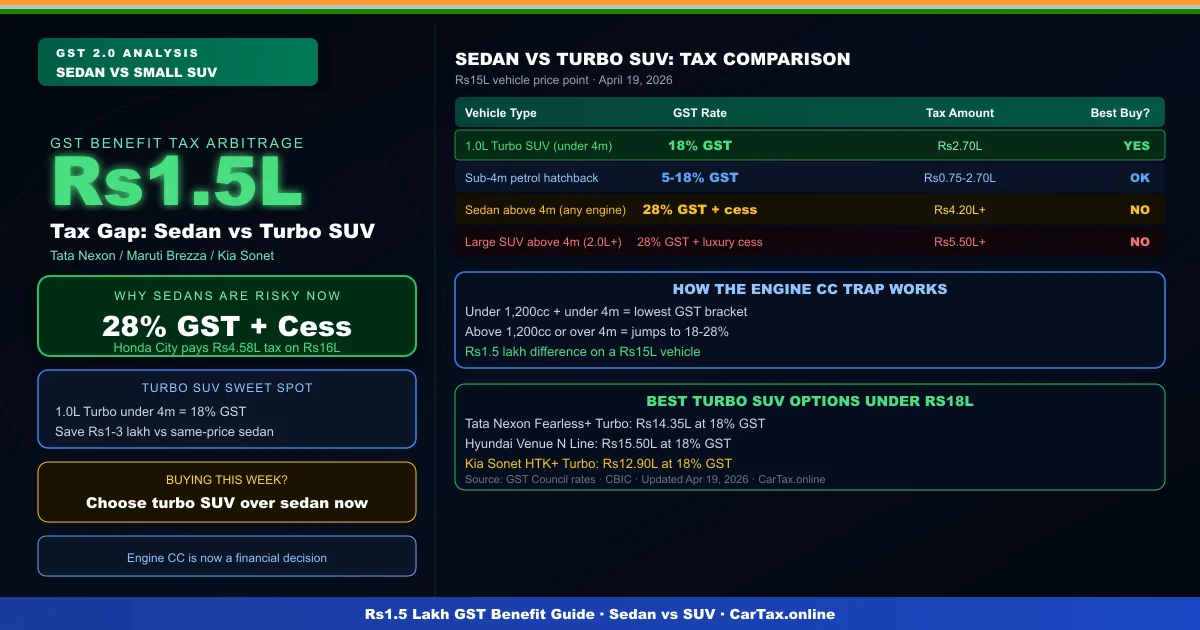
April 19, 2026 marks a structural inflexion point in the Indian automotive market that most buyers have not fully processed yet. The GST 2.0 framework — revised and effective from January 2026 — has created a tax arbitrage opportunity that was simply not possible two years ago. Today, a 1.0-litre turbocharged SUV under 4 metres attracts 18% GST, while a comparable sedan above 4 metres attracts 28% GST plus cess. The gap between these two categories has widened to the point where choosing a sedan over a turbo SUV at the same price point is now a financial decision — not just an emotional one.
The numbers are stark. A Rs15 lakh vehicle in the turbo SUV category carries Rs2.70 lakh in GST. The same Rs15 lakh in a sedan above 4 metres carries Rs4.20 lakh or more in GST and cess. That is a Rs1.50 lakh tax advantage built into the turbo SUV purchase — before you factor in fuel efficiency, resale value, or practicality. If you are in the market for a Rs12-20 lakh vehicle this Sunday, ignoring this math could cost you more than you think.
How the Engine CC Trap Works Against Sedan Buyers
The GST 2.0 structure uses two primary thresholds: vehicle length (4 metres) and engine displacement (1,200cc). A vehicle that crosses either threshold — or both — moves into a higher tax bracket. The current structure:
- Sub-4m hatchback with engine under 1,200cc: 5% GST (small hatches)
- Sub-4m SUV with 1.0L turbo engine: 18% GST (the sweet spot)
- Sub-4m SUV with 1.2L+ or non-turbo large engine: 24% GST
- Sedan above 4m with any engine: 28% GST + cess
- Large SUV above 4m with 2.0L+ engine: 28% + luxury cess
For a buyer comparing a Honda City ZX (Rs16.35 lakh, 28% GST + cess = Rs5.78 lakh tax) against a Tata Nexon Fearless+ Turbo (Rs14.35 lakh, 18% GST = Rs2.58 lakh tax), the tax difference alone is Rs3.20 lakh. Add the on-road price comparison and the Nexon wins by approximately Rs4 lakh — before the Honda City's higher fuel consumption and lower resale value are factored in. Related: GST 2.0 Sunday Special | 24 Hours to Go | 24 Hours to Go | 8th Pay Commission Analysis.
Best Turbo SUV Options Under Rs18 Lakh at 18% GST
The current sub-Rs18 lakh turbo SUV segment is where the GST arbitrage is most visible. Here are the top performers in terms of tax efficiency:
Tata Nexon Fearless+ Turbo (Rs14.35 lakh ex-showroom):
1.0L turbo petrol engine, 120PS, sub-4m body. 18% GST applies. On-road price in Delhi: approximately Rs17.50 lakh. Key advantage: India's best-selling compact SUV with 5-star GNCAP rating and strong hybrid option available.
Hyundai Venue N Line (Rs15.50 lakh ex-showroom):
1.0L turbo GDi engine, 120PS, sporty design. 18% GST applies. On-road price in Delhi: approximately Rs18.50 lakh. Key advantage: premium interior and connected car features as standard.
Kia Sonet HTK+ Turbo (Rs12.90 lakh ex-showroom):
1.0L turbo petrol, 120PS, sub-4m body. 18% GST applies. On-road price: approximately Rs15.50 lakh. Key advantage: lowest entry point in the turbo SUV segment with the highest feature density per rupee.
Maruti Brezza ZXi+ Turbo (Rs13.80 lakh ex-showroom):
1.0L K-Series turbo engine, 102PS, sub-4m body. 18% GST applies. On-road price: approximately Rs16.50 lakh. Key advantage: Maruti's lowest cost of ownership and widest service network.
Why Buying a Sedan Now Is the Worst Financial Decision
The case against sedans in 2026 is not about preference — it is about math. Consider the Honda City ZX at Rs16.35 lakh ex-showroom: the total tax burden (GST + cess) reaches Rs5.78 lakh before RTO. The same Rs16.35 lakh spent on a Mahindra XUV700 base variant (Rs16.50 lakh ex-showroom) attracts approximately Rs2.97 lakh in GST. The net advantage: Rs2.81 lakh in pre-tax savings, which translates to approximately Rs3.50 lakh lower on-road cost.
For buyers who specifically prefer sedan ride quality and low seating position: consider a sub-4m turbo hatchback like the Maruti Baleno or Toyota Glanza with a turbo engine. Both qualify for lower GST and deliver comparable fuel efficiency.
The One Exception: Premium Sedans Below Rs10 Lakh
If your budget is under Rs10 lakh, the GST equation shifts. Small hatchbacks and entry sedans at the sub-Rs10 lakh level attract 5% or lower GST, making them tax-efficient despite being sedans. The Honda Amaze, Maruti Dzire, and Tata Tigor all sit in lower tax brackets where the arbitrage does not apply. Above Rs10 lakh, the sedan penalty kicks in — and above Rs15 lakh, it becomes a genuine financial liability.
Official Resources: Parivahan Portal | Vahan Road Tax | India GST Portal | FAME-III Scheme
Frequently Asked Questions
Q: Why is 2026 the worst year to buy a sedan?
The GST 2.0 structure charges 28% GST plus cess on sedans above 4 metres, while turbo SUVs under 4m pay only 18% GST. The tax gap on a Rs15 lakh vehicle is Rs1.50 lakh or more.
Q: What is the best turbo SUV under Rs18 lakh with lowest GST?
Tata Nexon Fearless+ Turbo (Rs14.35L, 18% GST), Kia Sonet HTK+ Turbo (Rs12.90L, 18% GST), and Hyundai Venue N Line (Rs15.50L, 18% GST) are the top choices.
Q: How much does the engine CC threshold affect GST?
Engines under 1,200cc in sub-4m vehicles qualify for lower GST. Above 1,200cc or over 4m length triggers higher tax brackets of 18-28%.
Q: Are there any sedans that avoid the higher GST?
Sedans under Rs10 lakh with small engines qualify for lower GST brackets. Above Rs10 lakh, the 28% plus cess applies regardless of engine size.
Q: How much can I save by choosing a turbo SUV over a sedan at Rs15 lakh?
The GST difference alone is approximately Rs1.50 lakh on a Rs15 lakh vehicle. Factoring in on-road costs and fuel efficiency, the total savings can reach Rs2-3 lakh.