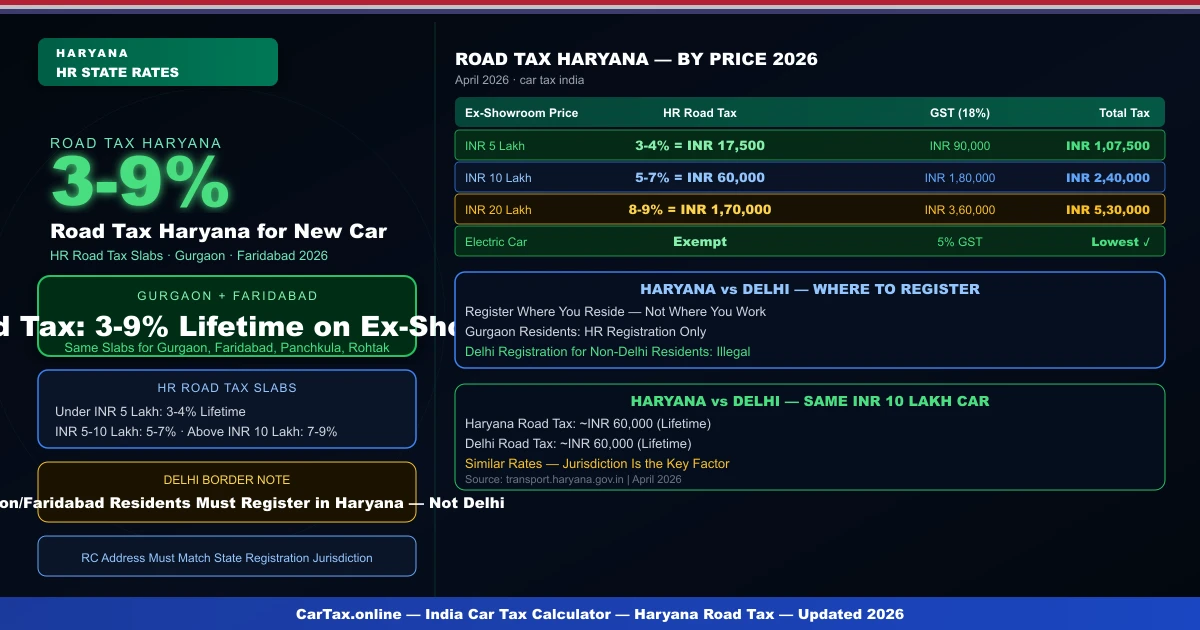
Road tax in Haryana for new cars in 2026 applies slab rates across all HR districts including Gurgaon, Faridabad, Panchkula, and other urban centres. Haryana's road tax structure is marginally higher than Delhi but remains competitive among northern states, making it an important consideration for buyers in the NCR region weighing options between Haryana and Delhi registration.
As of April 18, 2026, Haryana road tax applies slab rates from 5% to 8% depending on vehicle value, with electric vehicles enjoying road tax exemption under the Haryana Electric Vehicle Policy. The uniform application of rates across all Haryana districts simplifies the calculation regardless of which RTO processes the registration.
Haryana Road Tax Slabs for Cars
Haryana road tax for new passenger cars follows slab rates based on vehicle value. Cars priced up to INR 6 lakh attract road tax at 5%, vehicles between INR 6 to 10 lakh at 6%, vehicles between INR 10 to 15 lakh at 7%, and vehicles above INR 15 lakh at 8%. These rates apply uniformly across all 20+ Haryana districts including Gurgaon, Faridabad, Panchkula, Hisar, Rohtak, and Panipat.
For a car priced at INR 12 lakh, Haryana road tax amounts to INR 84,000 at 7%, while Delhi charges INR 72,000 at 6%. The INR 12,000 difference per vehicle makes Delhi marginally more attractive for mid-range vehicle buyers, though the difference is modest compared to the tax variance with southern states.
Gurgaon and Faridabad Road Tax
Gurgaon and Faridabad are among the most common registration locations in Haryana due to the concentration of automotive retail and commercial activity in these cities. Both cities fall under the same Haryana road tax slab system with no additional municipal charges on top of the state rate.
The road tax for a luxury SUV priced at INR 40 lakh in Gurgaon amounts to INR 3.2 lakh at 8%, compared to INR 3.2 lakh in Delhi also at 8%. For premium vehicles, Haryana and Delhi converge on tax rates, making other factors like insurance availability and service network more relevant to the purchase decision.
Electric Vehicle Road Tax in Haryana
Haryana provides road tax exemption for electric vehicles under the Haryana Electric Vehicle Policy. The exemption period and conditions are set by the state government and apply to all EVs registered in Haryana, whether in Gurgaon, Faridabad, or any other district.
The EV exemption combined with Haryana's already-competitive road tax rates makes the state attractive for electric vehicle purchases. For an electric SUV priced at INR 30 lakh, the road tax exemption saves INR 2.4 lakh over the exemption period, in addition to the 5% GST advantage and FAME-II subsidy available on electric vehicles.
Comparison with Delhi Road Tax
Comparing Haryana and Delhi road tax reveals marginal differences for most vehicle categories. For vehicles up to INR 6 lakh, both states charge 5%, creating identical tax burdens. For vehicles above INR 15 lakh, both states converge at 8%, making the tax impact identical for premium vehicle buyers.
The slight Haryana advantage exists for vehicles in the INR 6 to 15 lakh bracket where Delhi's 6% rate is marginally lower than Haryana's 7% rate. However, this difference of 1% on vehicles in this range amounts to only INR 6,000 to INR 15,000, which is unlikely to be the deciding factor in most vehicle purchase decisions. Use our India car tax calculator to compare Haryana and Delhi road tax for specific vehicles.
Registration and Road Tax Process in Haryana
Road tax in Haryana can be paid at the time of vehicle registration at any Haryana RTO. The registration process for new vehicles involves submitting the vehicle for inspection, paying road tax, paying registration fees, and receiving the registration certificate. Online payment portals are available through the Haryana Transport Department for pre-payment of road tax before visiting the RTO.
For instant estimates of Haryana road tax for any vehicle, use our India car tax calculator. The calculator covers all Haryana districts including Gurgaon and Faridabad, and automatically applies EV exemption where applicable. Registration fees for four-wheelers in Haryana are approximately INR 1,200 and are charged uniformly across all Haryana RTOs.
Frequently Asked Questions
What is the road tax rate for new cars in Haryana?
Haryana road tax for new cars follows slabs based on vehicle value: 5% for cars up to INR 6 lakh, 6% for cars INR 6 to 10 lakh, 7% for cars INR 10 to 15 lakh, and 8% for cars above INR 15 lakh. These rates apply to all districts including Gurgaon, Faridabad, Panchkula, and other HR registered vehicles.
How does Haryana compare to Delhi for road tax on new cars?
Haryana road tax rates are marginally higher than Delhi across most price brackets. For a car priced at INR 12 lakh, Haryana charges 7% (INR 84,000) while Delhi charges 6% (INR 72,000). The difference is modest but becomes more significant for higher-priced vehicles where Haryana charges 8% versus Delhi's 8% cap.
Do electric vehicles get road tax exemption in Haryana?
Yes, Haryana provides road tax exemption for electric vehicles registered in the state. The exemption period and conditions are set under the Haryana Electric Vehicle Policy. Electric vehicles enjoy significant cost advantages in Haryana, combining road tax exemption with lower registration fees for EV-category vehicles.
What districts in Haryana have different road tax rates?
Road tax rates in Haryana are uniform across all districts including Gurgaon, Faridabad, Panchkula, Hisar, Rohtak, and Panipat. There are no district-specific variations within Haryana. All vehicles registered in HR pay the same road tax percentage regardless of which RTO issued the registration.
Can I use the Haryana road tax calculator for all HR districts?
Yes, our Haryana vehicle tax calculation covers all Haryana districts uniformly. Enter the vehicle ex-showroom price, select fuel type, and the calculator will show the applicable road tax for any of the 20+ Haryana districts including Gurgaon, Faridabad, and Panchkula. Registration fees remain constant at approximately INR 1,200 for four-wheelers across all Haryana RTOs.
Official Resources: Parivahan Portal | Vahan Road Tax | India GST Portal | FAME-III Scheme
Frequently Asked Questions
Q: What is the current road tax rate for cars in India 2026?
Road tax rates in India vary by state and vehicle category. For new cars, GST is charged at 5% for EVs, 18% for hybrids under 1,200cc, and up to 28% for petrol/diesel SUVs. State road tax is charged separately and varies from Rs3,000-15,000 annually depending on the state's slab system. Check your specific state's RTO website for current rates.
Q: How do I calculate my car road tax online in India?
You can calculate your car road tax using online calculators available on state RTO portals and CarTax.online. The calculation considers your vehicle's ex-showroom price, fuel type, engine capacity, and state of registration. Road tax is payable annually or for the vehicle's lifetime depending on your state's rules.
Q: Is GST included in the road tax for new cars in India?
No — GST and road tax are separate charges. GST is a central tax charged by the vehicle manufacturer at the time of purchase. State road tax is a separate annual or one-time charge levied by your state's transport department. Both apply at the time of first registration, and annual road tax continues for subsequent years.
Q: Do electric vehicles get tax benefits in India 2026?
Yes — electric vehicles in India qualify for a reduced GST rate of 5% (down from 28% for petrol cars). Under FAME-III subsidies, EVs may also qualify for additional state-level incentives, reduced road tax, and free registration in many states. The exact benefits vary by state.
Q: What happens if I don't pay my car road tax on time?
If you don't pay road tax, your vehicle's registration can be flagged in the Vahan database, preventing renewal of fitness certificates and creating legal liability during police checks. Penalties range from Rs200-500 per day of default in most states. Road tax is a legal requirement under the Motor Vehicles Act.