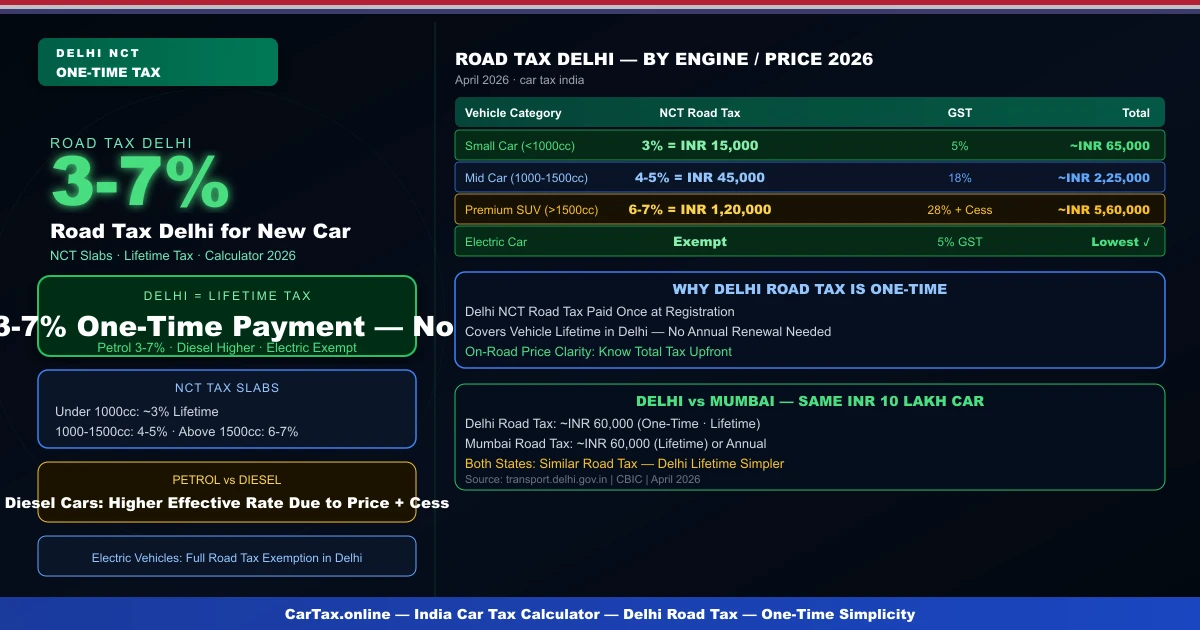
Road tax in Delhi for new cars in 2026 follows the NCT slab system that applies one of India's lowest road tax rates to vehicle purchases in the capital. Delhi's road tax structure is straightforward with no additional cess, making it one of the more affordable major cities for vehicle ownership despite the challenges of urban congestion and pollution-related restrictions.

As of April 18, 2026, Delhi road tax applies slab rates ranging from 4% for economy vehicles to 8% for premium cars, with electric vehicles enjoying a 10-year road tax exemption. The absence of additional state cess means Delhi's tax calculation is simpler than states like Karnataka and Maharashtra that layer multiple charges on the base road tax.

Delhi Road Tax Slabs for Cars

Delhi road tax for passenger cars follows value-based slabs introduced by the National Capital Territory. Vehicles priced up to INR 6 lakh attract road tax at 4%, vehicles between INR 6 to 10 lakh at 5%, vehicles between INR 10 to 15 lakh at 6%, and vehicles above INR 15 lakh at 8%. This slab system makes Delhi particularly attractive for buyers of premium vehicles where the 8% cap provides substantial savings compared to states with higher rates.

For example, a luxury SUV priced at INR 50 lakh attracts road tax of INR 4 lakh in Delhi at 8%. The same vehicle in Karnataka attracts road tax of INR 10 lakh at 20%, a difference of INR 6 lakh that significantly impacts the purchase decision for premium vehicle buyers.

No Additional Cess in Delhi

Unlike many other states, Delhi does not levy additional cess or surcharge on top of the base road tax rate. The NCT rates are flat percentages applied to the vehicle price without further additions. This simplicity makes Delhi road tax easier to calculate and predict compared to states that layer multiple cess charges, each with different calculation bases.

The absence of additional cess also means that sub-4 metre vehicles are taxed on the same slab rates as larger vehicles in Delhi, unlike Karnataka which applies an additional cess to smaller vehicles. For buyers of compact cars and hatchbacks, Delhi's uniform slab approach provides better value than states with sub-4 metre differentiation.

Electric Vehicle Road Tax Exemption in Delhi

Delhi's Electric Vehicle Policy provides road tax exemption for all electric vehicles registered in the National Capital Territory for the first 10 years of registration. This exemption applies to both personal and commercial electric vehicles, making Delhi one of the most EV-friendly jurisdictions in India from a tax perspective.

After the 10-year exemption period, electric vehicles in Delhi pay road tax at 50% of the standard NCT rate applicable to equivalent petrol or diesel vehicles. Given that most EVs remain in the higher price brackets, the 50% rate still provides meaningful ongoing savings compared to conventional vehicles.

Calculating Total Road Tax for New Cars in Delhi

Road tax in Delhi is calculated on the vehicle ex-showroom price, which does not include GST or insurance. For a car priced at INR 12 lakh at the showroom, road tax at 6% amounts to INR 72,000. GST at 18% adds INR 2.16 lakh separately, and registration fees of approximately INR 1,000 are charged by the RTO.

Use our India car tax calculator to get instant estimates of total on-road cost including road tax, GST, registration fees, and insurance for any vehicle in Delhi. The calculator covers all NCT slab rates and automatically applies the EV exemption where applicable.

Paying Delhi Road Tax Online

Delhi road tax can be paid through the official Parivahan portal (parivahan.gov.in) managed by the Ministry of Road Transport and Highways. Online payment accepts net banking, debit cards, and credit cards. After payment, you receive an electronic receipt that must be submitted at the RTO along with the vehicle for inspection and registration completion.

The online system significantly reduces the time spent at the RTO, as pre-payment of road tax allows you to skip the queue for tax payment and proceed directly to vehicle inspection and registration. Ensure the vehicle insurance and pollution certificate are valid before visiting the RTO, as these are mandatory for registration.

Frequently Asked Questions

What is the road tax rate for new cars in Delhi?

Delhi road tax for new cars is based on vehicle value: 4% for cars up to INR 6 lakh, 5% for cars INR 6 to 10 lakh, 6% for cars INR 10 to 15 lakh, and 8% for cars above INR 15 lakh. Delhi NCT road tax rates are among the lowest in India, making it relatively affordable to own a vehicle in the capital.

Is there any additional cess on road tax in Delhi?

Delhi does not levy additional cess on vehicle road tax, making its tax structure relatively simple. The NCT rates are flat percentages applied to the vehicle price without additional state-specific surcharges. This simplicity makes Delhi road tax easier to calculate compared to states that layer multiple cess charges on the base tax.

How is road tax calculated for a new car in Delhi?

Road tax in Delhi is calculated as a percentage of the vehicle ex-showroom price (excluding GST). For example, a car priced at INR 12 lakh attracts road tax of INR 72,000 (6%). GST and insurance are not included in the road tax calculation base. Registration fees of approximately INR 1,000 are charged separately.

Do electric cars pay road tax in Delhi?

Electric vehicles are currently exempt from road tax in Delhi for the first 10 years of registration under the Delhi Electric Vehicles Policy. This exemption applies to both personal and commercial electric vehicles registered in Delhi. After 10 years, EVs pay road tax at 50% of the standard rate applicable to equivalent petrol vehicles.

Can I pay Delhi road tax online?

Yes, Delhi road tax can be paid through the official Parivahan portal (parivahan.gov.in) or the Delhi Transport Department website. Online payment accepts net banking, debit cards, and credit cards. After payment, you receive an electronic receipt that must be submitted at the RTO for vehicle registration. Use our India car tax calculator for instant estimates before purchasing.

Official Resources: Parivahan Portal | Vahan Road Tax | India GST Portal | FAME-III Scheme

Frequently Asked Questions

Q: What is the current road tax rate for cars in India 2026?
Road tax rates in India vary by state and vehicle category. For new cars, GST is charged at 5% for EVs, 18% for hybrids under 1,200cc, and up to 28% for petrol/diesel SUVs. State road tax is charged separately and varies from Rs3,000-15,000 annually depending on the state's slab system. Check your specific state's RTO website for current rates.

Q: How do I calculate my car road tax online in India?
You can calculate your car road tax using online calculators available on state RTO portals and CarTax.online. The calculation considers your vehicle's ex-showroom price, fuel type, engine capacity, and state of registration. Road tax is payable annually or for the vehicle's lifetime depending on your state's rules.

Q: Is GST included in the road tax for new cars in India?
No — GST and road tax are separate charges. GST is a central tax charged by the vehicle manufacturer at the time of purchase. State road tax is a separate annual or one-time charge levied by your state's transport department. Both apply at the time of first registration, and annual road tax continues for subsequent years.

Q: Do electric vehicles get tax benefits in India 2026?
Yes — electric vehicles in India qualify for a reduced GST rate of 5% (down from 28% for petrol cars). Under FAME-III subsidies, EVs may also qualify for additional state-level incentives, reduced road tax, and free registration in many states. The exact benefits vary by state.

Q: What happens if I don't pay my car road tax on time?
If you don't pay road tax, your vehicle's registration can be flagged in the Vahan database, preventing renewal of fitness certificates and creating legal liability during police checks. Penalties range from Rs200-500 per day of default in most states. Road tax is a legal requirement under the Motor Vehicles Act.