How to Pay Car Tax Online in India — April 2026 Update
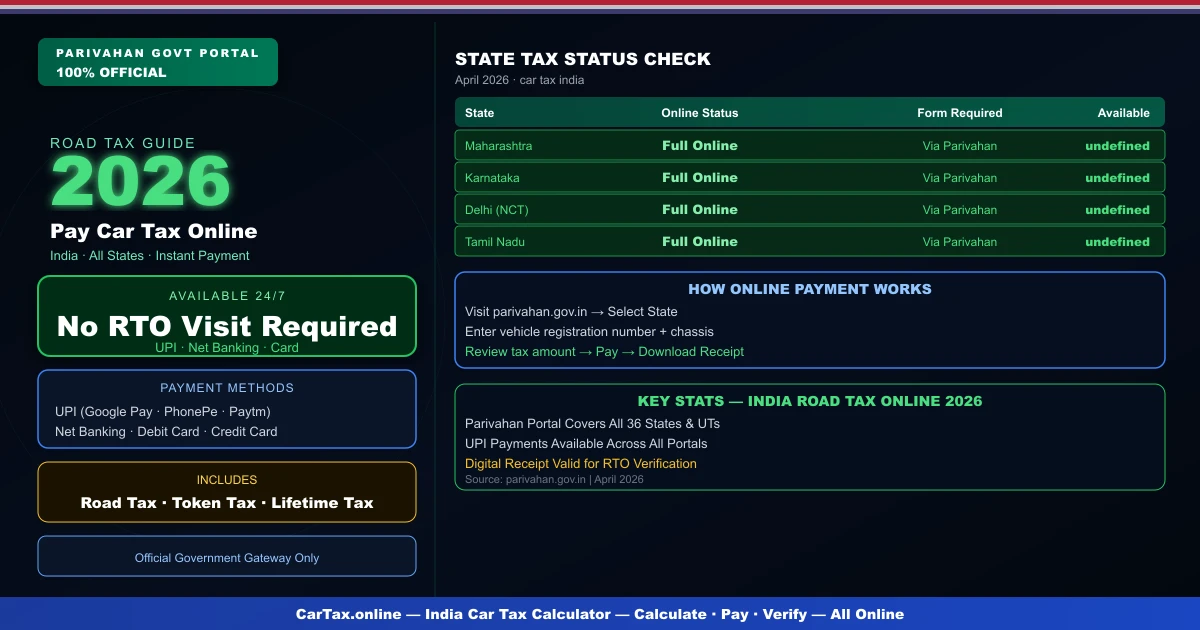
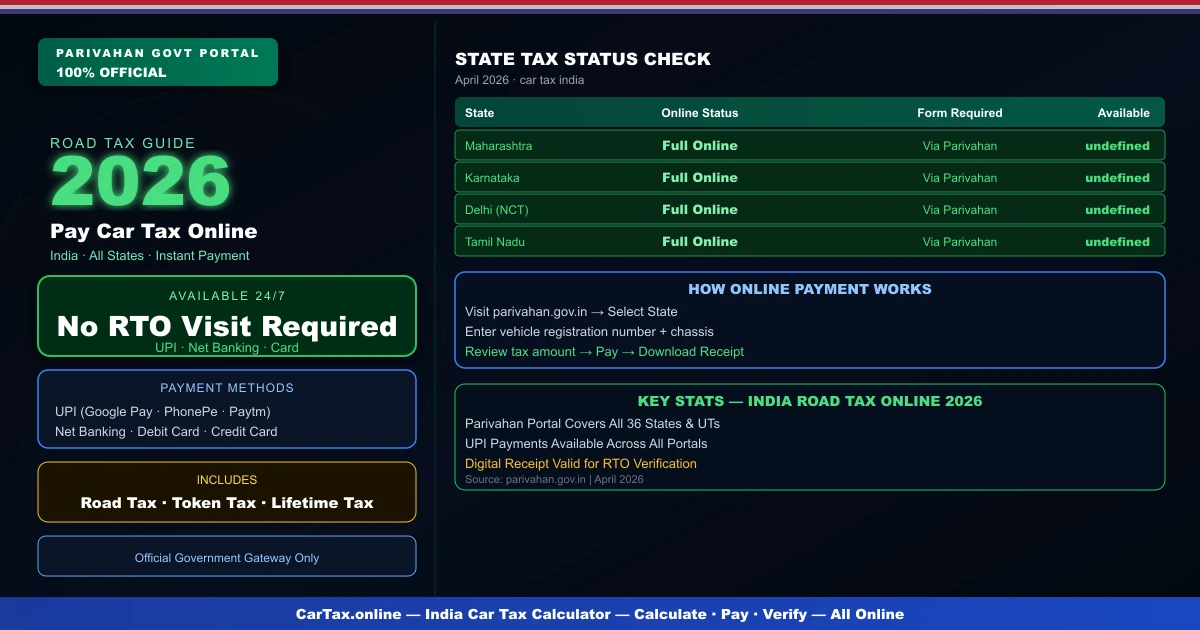
If you own a car in India, paying road tax online has become the default way to handle your vehicle registration obligations. In April 2026, the Parivahan portal run by the Ministry of Road Transport and Highways covers services across all 36 states and union territories, making it possible to pay car tax from your phone without visiting an RTO.
Road tax is mandatory under the Motor Vehicles Act, 1988. Every car owner must pay road tax to their state transport department — either as a one-time lifetime payment or as annual renewals depending on the state and vehicle category. The good news is that the digital infrastructure has improved significantly, and most states now process online payments within minutes.
Step-by-Step: Pay Car Tax Online in 2026
Visit parivahan.gov.in and select your state from the dropdown menu at the top of the page. Navigate to vehicle-related services and choose the road tax payment option. You will need your vehicle registration number, chassis number (VIN), and engine number — all available on your Registration Certificate (RC book).
Enter your details exactly as they appear on the RC. A wrong digit in the chassis number causes payment mismatches that take weeks to resolve. Select your payment category: new vehicle road tax, registration renewal, or ownership transfer road tax. The system will display the applicable amount based on your vehicle's details. Related: Car Depreciation Income Tax India 2026 — Section 32 Rates | Car Import Tax India 2026 — Duty Rates & Total Cost Guide | Car Sales Tax India 2026 — GST on New & Used Cars | Car Tax Calculator India 2026 — Free Instant Estimate.
Review the tax breakdown carefully — you may see a compensatory cess or green tax added for older vehicles. Then proceed to the payment gateway where you can use net banking, debit card, credit card, or UPI. After successful payment, download the receipt as a PDF immediately — this is your proof of tax payment.
Documents Needed to Pay Car Tax Online
Before starting your online payment, keep these ready: your Registration Certificate (RC book), Aadhaar card, PAN card, and vehicle insurance certificate. For new vehicles, have the dealer invoice and price certificate available. If paying road tax for a used car transfer, you will also need the No Objection Certificate (NOC) from the previous registering authority and Form 29/30.
Which States Support Online Car Tax Payment?
Almost all Indian states now support full or partial online car tax payment through the Parivahan portal. Maharashtra, Karnataka, Delhi (NCT), Tamil Nadu, Gujarat, Kerala, Rajasthan, and Uttar Pradesh all offer online payment options. Some states may require an in-person visit for first-time lifetime tax payment, but annual renewals are almost universally available online.
Benefits of Paying Car Tax Online
The shift to digital car tax payment eliminates the need to take time off work for an RTO visit. Receipts arrive instantly, and your payment history is stored digitally — making it easier to produce proof of tax payment during vehicle transfers or insurance renewals. Online records are also harder to dispute than physical receipts that can go missing from RTO files.
UPI payments have been a particularly significant development. In smaller towns and semi-urban areas where bank branches are limited, UPI enables car owners to pay road tax without a traditional bank account, bringing digital payment access to millions of first-time internet users.
Common Mistakes When Paying Car Tax Online
Several errors can derail your online car tax payment. Entering the wrong chassis number is the most common — always cross-check against your RC. Paying in the wrong state happens when you have re-registered your car in a new state but use the old state's portal. Using unofficial third-party portals is risky — always stick to the official Parivahan portal or your state transport department's website.
Frequently Asked Questions
Which portal should I use to pay car tax online in India?
For the most accurate information about pay car tax online, visit the official Parivahan portal or your nearest Regional Transport Office. Tax rules, rates, and exemptions are updated periodically by government authorities, so always verify current information before making financial decisions.
Can I pay car tax online for someone else's vehicle?
For the most accurate information about pay car tax online, visit the official Parivahan portal or your nearest Regional Transport Office. Tax rules, rates, and exemptions are updated periodically by government authorities, so always verify current information before making financial decisions.
What happens if I don't pay car tax on time?
For the most accurate information about pay car tax online, visit the official Parivahan portal or your nearest Regional Transport Office. Tax rules, rates, and exemptions are updated periodically by government authorities, so always verify current information before making financial decisions.
Is there a refund if I sell my car before the tax period ends?
For the most accurate information about pay car tax online, visit the official Parivahan portal or your nearest Regional Transport Office. Tax rules, rates, and exemptions are updated periodically by government authorities, so always verify current information before making financial decisions.
Should I pay lifetime road tax or annual tax — which is better?
For the most accurate information about pay car tax online, visit the official Parivahan portal or your nearest Regional Transport Office. Tax rules, rates, and exemptions are updated periodically by government authorities, so always verify current information before making financial decisions.
Conclusion
Paying car tax online in India is now faster, simpler, and more accessible than ever before. With the Parivahan portal covering all states and UTs, car owners can handle their road tax obligations from anywhere using a smartphone. Understanding your state-specific rates and having the right documents ready will ensure a smooth, error-free payment experience every time.
Frequently Asked Questions
Q: What is the current road tax rate for cars in India 2026?
Road tax rates in India vary by state and vehicle category. For new cars, GST is charged at 5% for EVs, 18% for hybrids under 1,200cc, and up to 28% for petrol/diesel SUVs. State road tax is charged separately and varies from Rs3,000-15,000 annually depending on the state's slab system. Check your specific state's RTO website for current rates.
Q: How do I calculate my car road tax online in India?
You can calculate your car road tax using online calculators available on state RTO portals and CarTax.online. The calculation considers your vehicle's ex-showroom price, fuel type, engine capacity, and state of registration. Road tax is payable annually or for the vehicle's lifetime depending on your state's rules.
Q: Is GST included in the road tax for new cars in India?
No — GST and road tax are separate charges. GST is a central tax charged by the vehicle manufacturer at the time of purchase. State road tax is a separate annual or one-time charge levied by your state's transport department. Both apply at the time of first registration, and annual road tax continues for subsequent years.
Q: Do electric vehicles get tax benefits in India 2026?
Yes — electric vehicles in India qualify for a reduced GST rate of 5% (down from 28% for petrol cars). Under FAME-III subsidies, EVs may also qualify for additional state-level incentives, reduced road tax, and free registration in many states. The exact benefits vary by state.
Q: What happens if I don't pay my car road tax on time?
If you don't pay road tax, your vehicle's registration can be flagged in the Vahan database, preventing renewal of fitness certificates and creating legal liability during police checks. Penalties range from Rs200-500 per day of default in most states. Road tax is a legal requirement under the Motor Vehicles Act.