Car Sales Tax in India — How It Works in 2026
Car sales tax in India primarily means GST — the Goods and Services Tax that replaced a patchwork of central and state taxes in 2017. In April 2026, GST is the single most significant tax component when buying a new car, and it works differently for new versus used vehicles. Understanding how GST applies to car sales helps you decode dealer quotes and negotiate more effectively.
GST Rates for New Cars — By Vehicle Category
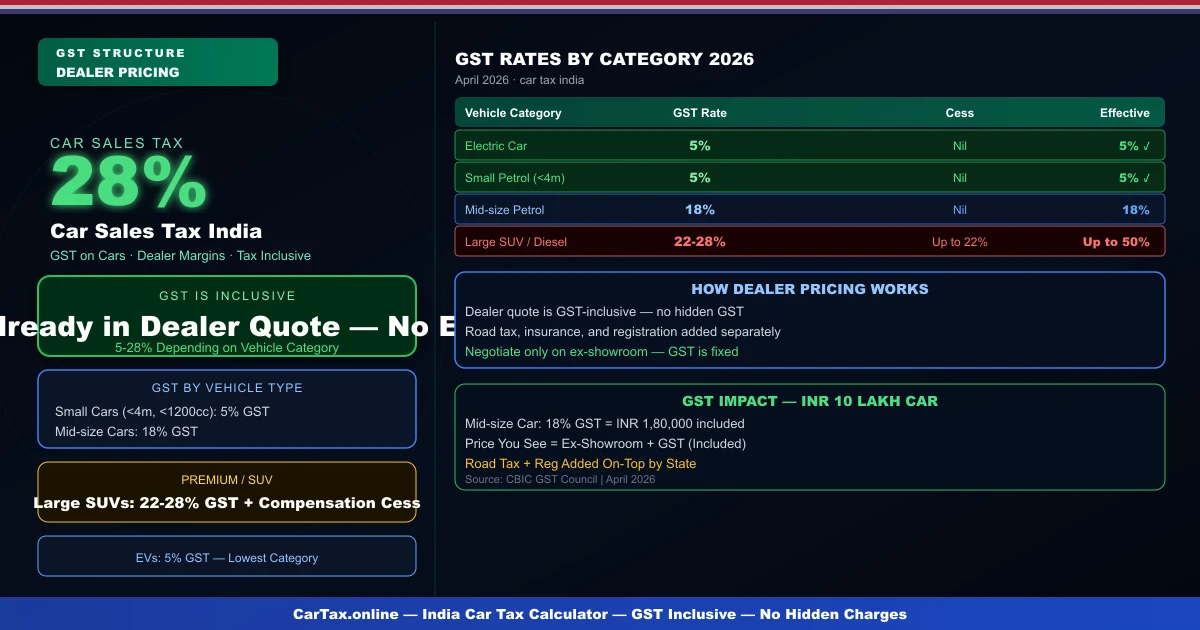
GST on new cars is always included in the ex-showroom price quoted by manufacturers and dealers — it is not an additional charge on top. The rate depends on the vehicle's size, engine capacity, and fuel type.
Small cars — petrol vehicles under 4 metres in length with engine capacity under 1,200cc — attract the lowest GST rate at just 5%. This is the most tax-efficient vehicle category. Mid-size cars — most sedans and SUVs with engine capacity between 1,200cc and 1,500cc — attract 18% GST. Large SUVs and diesel vehicles with engine capacity above 1,500cc attract 22-28% GST plus a Compensation Cess of up to 22% for the largest and most premium vehicles.
GST on Used Car Sales — Dealer vs Private Sale
For used car sales, GST treatment differs significantly between dealer transactions and private sales. When you buy a used car from a registered dealer, GST is charged on the dealer's margin — the difference between the purchase price and the sale price. This is called margin-based taxation and keeps GST on used cars relatively low since dealers usually sell below the original price.
Private used car sales between individuals do not attract GST at all. However, they do attract TDS (Tax Deducted at Source) at 1% of the sale price if the transaction exceeds INR 50,000, under Section 194Q of the Income Tax Act. This TDS is deducted by the buyer and deposited with the Income Tax Department.
How Dealer Pricing Works — GST Inclusive
One of the most common misconceptions is that GST can be negotiated away from the dealer quote. It cannot. GST is built into the ex-showroom price set by the manufacturer and is non-negotiable. What you can negotiate is the dealer discount applied to the ex-showroom price — which reduces the GST base since GST is calculated on the discounted price.
When negotiating with a dealer, always discuss the "ex-showroom price after discount" rather than the "GST amount." A INR 50,000 dealer discount on an INR 10 lakh car saves INR 9,000 in GST (at 18%) in addition to the INR 50,000 reduction — making the effective saving greater than the discount figure alone.
Compensation Cess on Premium Vehicles
Beyond GST, certain vehicle categories attract a Compensation Cess levied to compensate state governments for any loss of revenue during the GST transition. This cess applies to large SUVs, luxury sedans, and high-end diesel vehicles. The cess rates can be significant — up to 22% for the most premium SUVs — and are added on top of the base GST rate.
Electric vehicles are exempt from Compensation Cess, making them even more competitive on price for buyers of premium EVs. A INR 50 lakh electric car saves not just the 22% cess but also the 28% GST rate (paying only 5% GST) compared to an equivalent diesel SUV.
Car Sales Tax and GST on Trade-Ins
If you trade in your old car when buying a new one, the GST treatment can get complex. The dealer's exchange value for your old car is considered separately from the new car purchase. GST is charged on the new car's selling price (after deducting the exchange value), which can reduce the effective GST burden if your trade-in has a significant value.
Frequently Asked Questions
What is the current GST rate on new cars in India?
For the most accurate information about car sales tax india, visit the official Parivahan portal or your nearest Regional Transport Office. Tax rules, rates, and exemptions are updated periodically by government authorities, so always verify current information before making financial decisions.
How is GST calculated on used car sales by dealers?
For the most accurate information about car sales tax india, visit the official Parivahan portal or your nearest Regional Transport Office. Tax rules, rates, and exemptions are updated periodically by government authorities, so always verify current information before making financial decisions.
Do private used car sales attract GST in India?
For the most accurate information about car sales tax india, visit the official Parivahan portal or your nearest Regional Transport Office. Tax rules, rates, and exemptions are updated periodically by government authorities, so always verify current information before making financial decisions.
What is Compensation Cess on cars and SUVs in India?
For the most accurate information about car sales tax india, visit the official Parivahan portal or your nearest Regional Transport Office. Tax rules, rates, and exemptions are updated periodically by government authorities, so always verify current information before making financial decisions.
Can I negotiate GST when buying a new car from a dealer?
For the most accurate information about car sales tax india, visit the official Parivahan portal or your nearest Regional Transport Office. Tax rules, rates, and exemptions are updated periodically by government authorities, so always verify current information before making financial decisions.
Conclusion
Car sales tax in India — primarily through GST — significantly affects what you pay for a new vehicle. Understanding that GST is built into the ex-showroom price, negotiating on the post-discount price, and knowing the margin-based GST treatment for used cars from dealers will give you a clearer picture of the actual tax burden and help you negotiate more effectively at the dealership.
Frequently Asked Questions
Q: What is the current road tax rate for cars in India 2026?
Road tax rates in India vary by state and vehicle category. For new cars, GST is charged at 5% for EVs, 18% for hybrids under 1,200cc, and up to 28% for petrol/diesel SUVs. State road tax is charged separately and varies from Rs3,000-15,000 annually depending on the state's slab system. Check your specific state's RTO website for current rates.
Q: How do I calculate my car road tax online in India?
You can calculate your car road tax using online calculators available on state RTO portals and CarTax.online. The calculation considers your vehicle's ex-showroom price, fuel type, engine capacity, and state of registration. Road tax is payable annually or for the vehicle's lifetime depending on your state's rules.
Q: Is GST included in the road tax for new cars in India?
No — GST and road tax are separate charges. GST is a central tax charged by the vehicle manufacturer at the time of purchase. State road tax is a separate annual or one-time charge levied by your state's transport department. Both apply at the time of first registration, and annual road tax continues for subsequent years.
Q: Do electric vehicles get tax benefits in India 2026?
Yes — electric vehicles in India qualify for a reduced GST rate of 5% (down from 28% for petrol cars). Under FAME-III subsidies, EVs may also qualify for additional state-level incentives, reduced road tax, and free registration in many states. The exact benefits vary by state.
Q: What happens if I don't pay my car road tax on time?
If you don't pay road tax, your vehicle's registration can be flagged in the Vahan database, preventing renewal of fitness certificates and creating legal liability during police checks. Penalties range from Rs200-500 per day of default in most states. Road tax is a legal requirement under the Motor Vehicles Act.