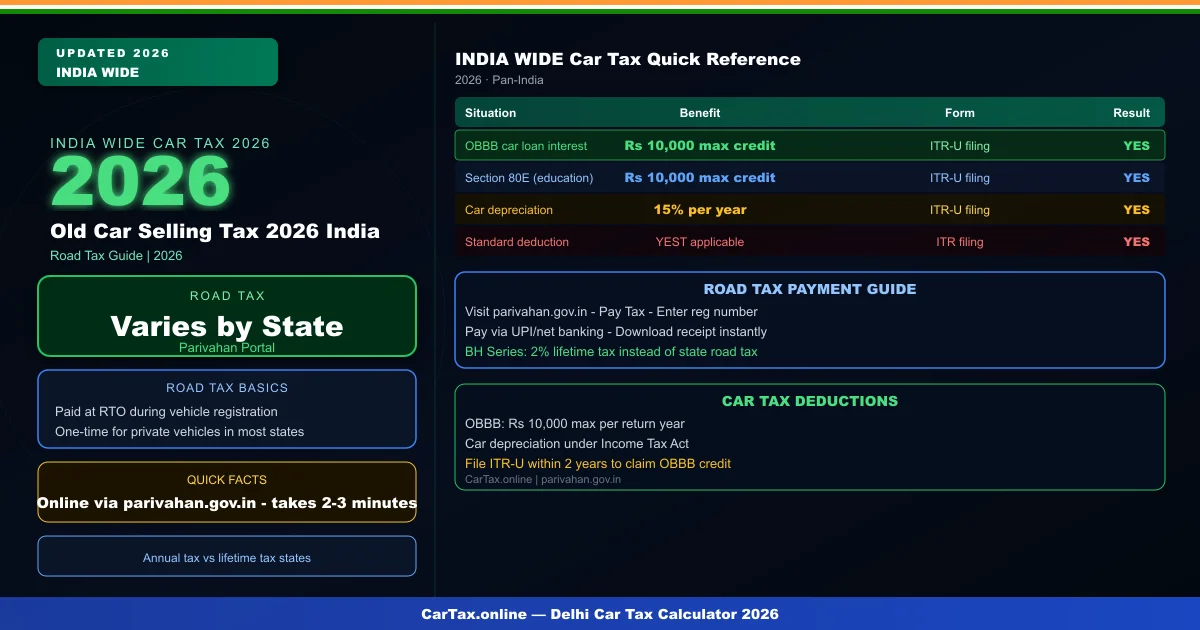
Old car selling tax in India in 2026 involves a framework of TCS deduction rules, capital gains considerations, and transfer registration charges that every vehicle seller should understand before signing a sale agreement. Whether you are selling a decade-old Maruti Alto or a five-year-old luxury SUV, the tax rules apply differently depending on the sale price, the vehicle's history of business use, and the depreciation claimed over ownership years.
The most critical change in recent years is the mandatory 1% TCS on car sales above INR 10 lakh. This rule, introduced under Section 206C(1F), places a compliance burden on the buyer but also creates a tax credit opportunity for the seller. Understanding how the TCS interacts with capital gains rules determines whether you receive a net refund or owe additional tax at the time of filing your return. CarTax.online covers these rules with regular updates as they evolve.
Understanding TCS on Old Car Sales Above INR 10 Lakh
Section 206C(1F) of the Income Tax Act mandates Tax Collection at Source for the sale of motor cars above INR 10 lakh. When you sell your old car for INR 10 lakh or more, the buyer is legally required to deduct 1% of the sale price as TCS and remit it to the government. For example, on a INR 12 lakh car sale, the buyer deducts INR 12,000 as TCS and pays you INR 11,88,000.
The 1% TCS deducted by the buyer is not a tax lost forever — it is advance income tax paid on your behalf. When filing your income tax return, you can claim credit of this TCS amount. If your total tax liability for the year is less than the TCS deducted, you receive a refund. If it exceeds INR 10 lakh, you receive credit that reduces your balance payment.
Capital Gains and Depreciation Recapture on Business-Used Cars
When a car was used for business purposes, depreciation was claimed on it each year, reducing its written-down value on your tax books. On sale, the difference between the sale price and the written-down value is recaptured and taxed. If you sold the car for more than its written-down value, the gain is taxable as a short-term or long-term capital gain. If sold for less, it is a capital loss.
The calculation matters for total tax planning. Claiming maximum depreciation each year minimises your tax during ownership but increases the taxable gain on sale. A balance between depreciation claimed and eventual sale price planning is essential for optimising your total tax position over the vehicle's life.
RTO Transfer Process and Liability Protection
Beyond income tax, old car selling involves a legal transfer process at the Regional Transport Office. The seller must submit Form 29 (notice of transfer) and Form 30 (application for transfer) within 14 days of the sale. Until the transfer is formally registered at the RTO, the seller remains the legal owner of the vehicle and may be held liable for traffic violations, accidents, or unpaid road tax involving the vehicle.
The RTO transfer fee is typically INR 100-500 depending on the state. Some states also require a noc (no objection certificate) clearance from the original RTO if the vehicle is being registered in a different state. Sellers should also verify that all road taxes are paid up to date, as some states withhold transfer until road tax clearance is demonstrated.
Frequently Asked Questions
What taxes apply when selling an old car in India 2026?
When selling an old car in India 2026, two main tax rules apply. First, if the sale price is INR 10 lakh or more, the buyer must deduct 1% TCS (Tax Collected at Source) under Section 206C(1F). Second, if the car was used for business purposes and depreciation was claimed on it, capital gains tax may apply on the difference between sale price and written-down value. Personal-use car sales below INR 50 lakh generally attract no income tax.
Do I pay capital gains tax on selling my old personal-use car?
Generally no — personal-use cars are not treated as capital assets under Section 2(14) of the Income Tax Act, meaning capital gains tax does not apply to their sale. However, if the car was used for business, was registered in the name of a business entity, or was let out for hire, capital gains rules may apply and the gain may be taxable as business income or capital gain.
What is the TCS rate when selling a car above INR 10 lakh?
The TCS rate on car sales above INR 10 lakh is 1% under Section 206C(1F) of the Income Tax Act. The buyer deducts this 1% from the purchase price and remits it to the government as advance income tax from the seller. The seller receives a Form 27D TCS certificate from the buyer and can claim credit of this amount when filing their income tax return.
How do I calculate my tax liability when selling an old car with business use?
For a business-used car, calculate your tax liability as follows: determine the written-down value (original cost minus accumulated depreciation), subtract the written-down value from the sale price to get the capital gain or loss, and if the gain is short-term, add it to your business income for the year. If the car was held for more than 24 months, it qualifies as long-term and is taxed at 20% with indexation benefits. A tax professional can help calculate this accurately.
What transfer and registration charges apply when selling an old car?
When selling an old car, both the seller and buyer need to execute a proper Form 29 (notice of transfer) and Form 30 (application for transfer) at the RTO. Transfer fee is approximately INR 100-500 depending on the state. The seller should ensure the vehicle is formally transferred within 14 days of sale to avoid liability for any traffic violations, accidents, or road tax arrears involving the vehicle.
Official Resources
For TCS provisions, capital gains rules, and ITR disclosure for car sales, refer to the Income Tax Department portal. For RTO transfer procedures, visit the Parivahan portal for your state's specific transfer forms and fee schedule.