What Determines New Car Tax in India — April 2026
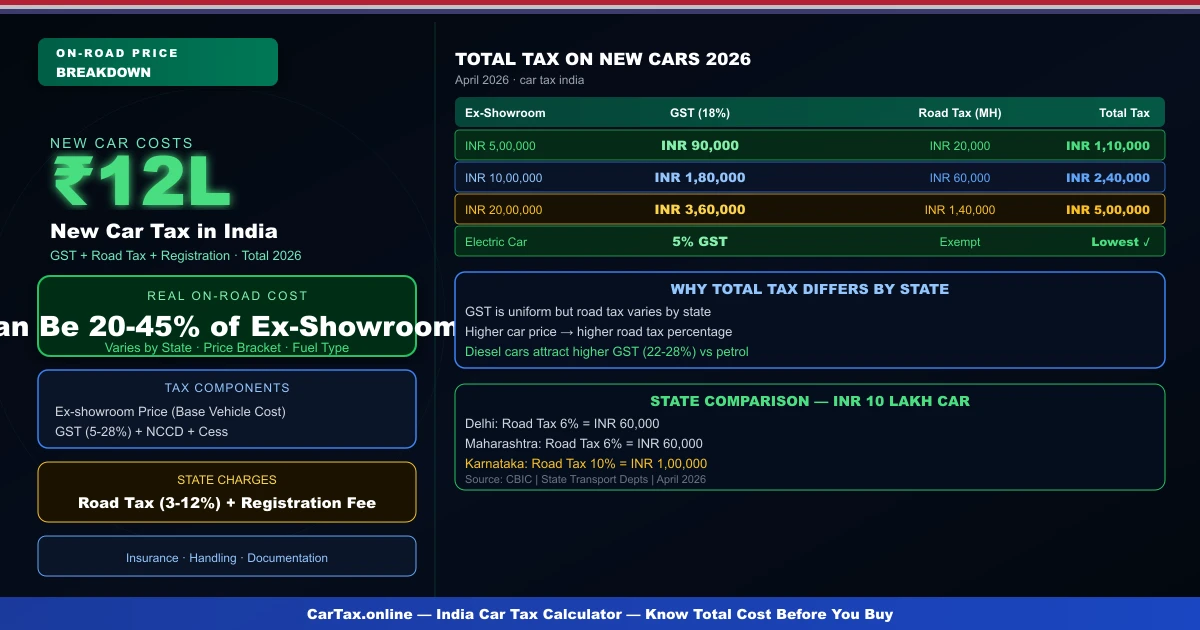
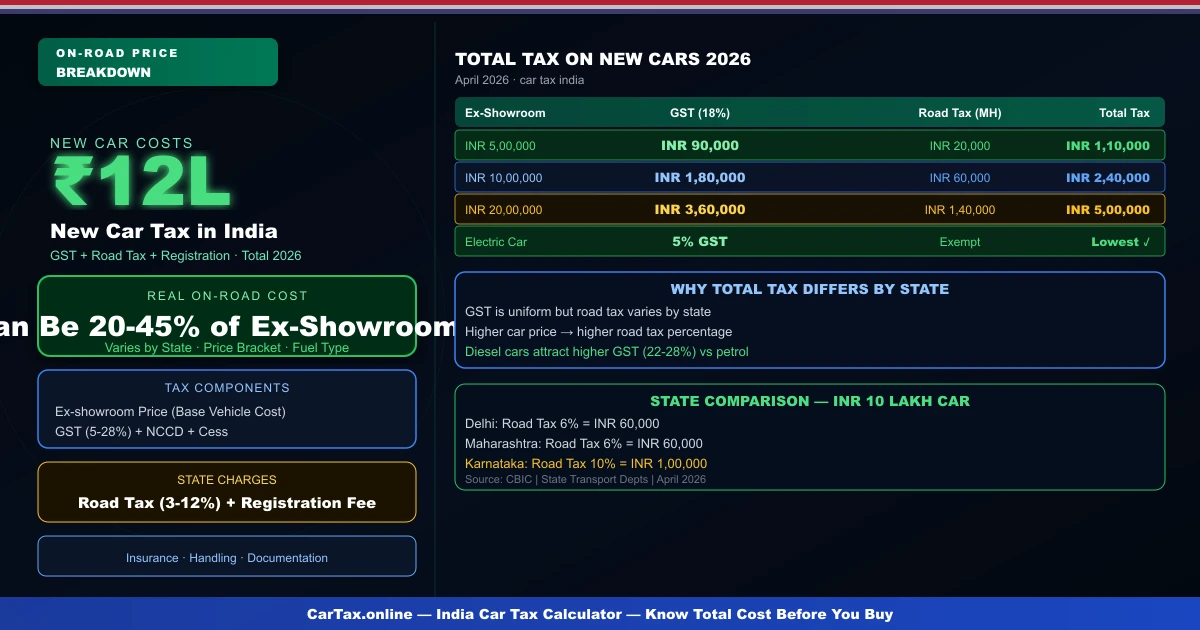
When you walk into a car showroom in India and see an ex-showroom price, that is only the beginning of what you will actually pay. In April 2026, the total cost of a new car is made up of the ex-showroom price plus multiple layers of government taxes that together can add INR 2-5 lakh to a mid-size car and INR 20-60 lakh to a premium vehicle.
The key to understanding new car tax in India is knowing that different taxes apply at different government levels — the central government charges GST and cess, while state governments charge road tax and registration fees.
GST on New Cars — The Central Levy
The Goods and Services Tax replaced multiple indirect taxes in 2017 and is now the primary central tax on new cars. GST rates on new cars in 2026 vary by category: small petrol cars under 4 metres with engine under 1,200cc attract just 5% GST — the lowest automobile rate. Most mid-size petrol cars attract 18% GST. Large SUVs, luxury sedans, and diesel vehicles above 1,500cc attract 22-28% GST.
An additional Compensation Cess is levied on top of GST for SUVs and large vehicles to compensate states for any GST transition revenue loss. This cess can add another 1-22% depending on the vehicle category and engine size.
Road Tax on New Cars — State Government Levy
Every state government levies road tax on new car registrations under the Motor Vehicles Act. Road tax is calculated on the ex-showroom price and is typically paid as a one-time lifetime payment or as annual instalments.
Road tax rates vary significantly between states. A mid-size INR 10 lakh car attracts approximately INR 60,000 road tax in Maharashtra and Delhi (6%), but approximately INR 1,00,000 in Karnataka (10%) and INR 3,00,000 for premium vehicles with 15% slab rates. This is why the same car costs different amounts to register in different states.
Registration Fees and Other Charges
New car registration fees range from INR 200 to INR 1,500 depending on the state. This is a relatively small component compared to road tax and GST but still adds to the final bill. Fastag charges (approximately INR 100-500), number plate charges, and optional extended warranty packages add another INR 5,000-20,000 to the on-road price.
Insurance — Compulsory and Optional Coverage
Motor insurance is mandatory for all vehicles in India. Third-party insurance for a new mid-size car costs approximately INR 2,000-3,000 per year, while comprehensive insurance with own-damage cover costs INR 30,000-60,000 for the first year (and reduces in subsequent years). Insurance is not technically a tax but is a compulsory cost that dealers typically bundle into the on-road price quote.
Total Cost Example — INR 10 Lakh New Car
For a mid-size petrol car priced at INR 10 lakh ex-showroom in Maharashtra: ex-showroom price INR 10,00,000 + GST at 18% INR 1,80,000 + road tax at 6% INR 60,000 + registration fee INR 1,000 + insurance (comprehensive, first year) INR 40,000 = on-road price approximately INR 12,81,000. The total tax on this INR 10 lakh car is approximately INR 2.41 lakh — nearly 25% of the ex-showroom price.
Electric Cars — Significantly Lower Tax
Electric cars enjoy dramatically lower new car tax in India. GST on EVs is just 5% (compared to 18-28% for petrol/diesel cars), and most states waive or substantially reduce road tax for electric vehicles. For a INR 10 lakh electric car in Maharashtra, the total tax would be approximately INR 50,000-80,000 compared to INR 2.41 lakh for the equivalent petrol car — a saving of INR 1.6-1.9 lakh on the vehicle itself, before factoring in lower fuel and maintenance costs.
Frequently Asked Questions
How much tax do I pay on a new car in India in 2026?
For the most accurate information about new car tax in india, visit the official Parivahan portal or your nearest Regional Transport Office. Tax rules, rates, and exemptions are updated periodically by government authorities, so always verify current information before making financial decisions.
What is the GST rate on new cars in India?
For the most accurate information about new car tax in india, visit the official Parivahan portal or your nearest Regional Transport Office. Tax rules, rates, and exemptions are updated periodically by government authorities, so always verify current information before making financial decisions.
Which state has the lowest road tax for new cars?
For the most accurate information about new car tax in india, visit the official Parivahan portal or your nearest Regional Transport Office. Tax rules, rates, and exemptions are updated periodically by government authorities, so always verify current information before making financial decisions.
Are electric cars taxed lower than petrol cars in India?
For the most accurate information about new car tax in india, visit the official Parivahan portal or your nearest Regional Transport Office. Tax rules, rates, and exemptions are updated periodically by government authorities, so always verify current information before making financial decisions.
What is the total cost difference between a INR 10 lakh petrol car and electric car?
For the most accurate information about new car tax in india, visit the official Parivahan portal or your nearest Regional Transport Office. Tax rules, rates, and exemptions are updated periodically by government authorities, so always verify current information before making financial decisions.
Conclusion
New car tax in India adds a significant layer to the ex-showroom price. Use our car tax calculator to get an exact breakdown for your vehicle, state, and purchase price. Electric vehicles offer compelling total cost advantages when you factor in the GST savings and road tax exemptions available across most states in 2026.
Frequently Asked Questions
Q: What is the current road tax rate for cars in India 2026?
Road tax rates in India vary by state and vehicle category. For new cars, GST is charged at 5% for EVs, 18% for hybrids under 1,200cc, and up to 28% for petrol/diesel SUVs. State road tax is charged separately and varies from Rs3,000-15,000 annually depending on the state's slab system. Check your specific state's RTO website for current rates.
Q: How do I calculate my car road tax online in India?
You can calculate your car road tax using online calculators available on state RTO portals and CarTax.online. The calculation considers your vehicle's ex-showroom price, fuel type, engine capacity, and state of registration. Road tax is payable annually or for the vehicle's lifetime depending on your state's rules.
Q: Is GST included in the road tax for new cars in India?
No — GST and road tax are separate charges. GST is a central tax charged by the vehicle manufacturer at the time of purchase. State road tax is a separate annual or one-time charge levied by your state's transport department. Both apply at the time of first registration, and annual road tax continues for subsequent years.
Q: Do electric vehicles get tax benefits in India 2026?
Yes — electric vehicles in India qualify for a reduced GST rate of 5% (down from 28% for petrol cars). Under FAME-III subsidies, EVs may also qualify for additional state-level incentives, reduced road tax, and free registration in many states. The exact benefits vary by state.
Q: What happens if I don't pay my car road tax on time?
If you don't pay road tax, your vehicle's registration can be flagged in the Vahan database, preventing renewal of fitness certificates and creating legal liability during police checks. Penalties range from Rs200-500 per day of default in most states. Road tax is a legal requirement under the Motor Vehicles Act.