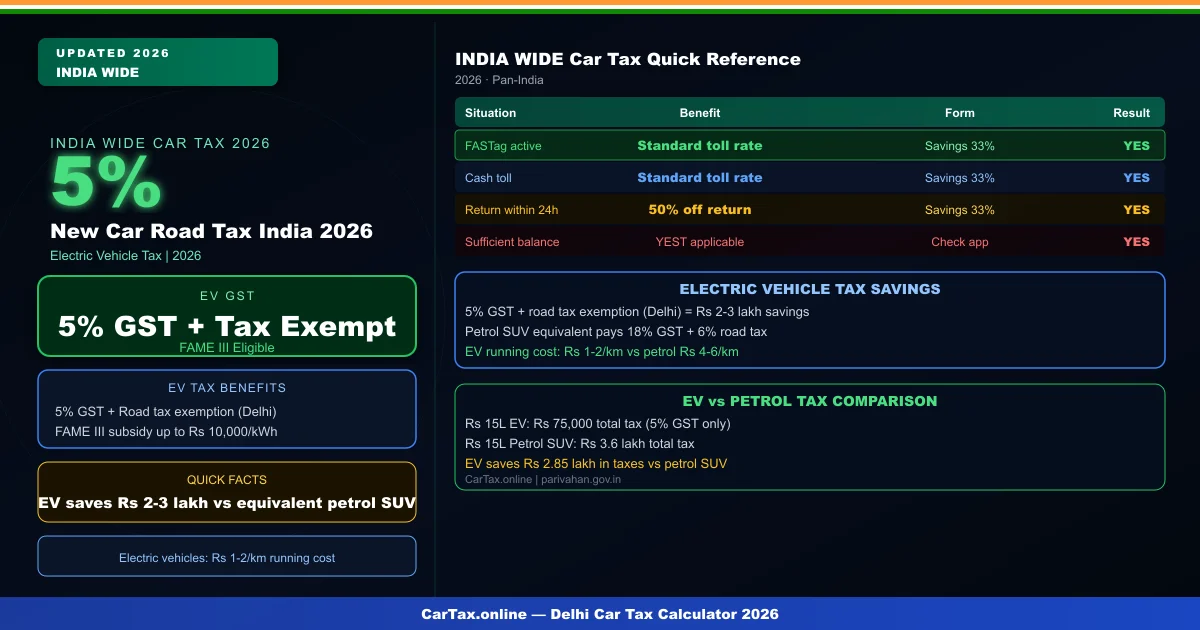
New car road tax in India in 2026 involves more layers than ever before. With GST 2.0 effective from April 2026, revised state road tax slabs, updated RTO fee structures, and new compensation cess rates on large SUVs, understanding the total on-road cost of a new car requires a comprehensive breakdown. This guide covers every tax component so you can budget accurately and compare states before making your purchase decision.
The total tax on a new car in India in 2026 consists of GST (the central component), state road tax (the regional component), and administrative fees (registration and Fastag). These three components together typically add 18-45% to the ex-showroom price of a vehicle, depending on the car category and state of registration. CarTax.online tracks GST 2.0 changes and state road tax updates throughout the year so you can calculate your exact on-road price.
GST 2.0 — Updated GST Rates on New Cars from April 2026
GST 2.0 introduced revised GST rates on vehicles effective April 2026. Electric vehicles remain the most favourably taxed category, attracting a flat 5% GST with no compensation cess. Strong hybrid vehicles under 1,200cc engine capacity attract 12% GST. Most petrol and diesel cars in the entry-level and mid-size segments attract 18% GST. Large petrol/diesel SUVs and luxury sedans attract 22-28% GST plus a compensation cess that can push the total central tax to 35-50%.
The compensation cess on large SUVs and luxury vehicles was introduced under the GST Act to compensate states for revenue losses during the GST transition. This cess is levied on the vehicle's assessable value and is payable by the manufacturer, but is passed on to consumers through higher ex-showroom prices.
State Road Tax Slabs for New Cars in 2026
State road tax on new cars is calculated as a percentage of the vehicle's ex-showroom price. The system varies significantly between states — some states like Delhi charge one-time lifetime tax, while others like Karnataka and Maharashtra charge annual tax. The table below summarises the state road tax positions for private petrol cars as of April 2026.
Delhi charges 3-7% one-time lifetime tax (higher-value cars pay a higher percentage). Karnataka charges 5-15% annual tax (slabs increase with vehicle price). Maharashtra charges 4-10% as either lifetime or annual depending on vehicle age. Gujarat charges 3-9% one-time. Rajasthan charges 3-8% one-time. Tamil Nadu charges 4-12% annual. West Bengal charges 5-10% annual.
Calculating Total On-Road Price for Your New Car
To calculate the total on-road price of a new car, start with the ex-showroom price and add GST at the applicable rate. Then add state road tax (lifetime or annual as applicable), registration fees, Fastag charges, and any optional accessories or extended warranty. Insurance is a separate cost typically financed with the vehicle but not counted as a tax.
For example, a INR 15 lakh mid-size SUV in Maharashtra attracts approximately INR 2.70 lakh in GST (18%), INR 90,000 in state road tax (6% one-time), and INR 1,500 in combined fees — a total tax of approximately INR 3.61 lakh, making the pre-dealer-margin on-road price approximately INR 18.61 lakh. Always use the CarTax.online calculator for your specific state and vehicle configuration.
Frequently Asked Questions
What is the GST rate on new cars in India 2026?
Under GST 2.0 effective April 2026, new car GST rates are: 5% for electric vehicles (EVs) with no compensation cess, 12% for strong hybrid vehicles under 1,200cc engine capacity, 18% for most petrol and diesel cars including mid-size and compact SUVs, and 22-28% for large SUVs, luxury sedans, and diesel vehicles above 1,500cc with additional compensation cess.
How much is total road tax on a new car in India 2026?
Total road tax on a new car in India 2026 equals GST plus state road tax plus registration fees. For a INR 10 lakh petrol car in Delhi, this means approximately INR 1.80 lakh in GST (18%), INR 60,000 in lifetime road tax (6%), and INR 1,000 in RTO fees — totaling approximately INR 2.41 lakh or 24.1% of ex-showroom price in total tax.
Which state has the lowest total road tax for new cars?
Gujarat, Rajasthan, and Delhi have the lowest total road tax burden for new private cars in 2026. Gujarat charges approximately 3-9% state road tax, Delhi charges 3-7% as a one-time lifetime payment, and Rajasthan charges 3-8%. States like Karnataka (5-15%), Maharashtra (4-10%), and Tamil Nadu (4-12%) have higher road tax rates for comparable vehicles.
What are the RTO fees for new car registration in India 2026?
RTO registration fees for new cars in India 2026 range from INR 200-1,500 depending on the state and vehicle category. Some states charge based on the vehicle's ex-showroom price, while others use a fixed fee. In addition, Fastag charges of INR 100-500 apply, and some states require hypothecation fee if the car is financed. These fees are separate from road tax and are payable at the time of first registration.
Does GST 2.0 affect on-road prices for new cars in April 2026?
GST 2.0 reforms effective April 2026 revised GST rates on certain vehicle categories. Small petrol cars under 1,200cc saw a rate reduction from 18% to 5% in some categories, directly reducing on-road prices. However, large SUVs and diesel vehicles above 1,500cc saw increases, with GST plus cess potentially reaching 35-50% of ex-showroom price. Check the CarTax.online calculator for your specific vehicle's post-GST 2.0 on-road cost.
Official Resources
For authoritative GST rates on new vehicles, refer to the GST portal. For state road tax rates, registration procedures, and fee structures, refer to your state transport department's website or the Parivahan portal, which provides online registration and tax payment services for most states.