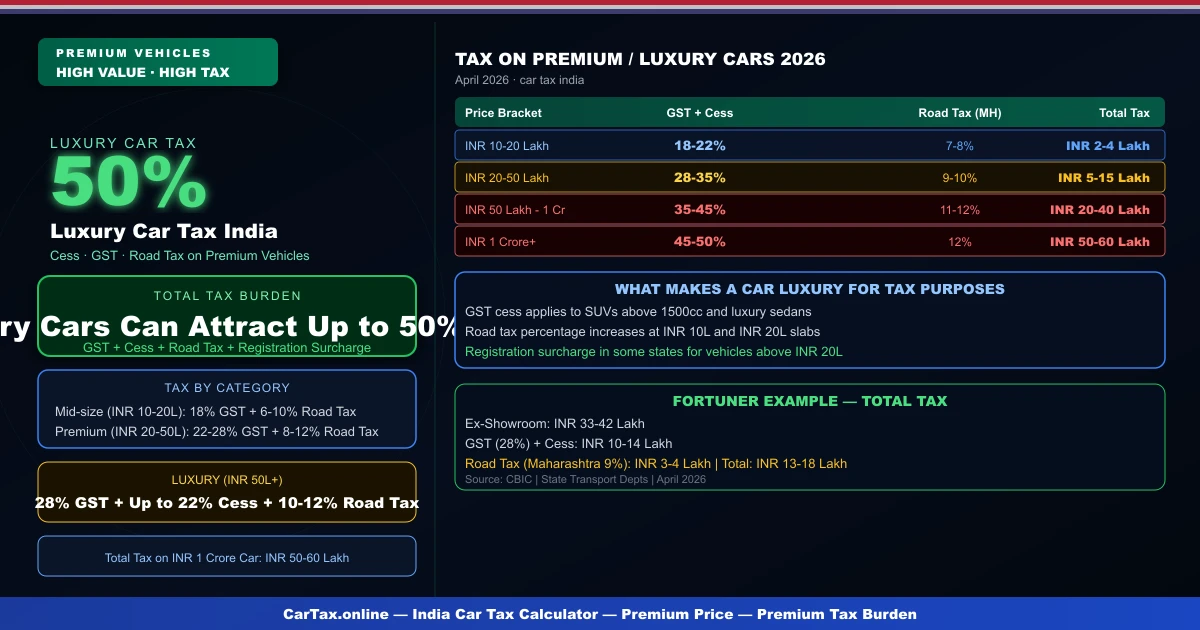
luxury car tax india
Luxury car tax India 2026 — GST cess, road tax, and total cost on premium vehicles.

Luxury Car Tax in India — How High Does It Go in 2026

Buying a luxury car in India in 2026 means navigating one of the most complex and layered tax structures in the automobile industry globally. Luxury vehicles — typically defined as SUVs, premium sedans, and vehicles priced above INR 20 lakh ex-showroom — attract GST at the highest slab, a Compensation Cess, higher road tax percentages, and in some states, registration surcharges.

For a INR 50 lakh premium SUV, the total tax burden can exceed INR 25 lakh — meaning you pay more in taxes than the ex-showroom price of many mid-size cars. Understanding where every rupee goes helps luxury car buyers plan their budgets accurately.

GST and Compensation Cess on Luxury Vehicles

Luxury SUVs and premium sedans attract GST at 28% — the highest automobile rate in India. Beyond this, a Compensation Cess applies to large vehicles, determined by the vehicle's length, engine capacity, and retail price. For the largest and most premium SUVs, cess can reach 22% in addition to the 28% GST.

On an INR 50 lakh luxury SUV, this means GST of INR 14 lakh plus Compensation Cess of up to INR 11 lakh — a combined central tax of INR 25 lakh before a single rupee of state road tax is added. The effective central tax rate on such a vehicle is 50% of the ex-showroom price.

Road Tax on Luxury Cars by State

State road tax on luxury vehicles uses higher percentage slabs than mid-size cars. In Maharashtra, a INR 50 lakh vehicle falls into the 10% road tax bracket, adding another INR 5 lakh to the registration cost. In Karnataka, the 15% slab for premium vehicles adds INR 7.5 lakh. In Delhi, the road tax on luxury vehicles reaches 12%, adding INR 6 lakh.

The total tax on a INR 50 lakh luxury SUV in Maharashtra therefore reaches approximately INR 30 lakh — 60% of the ex-showroom price — before insurance, accessories, and dealer handling charges are added.

Toyota Fortuner — Tax Example on a Popular Premium SUV

The Toyota Fortuner, one of India's best-selling premium SUVs, illustrates how luxury car tax adds up. With an ex-showroom price ranging from INR 33 lakh to INR 43 lakh depending on the variant: GST at 28% adds INR 9.2-12 lakh; Compensation Cess adds approximately INR 4-5 lakh; road tax at 10% in Maharashtra adds INR 3.3-4.3 lakh; registration and processing fees add approximately INR 0.2 lakh.

The total tax on a Fortuner ranges from approximately INR 16.7-21.5 lakh — meaning the on-road price is INR 49.7-64.5 lakh for a vehicle whose ex-showroom price is INR 33-43 lakh.

Registration Surcharges in Some States

Some states impose additional registration surcharges on vehicles above certain price thresholds. These surcharges are added to the standard registration fee and vary by state. Delhi, Mumbai, and Bangalore — India's most expensive registration markets — are the most likely to have such surcharges for premium vehicles. Always check the latest state-specific schedule before finalising your purchase budget.

Electric Luxury Cars — A Different Tax Picture

Electric luxury cars enjoy significantly better tax treatment even at the premium end of the market. BMW, Mercedes, and Audi have all launched electric luxury sedans and SUVs in India, and these attract just 5% GST with no Compensation Cess. A INR 50 lakh electric luxury car therefore attracts GST of INR 2.5 lakh compared to INR 14 lakh plus cess for an equivalent petrol/diesel model — a saving of INR 15-20 lakh on the central tax alone.

Road tax exemptions for electric vehicles in most states add further savings, making EVs increasingly competitive even against luxury petrol SUVs when viewed through a total cost of ownership lens.

Frequently Asked Questions

What is the total tax on a luxury car in India in 2026?

For the most accurate information about luxury car tax india, visit the official Parivahan portal or your nearest Regional Transport Office. Tax rules, rates, and exemptions are updated periodically by government authorities, so always verify current information before making financial decisions.

How much cess is charged on premium SUVs and luxury cars?

For the most accurate information about luxury car tax india, visit the official Parivahan portal or your nearest Regional Transport Office. Tax rules, rates, and exemptions are updated periodically by government authorities, so always verify current information before making financial decisions.

What is the total cost of a Toyota Fortuner including all taxes?

For the most accurate information about luxury car tax india, visit the official Parivahan portal or your nearest Regional Transport Office. Tax rules, rates, and exemptions are updated periodically by government authorities, so always verify current information before making financial decisions.

Which state has the highest road tax for luxury cars?

For the most accurate information about luxury car tax india, visit the official Parivahan portal or your nearest Regional Transport Office. Tax rules, rates, and exemptions are updated periodically by government authorities, so always verify current information before making financial decisions.

Are electric luxury cars taxed lower than petrol luxury cars in India?

For the most accurate information about luxury car tax india, visit the official Parivahan portal or your nearest Regional Transport Office. Tax rules, rates, and exemptions are updated periodically by government authorities, so always verify current information before making financial decisions.

Conclusion

Luxury car tax in India in 2026 adds a layer of complexity and cost that significantly affects the true on-road price of premium vehicles. Total tax on a INR 50 lakh luxury SUV can reach INR 25-30 lakh — 50-60% of the ex-showroom price. Electric luxury cars offer dramatically better tax treatment, with savings of INR 15-20 lakh on central taxes alone compared to equivalent petrol/diesel models.

Frequently Asked Questions

Q: What is the current road tax rate for cars in India 2026?
Road tax rates in India vary by state and vehicle category. For new cars, GST is charged at 5% for EVs, 18% for hybrids under 1,200cc, and up to 28% for petrol/diesel SUVs. State road tax is charged separately and varies from Rs3,000-15,000 annually depending on the state's slab system. Check your specific state's RTO website for current rates.

Q: How do I calculate my car road tax online in India?
You can calculate your car road tax using online calculators available on state RTO portals and CarTax.online. The calculation considers your vehicle's ex-showroom price, fuel type, engine capacity, and state of registration. Road tax is payable annually or for the vehicle's lifetime depending on your state's rules.

Q: Is GST included in the road tax for new cars in India?
No — GST and road tax are separate charges. GST is a central tax charged by the vehicle manufacturer at the time of purchase. State road tax is a separate annual or one-time charge levied by your state's transport department. Both apply at the time of first registration, and annual road tax continues for subsequent years.

Q: Do electric vehicles get tax benefits in India 2026?
Yes — electric vehicles in India qualify for a reduced GST rate of 5% (down from 28% for petrol cars). Under FAME-III subsidies, EVs may also qualify for additional state-level incentives, reduced road tax, and free registration in many states. The exact benefits vary by state.

Q: What happens if I don't pay my car road tax on time?
If you don't pay road tax, your vehicle's registration can be flagged in the Vahan database, preventing renewal of fitness certificates and creating legal liability during police checks. Penalties range from Rs200-500 per day of default in most states. Road tax is a legal requirement under the Motor Vehicles Act.