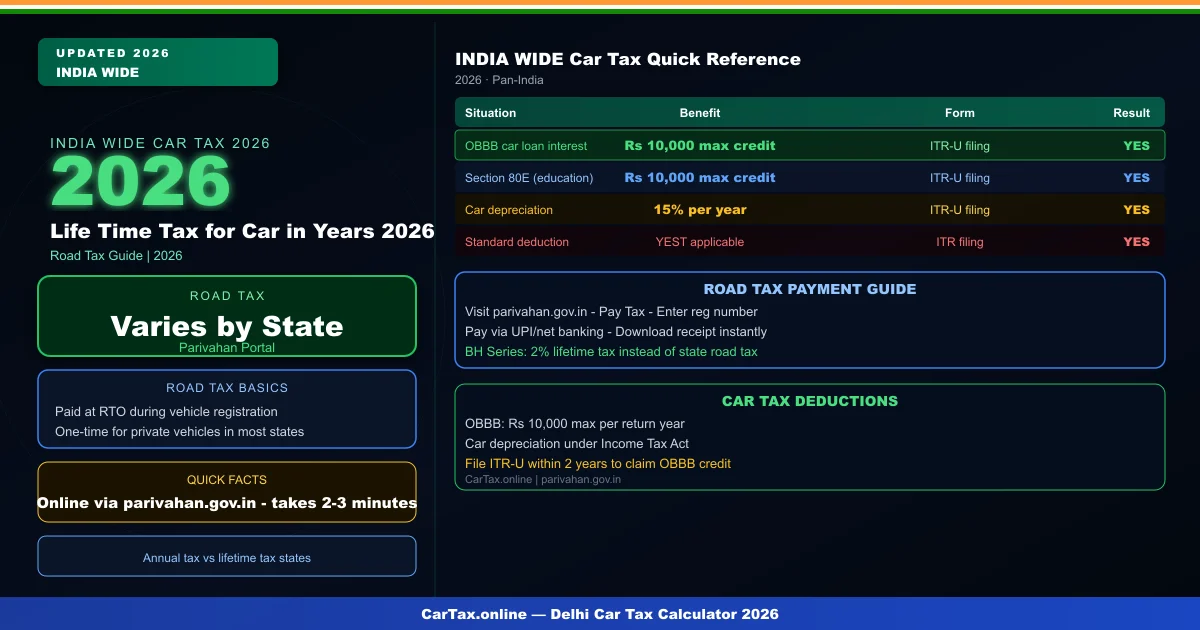
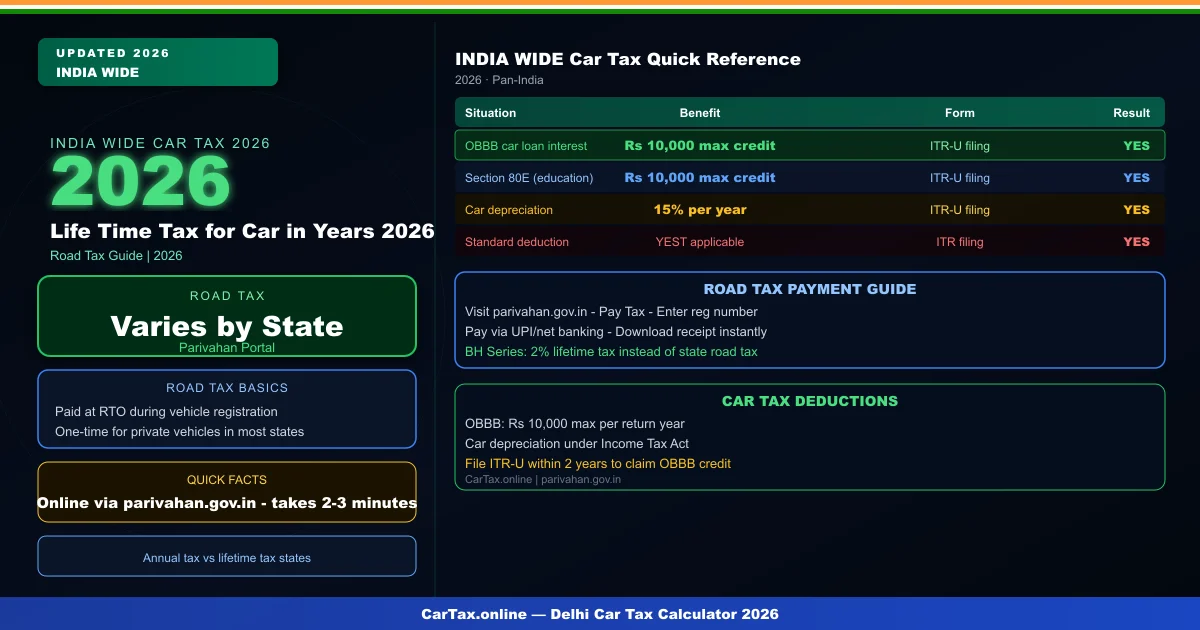
Life Time Tax for Car — How Long Does Road Tax Last in India
One of the most common questions from Indian car buyers is how long car road tax lasts and whether it needs to be renewed annually or is paid once for the lifetime of the vehicle. The answer in India is not uniform — it varies significantly by state. Some states like Delhi and Gujarat charge a one-time lifetime road tax that covers the vehicle for a set number of years (typically 15 years), after which no further road tax is payable. Other states like Maharashtra charge annual road tax that must be renewed every year throughout the vehicle's life.
Understanding your state's road tax system is important because it affects both the upfront cost of purchasing a car and the ongoing annual cost of ownership. A state with lifetime tax may have a higher initial road tax but zero ongoing obligation, while a state with annual tax has a lower initial payment but requires annual renewals and continued expense.
Lifetime Tax States — One-Time Payment System
Delhi operates a lifetime road tax system for private cars. Under the Delhi Motor Vehicles Taxation Act, private cars pay a one-time road tax at the time of first registration. The tax is calculated as a percentage of the vehicle's cost (ex-showroom price) and covers the vehicle for a validity period — currently 15 years for private cars. After the 15-year validity period, the vehicle is exempt from further road tax and the registration is renewed on a lifetime basis without additional road tax payments.
Gujarat similarly operates a lifetime tax system. The Gujarat Motor Vehicles Taxation Act prescribes a one-time tax for private cars valid for 15 years. After 15 years, vehicles are exempt from road tax in Gujarat. The tax rate in Gujarat is relatively moderate compared to many other states, making it one of the more cost-efficient states for car ownership from a road tax perspective.
Karnataka shifted to a modified lifetime tax system several years ago. Under the Karnataka system, road tax for private cars is calculated on a slab basis and covers the vehicle for a validity period (currently around 13 years for most private cars), after which no further road tax is payable. Karnataka's system uses the ex-showroom price as the base for road tax calculation.
Rajasthan, Punjab, Uttar Pradesh, and several other states also operate variations of the lifetime tax system, with validity periods ranging from 10 to 15 years depending on the state and vehicle category.
Annual Tax States — Yearly Renewal System
Maharashtra is the most prominent state operating an annual road tax system for private cars. Under the Maharashtra Motor Vehicles Taxation Act, private cars pay road tax annually, and the registration renewal each year is contingent on payment of the annual road tax. The annual tax rates in Maharashtra are among the highest in the country, and the cumulative annual payments over the vehicle's lifetime can significantly exceed the one-time lifetime tax in states like Delhi or Gujarat.
The Maharashtra annual tax structure uses a slab system based on the vehicle's engine capacity and value. Higher-value and higher-capacity vehicles attract higher annual road tax rates. For SUVs and large sedans above 2-litre engine capacity — like the Toyota Fortuner — the annual road tax in Maharashtra can exceed INR 40,000-60,000 per year, which over a 15-year ownership period totals INR 6-9 lakh in cumulative road tax payments.
West Bengal also operates on an annual road tax system for many vehicle categories, with annual renewal requirements and rates that can vary significantly by vehicle type. The annual road tax burden in West Bengal for premium vehicles has increased with the revised rates introduced in April 2026.
Comparing Lifetime Tax vs Annual Tax — Total Cost of Ownership
For a INR 15 lakh SUV in Delhi (lifetime tax state), the one-time road tax at 10% of ex-showroom is approximately INR 1.5 lakh, covering the vehicle for 15 years with no further road tax obligation. After 15 years, no further road tax is payable. Total road tax over 15 years: INR 1.5 lakh.
For the same INR 15 lakh SUV in Maharashtra (annual tax state) with an annual road tax of approximately INR 45,000, the cumulative road tax over 15 years is approximately INR 6.75 lakh — more than four times the lifetime tax in Delhi. The difference is even more stark if the vehicle is held for longer than 15 years, as Delhi effectively makes the vehicle road-tax-free after 15 years while Maharashtra continues to charge annual tax.
However, Maharashtra's annual system means the tax is spread over time rather than paid upfront, which may suit some buyers' cash flow preferences. The upfront cost of purchasing a car in Maharashtra is lower because the annual road tax is not paid at the time of purchase — though the cumulative long-term cost is higher.
Renewal Requirements After Validity Period
In lifetime tax states like Delhi, once the validity period (typically 15 years) expires, the vehicle's registration is renewed on a lifelong basis without further road tax payments. The owner must still complete the fitness test and renewal process, and the vehicle must meet roadworthiness standards, but no additional road tax is due. This effectively makes older vehicles in lifetime tax states road-tax-free, which is a significant long-term benefit.
In annual tax states like Maharashtra, there is no equivalent exemption — annual road tax continues to be payable as long as the vehicle is registered and on the road, regardless of age. This creates an ongoing cost obligation that does not expire. Some states provide reduced rates for older vehicles (typically above 15 years), but the reduction is often modest compared to the lifetime exemption available in Delhi and similar states.
Vehicles above 15 years old in states like Delhi benefit from substantially lower insurance premiums and no road tax obligation, making them cheaper to maintain on a per-year basis than vehicles in annual-tax states, even after accounting for any reduction in annual tax rates that annual-tax states may offer for older vehicles.
State-wise Road Tax Validity Summary
For quick reference in April 2026: Delhi charges one-time lifetime tax for 15 years validity, then exempt; Maharashtra charges annual tax, no exemption period; Karnataka charges one-time tax for approximately 13 years validity, then exempt; Gujarat charges one-time tax for 15 years validity, then exempt; Tamil Nadu charges one-time tax for approximately 10-13 years depending on vehicle category; West Bengal charges annual tax with annual renewal; Rajasthan charges one-time tax for 15 years, then exempt; Punjab charges one-time tax for 15 years, then exempt; Uttar Pradesh charges one-time tax for 10-15 years depending on vehicle; Telangana charges one-time tax for 15 years, then exempt.
Frequently Asked Questions
How long does car road tax last in Delhi?
In Delhi, road tax is paid as a one-time lifetime tax at the time of first registration. This one-time payment covers the vehicle for a validity period of 15 years for private cars. After the 15-year validity period, the vehicle is exempt from further road tax in Delhi. The owner must still complete the registration renewal and fitness process, but no additional road tax payments are due. This makes vehicles above 15 years old in Delhi effectively road-tax-free, which significantly reduces their ongoing cost of ownership.
What is the difference between lifetime tax and annual tax for cars in India?
Lifetime road tax is a one-time payment made at the time of first registration that covers the vehicle for a set validity period (typically 10-15 years), after which no further road tax is payable. Annual road tax must be renewed each year for as long as the vehicle is registered and on the road. States like Delhi, Gujarat, and Karnataka use the lifetime tax system. States like Maharashtra and West Bengal use the annual tax system. The cumulative cost of annual tax over a vehicle's lifetime is typically higher than lifetime tax, but annual tax spreads the payment burden over time.
Do I need to renew car road tax after the validity period expires?
In lifetime tax states like Delhi and Gujarat, once the validity period (typically 15 years) expires, no further road tax renewal is required — the vehicle is exempt from road tax for its remaining life. In annual tax states like Maharashtra and West Bengal, road tax must be renewed every year throughout the vehicle's lifetime with no exemption period. The renewal process in both cases requires completing the vehicle's registration renewal and fitness test at your local RTO or through online portals like Parivahan.
Which Indian state has the best road tax system for car owners?
From a purely financial perspective, lifetime tax states with moderate rates like Gujarat offer the best long-term road tax economics — a one-time payment that ends after the validity period with no further obligations. Delhi is similar but with higher tax rates at the time of purchase. However, overall car ownership cost depends on many factors beyond road tax, including the cost and availability of vehicles, service centre density, and insurance costs. Maharashtra's annual tax system is financially the most expensive over a vehicle's lifetime but may be preferred by buyers who prioritise lower upfront costs.
What happens if I move my car from one state to another?
If you change your permanent residence to a different state, you are required to re-register the vehicle in the new state within 12 months of the change of address. Re-registration triggers the new state's road tax rules, which may be different from your original state. You will need to pay road tax in the new state (either as a new lifetime tax or annual tax depending on the new state's system), and you may be eligible for a refund of unexpired road tax from the original state under the Motor Vehicles Act provisions. The process involves surrendering the original registration certificate and number plate and obtaining new ones from the new state RTO.