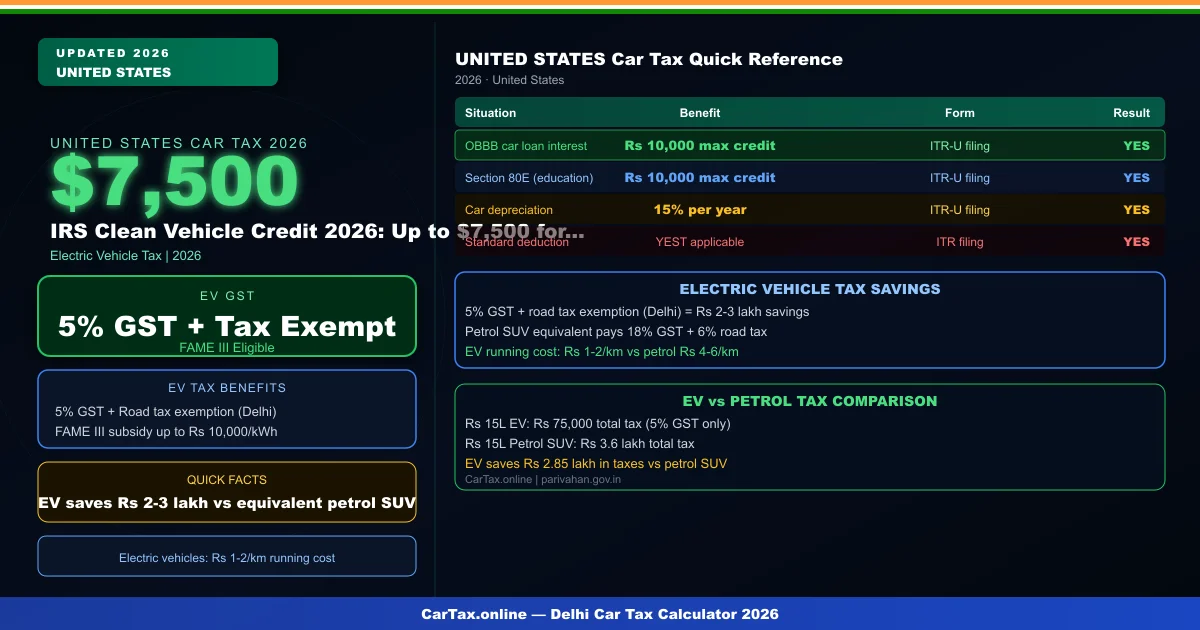
The IRS Clean Vehicle Credit remains one of the most significant federal incentives for buyers of new electric vehicles.
Whether you're buying a new Tesla, Chevrolet Equinox EV, or Hyundai IONIQ 5, understanding the clean vehicle credit eligibility rules is essential before you sign the dotted line.
How Does the Clean Vehicle Credit Work?
The Clean Vehicle Credit is a non-refundable tax credit claimed on your federal income tax return using IRS Form 8936. This means:
- It reduces your tax liability dollar-for-dollar
- It cannot result in a refund if your tax liability is less than the credit amount
- You must have sufficient federal income tax liability to use the full credit
Transferring the Credit to a Dealer
For 2026, the credit can be transferred to a participating dealer as an instant rebate at the point of sale. This means you don't have to wait until tax filing season — the dealer reduces the purchase price by the credit amount upfront. Not all dealers participate, so ask before negotiating. Related: IRS Clean Vehicle Credit 2026 | Electric Car Tax Credit 2026 | Used EV Tax Credit 2026 | UAE EV Rebates 2026.
Clean Vehicle Credit Amount — New EVs
The credit amount depends on two factors:
- Battery capacity — Vehicles with larger batteries qualify for more
- Critical mineral and battery component requirements — Domestic content rules affect the final amount
2026 Clean Vehicle Credit — Credit Tiers
| Requirement Met | Credit Amount |
|---|---|
| Both critical mineral + battery component | $7,500 |
| Critical mineral requirement only | $3,750 |
| Battery component requirement only | $3,750 |
| Neither requirement met | $0 ( ineligible) |
Eligibility Requirements for 2026
To qualify for the full $7,500 clean vehicle credit, your new EV must meet several requirements:
1. Final Assembly in North America
The vehicle must be final assembled in North America. You can verify this by checking the Vehicle Identification Number (VIN) — vehicles assembled in the US, Canada, or Mexico have a VIN starting with 1, 4, or 5.
2. MSRP Price Cap
The Manufacturer's Suggested Retail Price (MSRP) must not exceed:
- Vans, SUVs, Pickup trucks: $80,000 MSRP cap
- Other vehicles (sedans, hatchbacks): $55,000 MSRP cap
3. Income Limits
Your Modified Adjusted Gross Income (MAGI) must fall below these thresholds:
- Single filers: $150,000 MAGI
- Head of household: $225,000 MAGI
- Married filing jointly: $300,000 MAGI
The credit phases out completely once your income exceeds these limits.
4. Battery Critical Mineral Requirements
A percentage of the battery's critical minerals must be extracted or processed in North America or a country with a US free trade agreement, or recycled in North America. The required percentage increases each year — 2026 has the most stringent requirements yet.
5. Battery Component Requirements
A percentage of the battery's components must be manufactured or assembled in North America. Like critical minerals, this percentage requirement increases annually.
Eligible New EVs for 2026
| Model | Est. Credit | Battery | MSRP Cap Met? | Status |
|---|---|---|---|---|
| Chevrolet Equinox EV | $7,500 | 85 kWh | Yes (~$35,000) | Eligible |
| Tesla Model 3 RWD | $7,500 | 57.5 kWh | Yes (~$40,000) | Eligible |
| Ford Mustang Mach-E | $3,750 | 91 kWh | Yes (~$42,000) | Partial |
| Nissan Leaf | Varies | 62 kWh | Yes (~$28,000) | Eligible |
| Tesla Model S / Model X | $0 | 100+ kWh | No (over $80k) | Ineligible |
| Hyundai IONIQ 5 | Varies | 77 kWh | Yes (~$41,000) | Eligible |
| Cadillac Lyriq | $7,500 | 102 kWh | Yes (~$54,000) | Eligible |
Credit amounts depend on individual vehicle's battery content meeting IRS requirements. Check the fueleconomy.gov guide for your specific vehicle.
Used Clean Vehicle Credit — Up to $4,000
Buying a used electric vehicle? The credit for used clean vehicles is up to $4,000 or 30% of the sale price, whichever is less. Key rules:
- Vehicle must be at least 2 model years old
- Sale price must be $25,000 or less
- Same income limits apply
- No MSRP cap for used vehicles
- Credit is non-transferable for used vehicles
How to Claim the Clean Vehicle Credit
- Check eligibility — Verify your income, the vehicle's eligibility, and the MSRP
- Obtain Form 8936 — Available at irs.gov
- Complete Form 8936 — Part II for new vehicles, Part III for used vehicles
- Attach to your tax return — Submit with your 1040
- Alternatively — Ask your dealer if they participate in the transfer program for instant credit
State-Level EV Incentives (Stack with Federal Credit)
Many states offer additional EV incentives that stack on top of the federal credit:
- California: CVRP up to $7,500 for income-qualified buyers
- New York: Drive Clean Rebate up to $2,000
- Colorado: Innovate EV Rebate up to $5,000
- Washington: State EV rebate up to $1,500
Frequently Asked Questions
Can I lease an EV and still get the credit?
Yes — but the credit goes to the leasing company, not you. Many dealers mark up the residual value to capture the credit. However, the federal credit can be transferred to a dealer for an instant rebate on a purchased vehicle. Some lease deals are structured to pass the credit value to you — ask your dealer specifically.
Does the credit apply to plug-in hybrids (PHEVs)?
Yes — plug-in hybrid electric vehicles (PHEVs) with a battery capacity of at least 7 kWh qualify for the credit, subject to the same battery content and assembly requirements. PHEVs with larger batteries typically qualify for more of the credit.
What if my tax liability is less than the credit amount?
The credit is non-refundable. If your tax liability is $3,000 and your credit is $7,500, you only reduce your tax to $0 and lose the remaining $4,500. Plan your purchase timing accordingly — if your income varies year to year, consider whether a partial credit this year is better than waiting for a higher-income year.
Can I claim the credit on a vehicle for business use?
Yes — if you use the EV for business, you can also claim Section 179 or bonus depreciation in addition to the Clean Vehicle Credit. However, the depreciable basis of the vehicle must be reduced by the credit amount. Consult a tax professional for guidance on stacking both benefits.
How do I confirm a vehicle's eligibility?
Use the IRS Qualifying Vehicle Finder at fueleconomy.gov or check the IRS Clean Vehicle Credit page for the most current eligible vehicle list.
Conclusion
The IRS Clean Vehicle Credit 2026 offers up to $7,500 for new EVs and up to $4,000 for used EVs — one of the most substantial federal tax incentives available to American consumers. With proper planning around income limits, MSRP caps, and battery content requirements, you can maximize your credit and significantly reduce the cost of going electric.
For the most current eligibility information, visit irs.gov and fueleconomy.gov.
Disclaimer: This article is for informational purposes only and does not constitute legal or financial advice. Tax credits and eligibility rules change frequently. Always verify current information at irs.gov or consult a licensed tax professional.