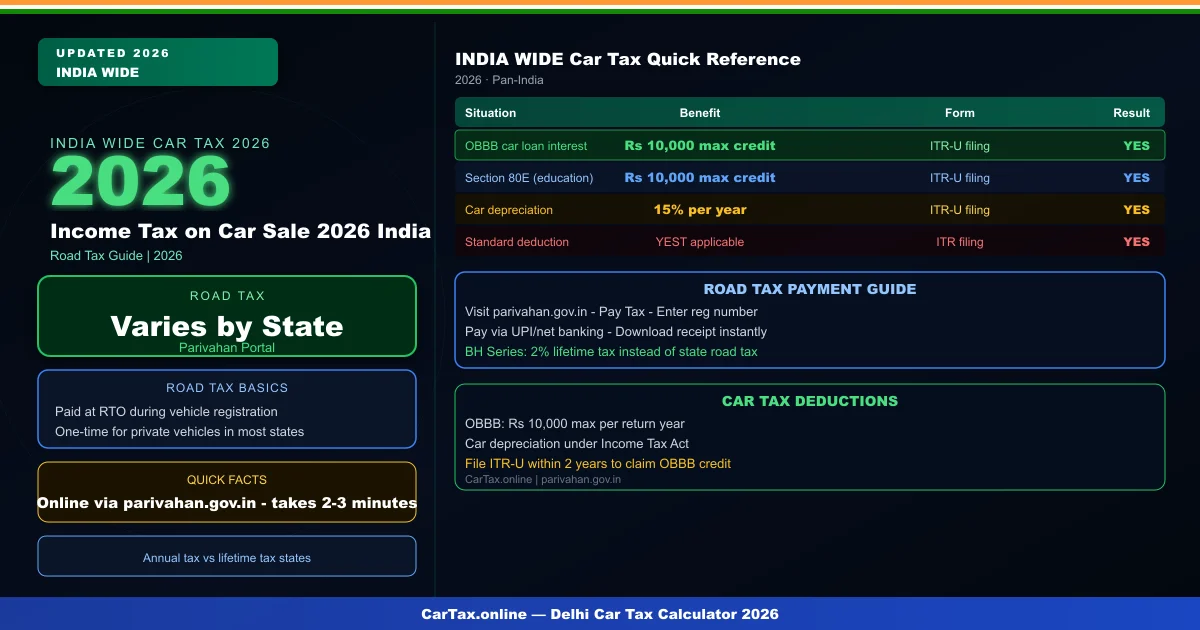
Income tax on car sale in India becomes relevant the moment you sell a vehicle for INR 10 lakh or more. In April 2026, the tax framework governing car sales involves TCS deduction rules, capital gains considerations, and Section 48 exemptions that can significantly affect your net proceeds from the sale. Whether you are selling a used Maruti or a luxury BMW, understanding these rules prevents unexpected tax liabilities and helps you plan the sale timing.
The key distinction in India's income tax framework is between personal-use cars and business-asset cars. A car you bought for personal use and sold later is generally not treated as a capital asset under Section 2(14) of the Income Tax Act, which means no capital gains tax applies to the sale. However, this rule has important nuances — the TCS requirement still applies, and if the car was ever used for business, the situation changes. CarTax.online tracks these rules as they evolve across financial years.
TCS Rules on Car Sales from April 2026
The Tax Collected at Source (TCS) requirement under Section 206C(1F) of the Income Tax Act mandates that buyers deduct 1% TCS when purchasing a motor car for INR 10 lakh or more. This rule applies to all private sales and dealer purchases alike. The seller receives 99% of the agreed price, and the remaining 1% is remitted to the government by the buyer.
The TCS deducted can be claimed as credit when filing your income tax return. If you have no other income tax liability, you can claim a refund of the TCS amount. Form 27D is issued by the buyer as evidence of TCS deduction. Sellers should retain this certificate carefully as it is the only proof of TCS credit available.
Capital Gains on Business-Used Cars
If a car was registered in the name of a business or self-employed individual and used for business purposes, it qualifies as a depreciable asset. Depreciation claimed under Section 32 reduces the car's tax book value each year. When sold, the difference between the sale price and the written-down value (original cost minus accumulated depreciation) is taxed as either a short-term or long-term capital gain.
Short-term capital gains on business cars are taxed at the individual's applicable slab rate. Long-term capital gains are taxed at 20% with indexation benefits. However, if the car was used more than 50% for personal purposes, the income tax department may disallow the business-use depreciation claim, requiring the depreciation to be added back to income.
Section 48 Exemptions and Transfer Rules
Section 48 of the Income Tax Act provides the framework for calculating capital gains on asset transfers. For cars that qualify as capital assets, the gain is the sale consideration minus the cost of acquisition and improvement, minus allowable depreciation. Indexation benefits are available for long-term gains, adjusting the cost basis for inflation.
Transfer of a car between close family members (parent-to-child, spouse-to-spouse) does not attract capital gains tax under Section 47(iii). However, these transfers must be at market value to avoid scrutiny from the income tax department. For non-family transfers, fair market value is used as the deemed sale consideration.
Frequently Asked Questions
Do I have to pay income tax on selling my car in India 2026?
Yes — income tax on car sale applies when you sell a motor car for a price above INR 10 lakh. The buyer is required to deduct Tax Collected at Source (TCS) at 1% under Section 206C(1F) of the Income Tax Act. For cars sold below INR 10 lakh, no TCS applies, but capital gains rules may still be relevant.
Is a car sale treated as capital gains in India?
A motor car held as a personal asset is generally not treated as a capital asset under Section 2(14) of the Income Tax Act, meaning capital gains tax does not normally apply when selling a personal-use car. However, if the car was used for business purposes or was a depreciable asset on your books, capital gains rules under Section 48 and the benefit of indexation may apply.
What is TCS on car sale and who deducts it?
TCS (Tax Collected at Source) at 1% is deducted by the BUYER when purchasing a car for INR 10 lakh or more. The seller receives the net amount after TCS deduction. The buyer deposits this TCS to the government and issues a TCS certificate (Form 27D) to the seller, who can claim credit of this TCS against their income tax liability.
Can I claim a capital loss on selling my car?
Capital loss on a car can only be claimed if the car qualifies as a capital asset under the Income Tax Act. Personal-use cars are exempt from capital gains under Section 2(14). However, if the car was registered as a business asset, depreciation was claimed on it, and it is now sold for less than its written-down value, the loss may be claimed as a business loss.
How do I report car sale income on my ITR?
If capital gains apply (business-used car), report it under Schedule Gains from Business or Profession. If TCS was deducted, claim credit in the respective head. For personal-use car sales below INR 50 lakh, no reporting is typically required. For sales above INR 50 lakh or where capital gains rules apply, consult a tax professional to ensure correct disclosure on ITR-2 or ITR-3.
Official Resources
For authoritative income tax rules on car sales, refer to the Income Tax Department portal for current ITR forms, TCS provisions, and capital gains schedule instructions. The Parivahan portal provides vehicle transfer and registration change details necessary for completing the sale process legally.