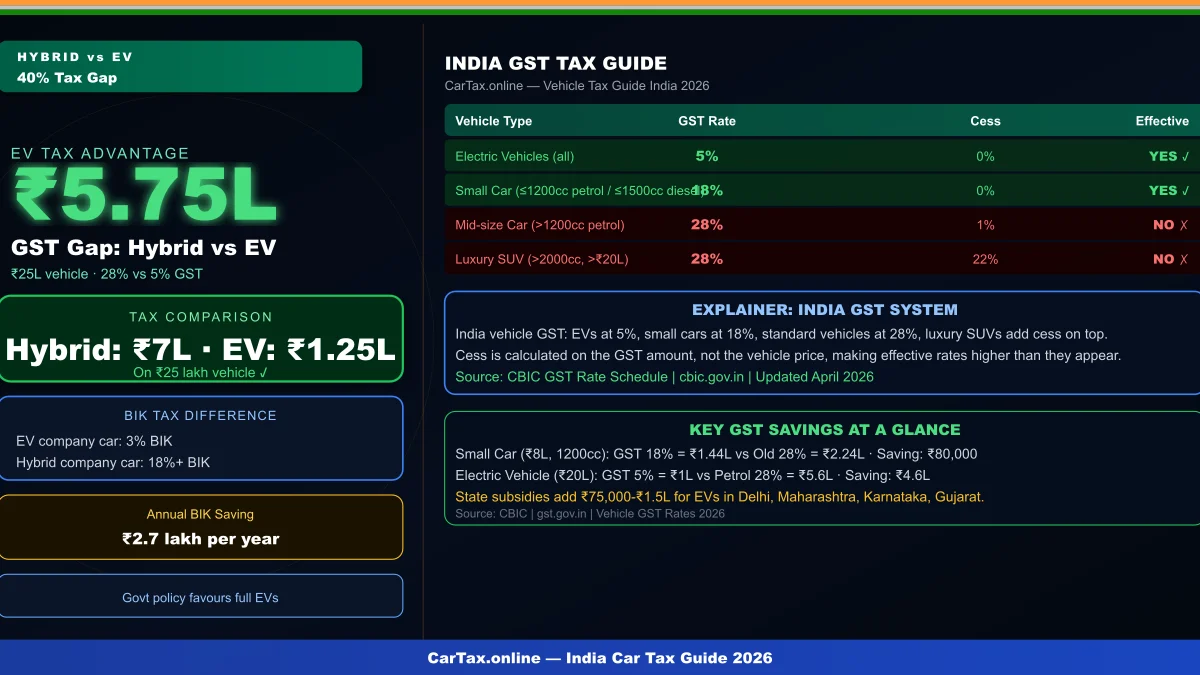
India's hybrid versus electric vehicle taxation debate creates confusion for car buyers trying to make the right choice. The current tax structure treats these technologies differently, significantly impacting purchase economics and long-term ownership costs.
Understanding the Current Tax Structure
India's vehicle taxation framework places hybrid and electric vehicles in different brackets despite their shared goal of reducing emissions. Electric vehicles enjoy a 5% GST rate under FAME III incentives, while hybrid vehicles fall into the standard 18-28% brackets depending on their specifications. This creates a substantial price gap between otherwise similar vehicles, with the tax difference alone potentially reaching ₹3-15 lakhs for mid-range models. The policy intent appears to be accelerating pure EV adoption while gradually phasing out hybrid technology, though the approach has generated debate among industry experts and buyers.
Arguments for Equal Tax Treatment
Industry advocates argue that hybrids deserve tax treatment closer to electric vehicles given their environmental benefits. Modern hybrids can achieve fuel efficiency improvements of 30-50% compared to conventional vehicles, significantly reducing both emissions and fuel consumption. The charging infrastructure limitations in India make pure electric vehicles impractical for many buyers, positioning hybrids as a pragmatic transition technology. Treating hybrids more favorably could accelerate emissions reduction across the broader vehicle fleet while the charging infrastructure matures. Additionally, hybrids provide grid stabilization benefits during the transition period that pure EVs cannot yet deliver at scale.
Arguments Against Equal Treatment
Government policy positions treat hybrids as essentially conventional vehicles with limited environmental benefit, arguing that they still depend on fossil fuels and do not represent a true transition away from petrol and diesel. Tax parity with EVs could undermine the aggressive EV adoption targets that India has committed to under international climate agreements. The administrative complexity of creating nuanced tax categories based on hybrid technology sophistication creates challenges for consistent policy implementation. Furthermore, some critics suggest that premium hybrid models are primarily purchased by affluent buyers who can afford the current tax burden, reducing the equity argument for preferential treatment. Related: Electric Car Tax India 2026 — EV Road Tax & Savings | Hybrid Car GST India 2026 | Car Loan Tax Benefit India 2026 — Section 80EEB Deductions | Car Tax Changes India 2026 — Latest Updates & New Rules.
Market Impact of Current Tax Structure
The tax differential has created a bifurcated market where EV sales have surged among buyers who can afford the higher upfront costs, while hybrid sales remain limited despite their practical advantages. Toyota, the primary hybrid manufacturer in India, has seen strong demand for models like the Innova Hycross and Camry Hybrid despite their premium pricing, suggesting latent demand that tax parity could unlock. Dealers report that hybrid customers frequently cite charging infrastructure concerns as their primary EV hesitation, creating a customer segment that would readily adopt hybrids if the tax advantage were more favorable. Market analysis suggests hybrid sales could potentially double with EV-equivalent tax treatment.
Future Policy Directions
The GST Council continues to deliberate on vehicle taxation reforms that could address the hybrid-EV disparity. Industry lobbying and international pressure may influence future adjustments, particularly as global manufacturers push for consistent environmental policy across markets. However, India's domestic manufacturing priorities and revenue considerations create competing pressures that complicate simple tax parity solutions. Buyers currently considering hybrid purchases face uncertainty around future tax changes, making immediate purchase decisions more challenging. Monitoring GST Council meetings and understanding the political dynamics around vehicle taxation provides insight into when or if policy adjustments might occur.
Frequently Asked Questions
What is the current GST rate on hybrid vehicles in India?
Hybrid vehicles in India face GST rates of 18-28% depending on engine size and vehicle type, significantly higher than the 5% rate applied to pure electric vehicles.
Why does India tax hybrids higher than electric vehicles?
India's policy framework positions hybrids as transitional technology that still depends on fossil fuels, while EVs receive preferential treatment to accelerate adoption toward zero-emission transportation.
Are hybrid vehicles still worth buying despite higher taxes?
For buyers without reliable home charging access or facing range anxiety with pure EVs, hybrids offer 30-50% better fuel efficiency and remain practical despite the tax disadvantage.
Could hybrid tax rates change in the future?
The GST Council continues deliberations on vehicle taxation, and industry pressure plus international comparisons may influence adjustments, though no immediate changes appear imminent.
How much tax difference exists between comparable hybrid and EV models?
Tax differences between comparable hybrid and EV models can reach ₹3-15 lakhs depending on vehicle category, creating substantial upfront price variations for buyers choosing between the technologies.
Official Resources: Parivahan Portal | Vahan Road Tax | India GST Portal | FAME-III Scheme
Frequently Asked Questions
Q: What is the current road tax rate for cars in India 2026?
Road tax rates in India vary by state and vehicle category. For new cars, GST is charged at 5% for EVs, 18% for hybrids under 1,200cc, and up to 28% for petrol/diesel SUVs. State road tax is charged separately and varies from Rs3,000-15,000 annually depending on the state's slab system. Check your specific state's RTO website for current rates.
Q: How do I calculate my car road tax online in India?
You can calculate your car road tax using online calculators available on state RTO portals and CarTax.online. The calculation considers your vehicle's ex-showroom price, fuel type, engine capacity, and state of registration. Road tax is payable annually or for the vehicle's lifetime depending on your state's rules.
Q: Is GST included in the road tax for new cars in India?
No — GST and road tax are separate charges. GST is a central tax charged by the vehicle manufacturer at the time of purchase. State road tax is a separate annual or one-time charge levied by your state's transport department. Both apply at the time of first registration, and annual road tax continues for subsequent years.
Q: Do electric vehicles get tax benefits in India 2026?
Yes — electric vehicles in India qualify for a reduced GST rate of 5% (down from 28% for petrol cars). Under FAME-III subsidies, EVs may also qualify for additional state-level incentives, reduced road tax, and free registration in many states. The exact benefits vary by state.
Q: What happens if I don't pay my car road tax on time?
If you don't pay road tax, your vehicle's registration can be flagged in the Vahan database, preventing renewal of fitness certificates and creating legal liability during police checks. Penalties range from Rs200-500 per day of default in most states. Road tax is a legal requirement under the Motor Vehicles Act.