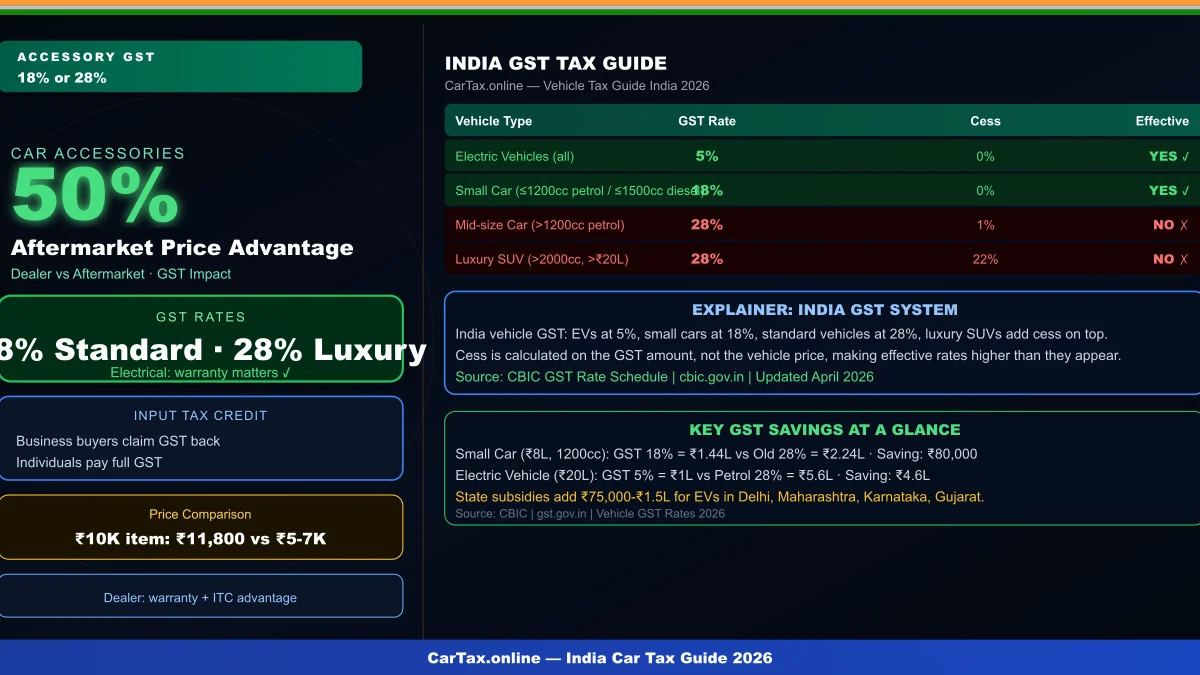
Car accessories GST savings create a significant decision point between dealer-installed and aftermarket options. Understanding the tax structure and value propositions helps buyers optimize their vehicle setup while managing costs effectively.
Understanding Car Accessories GST Structure
Car accessories in India fall under varying GST rates depending on their classification and installation context. Dealer-installed accessories often carry GST at 18-28% as part of the overall vehicle package, while standalone aftermarket accessories face similar or sometimes lower GST rates depending on their specific product category. Understanding these distinctions helps buyers evaluate whether dealer packages offer genuine value or represent markup opportunities disguised as tax efficiency. Genuine manufacturer accessories typically carry 18% GST, while some aftermarket products may attract 12% or lower rates depending on their material composition and functional classification.
Dealer-Installed Accessory Advantages
Dealer-installed accessories carry several advantages beyond simple tax considerations that justify their typically higher prices. Warranty coverage extends to dealer-installed genuine parts, protecting buyers from defects and installation-related failures. Vehicle resale value benefits from documented dealer installations, as subsequent buyers recognize the premium treatment and documentation. Insurance claims are simpler when accessories are dealer-documented, avoiding disputes about installation quality or part authenticity. The after-sales support relationship with the dealership provides convenient servicing and adjustment access for installed accessories.
Aftermarket Accessory Benefits and Considerations
Aftermarket accessories offer substantial price advantages for budget-conscious buyers willing to navigate quality variations and installation risks. Competition among aftermarket suppliers drives prices 30-70% below equivalent dealer offerings for comparable products. Customization options in the aftermarket far exceed what dealers can offer, enabling buyers to personalize vehicles according to their specific preferences and requirements. However, quality assurance requires more buyer research and potentially higher risk of product or installation failures. Warranty claims become more complex with aftermarket accessories, potentially requiring multiple vendor relationships and documentation. Related: Hybrid vs EV Tax Debate India 2026 | The "Used Car" GST Trap 2026 | Canada Car Insurance Tax 2026 | GST/HST Rebate on Vehicle Purchase 2026.
Tax Optimization Strategies
Strategic purchasing approaches can minimize the overall tax burden on vehicle accessories through careful vendor selection and purchase timing. Year-end sales and festival season offers from aftermarket retailers often include GST-inclusive pricing with substantial margins already reduced. Manufacturer accessory packages purchased during vehicle delivery frequently qualify for promotional pricing that offsets the higher GST component. Corporate purchases of vehicle accessories may allow input tax credit claims, creating different optimal strategies for business versus personal buyers. Separating accessory purchases from vehicle purchases may create different tax treatment opportunities depending on the specific items and vendors involved.
Balancing Quality, Cost, and Tax Efficiency
Optimal accessory purchasing strategies balance quality requirements, budget constraints, and tax efficiency to maximize overall value. High-safety items like floor mats, seat covers, and emergency equipment justify dealer-quality purchases regardless of minor price premiums. Performance accessories where genuine parts provide documented benefits warrant dealer sourcing despite tax implications. Visual and comfort accessories often deliver equivalent value from quality aftermarket sources at significantly lower prices. Creating a tiered approach that differentiates between essential safety items, warranty-sensitive components, and price-driven cosmetic additions helps structure purchases optimally.
Frequently Asked Questions
What GST rate applies to car accessories in India?
Car accessories typically attract GST rates of 12-28% depending on material composition and functional classification, with dealer-installed genuine accessories generally at 18%.
Are dealer-installed accessories tax-efficient compared to aftermarket?
Dealer-installed accessories are often included in the vehicle GST structure, but they typically cost 30-70% more than equivalent aftermarket options, making tax efficiency comparisons complex.
Can businesses claim input tax credit on car accessories?
Businesses may be able to claim input tax credit on commercial vehicle accessories, though restrictions apply based on usage patterns and vehicle classification for passenger versus commercial purposes.
Where can buyers find the best accessory deals while managing tax costs?
Festival season sales from established aftermarket retailers often provide the best value, combining competitive pricing with reasonable quality assurance compared to dealer options.
Should safety-critical accessories be purchased from dealers despite higher costs?
Yes, safety-critical accessories like floor mats, emergency kits, and basic protection items benefit from dealer installation quality and warranty support, justifying the price premium over aftermarket alternatives.
Official Resources: Parivahan Portal | Vahan Road Tax | India GST Portal | FAME-III Scheme
Frequently Asked Questions
Q: What is the current road tax rate for cars in India 2026?
Road tax rates in India vary by state and vehicle category. For new cars, GST is charged at 5% for EVs, 18% for hybrids under 1,200cc, and up to 28% for petrol/diesel SUVs. State road tax is charged separately and varies from Rs3,000-15,000 annually depending on the state's slab system. Check your specific state's RTO website for current rates.
Q: How do I calculate my car road tax online in India?
You can calculate your car road tax using online calculators available on state RTO portals and CarTax.online. The calculation considers your vehicle's ex-showroom price, fuel type, engine capacity, and state of registration. Road tax is payable annually or for the vehicle's lifetime depending on your state's rules.
Q: Is GST included in the road tax for new cars in India?
No — GST and road tax are separate charges. GST is a central tax charged by the vehicle manufacturer at the time of purchase. State road tax is a separate annual or one-time charge levied by your state's transport department. Both apply at the time of first registration, and annual road tax continues for subsequent years.
Q: Do electric vehicles get tax benefits in India 2026?
Yes — electric vehicles in India qualify for a reduced GST rate of 5% (down from 28% for petrol cars). Under FAME-III subsidies, EVs may also qualify for additional state-level incentives, reduced road tax, and free registration in many states. The exact benefits vary by state.
Q: What happens if I don't pay my car road tax on time?
If you don't pay road tax, your vehicle's registration can be flagged in the Vahan database, preventing renewal of fitness certificates and creating legal liability during police checks. Penalties range from Rs200-500 per day of default in most states. Road tax is a legal requirement under the Motor Vehicles Act.