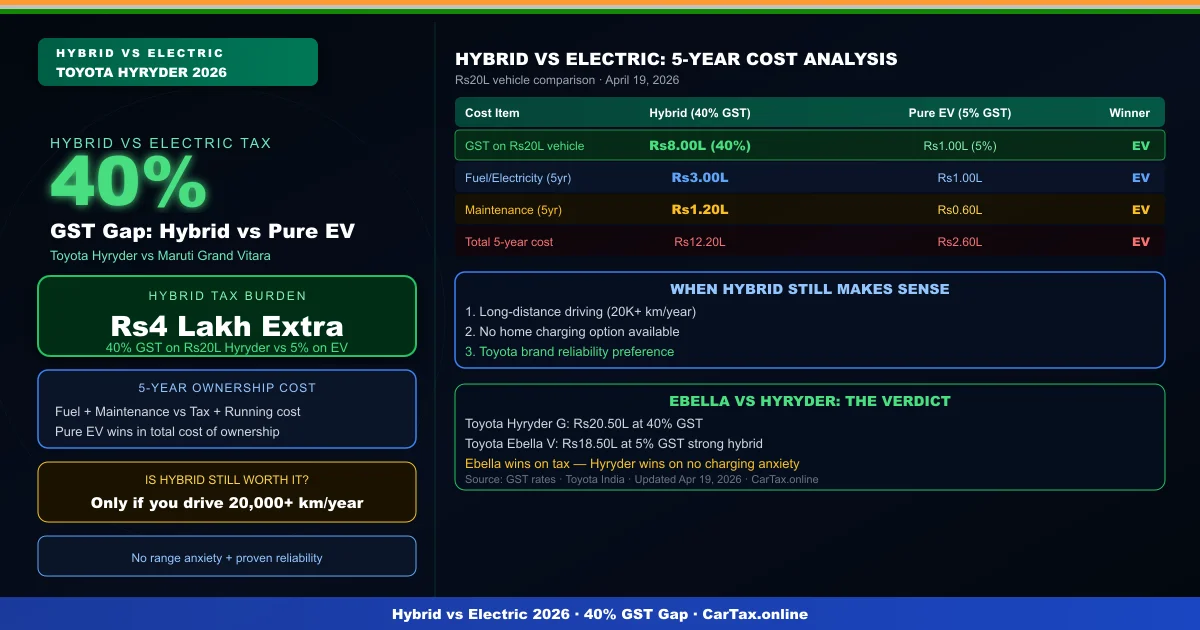
The gap between a hybrid and a pure electric vehicle has never been wider in India than it is in April 2026. On one side: the Toyota Hyryder and Maruti Grand Vitara, priced between Rs18-24 lakh with engines that cross the 1,200cc threshold, attracting GST at 40% or higher. On the other: the Tata Nexon EV and Hyundai Creta Electric, priced at similar levels but qualifying for 5% GST as pure electric vehicles. The tax difference alone — on a Rs20 lakh vehicle — is Rs7 lakh. This is the question every car buyer in the Rs15-25 lakh segment is now wrestling with: is the 40% GST on a hybrid a deal-breaker?
The answer is not binary. It depends on your daily commute, your access to home charging, your annual driving distance, and your personal tolerance for range anxiety. But the math, when laid out honestly, is revealing.
The GST Math: Where the Gap Starts and Why It Matters
For a vehicle priced at Rs20 lakh ex-showroom, here is how the GST comparison looks:
- Pure EV at 5% GST: Rs1.00 lakh in tax
- Strong Hybrid at 18% GST: Rs3.60 lakh in tax
- Petrol/hybrid above 1,200cc at 28-40% GST: Rs5.60-8.00 lakh in tax
The gap between a pure EV and a petrol-hybrid above the 1,200cc threshold is Rs4.60-7 lakh in GST alone. On a Rs20 lakh vehicle, this is a difference that can be financed into an EMI — or saved entirely by choosing the right vehicle category. Related: GST 2.0 Sunday Special | 24 Hours to Go | 24 Hours to Go | The Rs1.5 Lakh GST Benefit.
The Toyota Hyryder mid-variant at Rs20.50 lakh ex-showroom with 40% GST (including cess) carries a tax burden of Rs8.20 lakh. The Tata Nexon EV Long Range at Rs17.50 lakh with 5% GST carries Rs87,500 in tax. The difference in just GST: Rs7.32 lakh.
5-Year Ownership Cost Analysis: Hybrid vs Pure EV
To understand whether the hybrid premium is justified, let's run a 5-year ownership cost comparison for a family driving approximately 15,000 km per year:
Toyota Hyryder S (Petrol Hybrid, Rs20.50 lakh, 40% GST):
GST: Rs8.20 lakh. Fuel cost at 18 km/l, petrol at Rs108/l: Rs90,000 per year. Maintenance (hybrid): Rs12,000 per year. Total fuel + maintenance over 5 years: Rs5.10 lakh. Total 5-year cost: Rs13.30 lakh in GST + fuel + maintenance = Rs33.60 lakh.
Tata Nexon EV Long Range (Rs17.50 lakh, 5% GST):
GST: Rs87,500. Electricity cost at home charging (Rs6/unit, 15km/unit): Rs36,000 per year. Maintenance (EV): Rs6,000 per year. Total electricity + maintenance over 5 years: Rs2.10 lakh. Total 5-year cost: Rs2.97 lakh in GST + electricity + maintenance = Rs20.47 lakh.
The pure EV is Rs13.13 lakh cheaper over 5 years in this scenario. For families driving more (20,000+ km/year), the gap narrows slightly as fuel costs increase for the hybrid — but the pure EV remains significantly ahead.
When Hybrid Still Makes Sense in 2026
The hybrid argument has not disappeared entirely. There are three scenarios where a Toyota Hyryder or Grand Vitara makes more sense than a pure EV:
1. No home charging option:
If you live in an apartment without dedicated EV charging infrastructure, a hybrid's ability to run on petrol without daily charging dependency is a genuine advantage. The Hyryder's self-charging mechanism means you never need to plan your day around a charging stop.
2. Long-distance highway driving over 20,000 km/year:
If your annual driving includes significant highway mileage (10,000+ km on highways), the hybrid's fuel efficiency advantage and absence of range anxiety becomes meaningful. A pure EV's highway range drops significantly at high speeds, requiring more frequent stops to charge.
3. Toyota brand loyalty and reliability preference:
For buyers who specifically value Toyota's brand reputation, strong hybrid technology (which Toyota has perfected over two decades), and the assurance of a proven powertrain — the hybrid premium is an emotional and practical investment, not just a financial one.
Toyota Ebella vs Hyryder: The Internal Decision
For buyers deciding between the upcoming Toyota Ebella V (strong hybrid at Rs18.50 lakh, 5% GST) and the Hyryder S (at Rs20.50 lakh, 40% GST), the decision is clearer. The Ebella V qualifies for 5% GST due to its strong hybrid system under the 1,200cc threshold, making it subject to a lower tax bracket than the larger-engined Hyryder. The Ebella wins on tax — and its newer platform and technology give it additional advantages.
The Hyryder becomes the choice only for buyers who need the larger body style, higher ground clearance, and specific variant features that the Ebella does not offer. For everything else, the Ebella's tax efficiency is a decisive advantage.
Official Resources: Parivahan Portal | Vahan Road Tax | India GST Portal | FAME-III Scheme
Frequently Asked Questions
Q: Is 40 percent GST on Toyota Hyryder a deal-breaker in 2026?
For buyers with home charging access and annual driving under 20,000 km, yes — the Rs7+ lakh GST premium over a pure EV is difficult to justify financially. For buyers without home charging or who drive long distances, the hybrid's lack of range anxiety may justify the premium.
Q: How much does a pure EV save in GST versus a hybrid at Rs20 lakh?
A pure EV at 5% GST saves approximately Rs7 lakh in GST alone compared to a petrol-hybrid at 40% GST on a Rs20 lakh vehicle.
Q: Is the Toyota Ebella a better buy than the Hyryder for tax reasons?
Yes — the Toyota Ebella V at Rs18.50 lakh with 5% strong hybrid GST is significantly more tax-efficient than the Hyryder at Rs20.50 lakh with 40% GST. The Ebella wins on total cost of ownership.
Q: When does a hybrid still make sense over an electric vehicle?
Hybrids make sense for buyers without home charging, those driving over 20,000 km per year with significant highway usage, and Toyota brand loyalists who value proven hybrid reliability over financial optimization.
Q: How much can I save over 5 years by choosing a pure EV over a hybrid?
On a Rs20 lakh vehicle, the pure EV saves approximately Rs13 lakh over 5 years in GST, fuel/electricity, and maintenance combined versus a petrol-hybrid.