How much is road tax for my car is the first question every Indian car buyer asks before signing the deal. In April 2026, the answer involves at least two layers of taxation — central GST and state road tax — plus registration fees, green tax, and in some cases a compensation cess on SUVs. The exact amount depends on which state you register in, the vehicle's ex-showroom price, and the fuel type. This guide covers every tax component so you can calculate your total car cost before visiting the dealership.
India's road tax system operates at the state level, meaning the same INR 10 lakh car can cost INR 2.4 lakh in road tax in Karnataka but only INR 1.8 lakh in Gujarat. Understanding these differences can save you INR 50,000 to INR 1 lakh over the vehicle's lifetime, which is why CarTax.online tracks state-wise road tax changes throughout the year.
Breaking Down the Road Tax Components in 2026
When you buy a new car in India in 2026, the road tax system is made up of five distinct charges. GST is the central tax applied at the time of purchase by the vehicle's manufacturer or dealer. GST rates were revised under GST 2.0 in April 2026, with electric cars at 5%, most petrol and hybrid vehicles at 18%, and large petrol/diesel SUVs at 22-28% with additional compensation cess.
State road tax is charged on top of GST and varies by state. Most states calculate it as a percentage of the vehicle's ex-showroom price. Delhi, for example, charges one-time lifetime road tax of 3-7% depending on the car's value. Karnataka charges 5-15%, Maharashtra 4-10%, Gujarat 3-9%, and Rajasthan 3-9%. Some states like Tamil Nadu and West Bengal charge road tax annually rather than as a lump sum, which changes the total cost equation.
State-Wise Road Tax Slabs for Common Vehicle Types
For a standard mid-size petrol car priced at INR 10 lakh ex-showroom, the state road tax in major states ranges from INR 30,000 (Gujarat at 3%) to INR 1,50,000 (Karnataka at 15%). Maharashtra and Delhi both sit around INR 60,000-65,000 at approximately 6-7% of ex-showroom price. These figures are approximate — actual rates vary by exact vehicle specifications and any state-specific concessions.
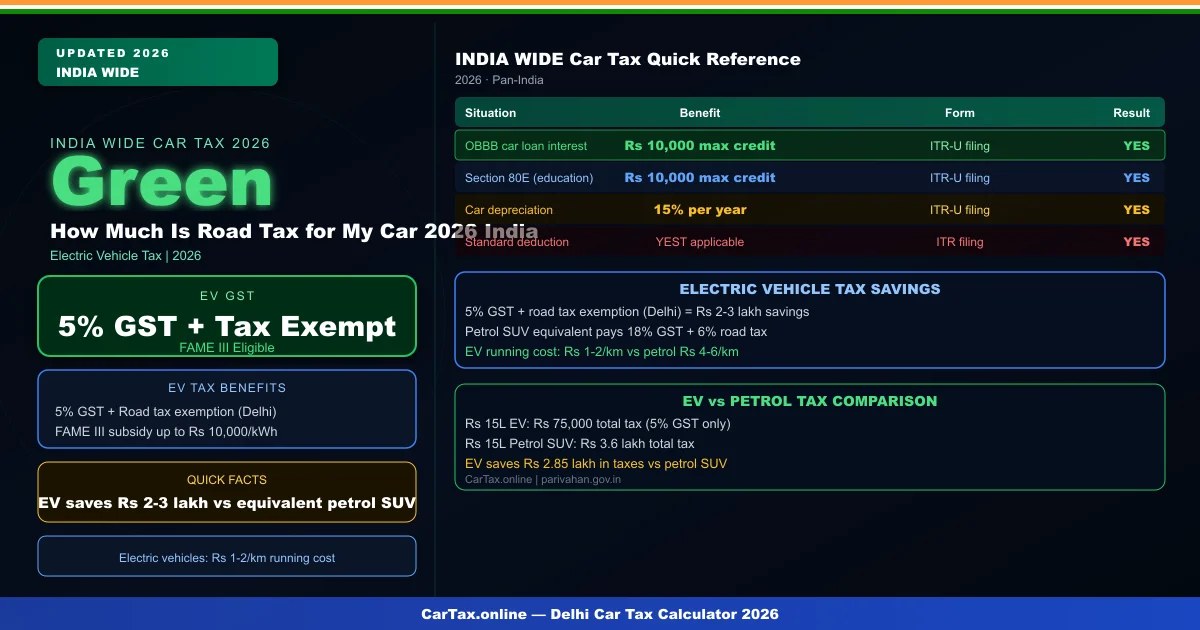
Electric vehicles receive the most favourable road tax treatment in 2026, with several states offering full or near-full road tax exemption for EVs registered before March 2027. The FAME-III subsidy framework also provides upfront incentives that combine with these state exemptions to make EVs significantly cheaper at purchase.
How to Calculate Your Total Car Tax Instantly
The fastest way to answer how much is road tax for my car question is to use the CarTax.online state calculator for your specific vehicle and registration state. The calculator factors in GST 2.0 rates, state road tax slabs, vehicle age for green tax eligibility, and any applicable environmental concessions.
For manual calculation, start with the ex-showroom price, multiply by your state's road tax percentage, add GST at the applicable rate, and add registration and Fastag fees. For example, a INR 12 lakh SUV in Maharashtra would attract approximately INR 2.16 lakh in GST (18%), INR 72,000 in state road tax (6%), and INR 1,000 in combined fees — bringing total tax to approximately INR 2.89 lakh before any dealer margin.
Frequently Asked Questions
How much is road tax for my car in India 2026?
Road tax for cars in India 2026 varies by state and vehicle type. GST 2.0 applies at 5% for EVs, 18% for most petrol/hybrid cars, and up to 28% for large SUVs/diesel vehicles. State road tax on top adds 3-15% depending on your state. Use the CarTax.online calculator for instant state-wise estimates.
Is road tax the same as registration tax in India?
Road tax and registration fee are separate charges. Road tax is a state-level tax on vehicle ownership, calculated as a percentage of ex-showroom price (lifetime or annual depending on the state). Registration fee is a smaller administrative charge (INR 200-1,500) collected by the RTO for the registration certificate.
How is road tax calculated for a new car in India?
Road tax for a new car is calculated on the ex-showroom price declared by the manufacturer. States use either a percentage slab system or a fixed rate based on vehicle category, fuel type, and engine capacity. GST is excluded from the road tax base in most states.
Which Indian state has the lowest road tax for cars?
Delhi (NCT) has some of the lowest road tax rates for private cars, ranging from 3-7% as a one-time lifetime tax. Gujarat, Rajasthan, and Uttar Pradesh also offer competitive road tax rates for private vehicles. States like Karnataka, Maharashtra, and Tamil Nadu have higher road tax slabs for mid-size and premium vehicles.
Can I pay road tax online in India 2026?
Yes — road tax can be paid online through state transport department portals, Parivahan.gov.in, and the Vahan platform. Most states now accept digital payment for initial road tax, annual tax, and green tax. CarTax.online also provides state-wise guidance and calculators for online payment.
Official Resources
For authoritative road tax rates and vehicle tax rules, always refer to your state transport department's official portal. The Parivahan portal provides access to state transport department services, vehicle registration records, and road tax payment facilities across all states. The GST portal carries the latest GST rates on vehicles, which were updated under the GST 2.0 reform effective April 2026.