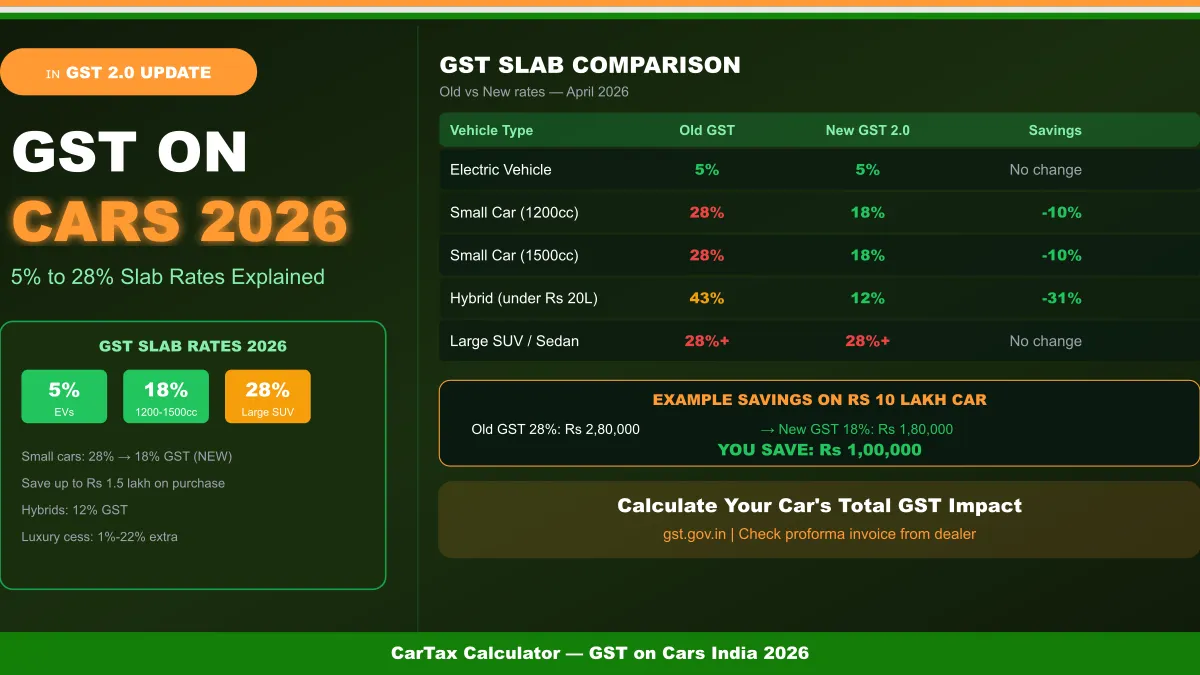
April 12, 2026 in India — GST on cars in India has been restructured under GST 2.0, bringing significant relief to small car buyers. Understanding the GST slab rates is crucial for calculating your car's true cost. This comprehensive guide explains every GST rate category for vehicles.
The GST Council's revamp of automobile taxation effective April 2026 represents the biggest change in car pricing since GST implementation in 2017. Small car buyers save up to Rs 1.5 lakh, while large vehicle prices remain largely unchanged.
GST 2.0: Complete Slab Rates for Cars
GST Rate Structure (April 2026)
| Vehicle Category | GST Rate | Previous Rate | Savings on Rs 10L |
|---|---|---|---|
| Electric Vehicle (EV) | 5% | 5% | No change |
| Small Car (under 1200cc petrol) | 18% | 28% | Rs 1,00,000 |
| Small Car (1200-1500cc) | 18% | 28% | Rs 1,00,000 |
| Hybrid (under Rs 20 lakh) | 12% | 43% | Rs 3,10,000 |
| Large SUV/Sedan (over 4m) | 28% | 28% | No change |
| Luxury Vehicle | 28% + Cess | 28% + Cess | No change |
Understanding Each GST Slab
5% GST: Electric Vehicles
Electric vehicles enjoy the lowest GST rate in India. EVs remain at 5% GST under GST 2.0, making them significantly cheaper than internal combustion engine vehicles. Combined with state incentives, EV buyers save lakhs compared to equivalent petrol/diesel cars.
18% GST: Small Cars (Under 1500cc)
This is the biggest change in GST 2.0. Cars with petrol engines up to 1200cc and diesel engines up to 1500cc now attract only 18% GST instead of 28%. The vehicle must also be under 4 meters in length to qualify for this reduced rate.
Examples of cars now at 18% GST:
- Maruti Swift (1197cc petrol)
- Maruti Baleno (1197cc petrol)
- Tata Tiago (1199cc petrol)
- Maruti Brezza (1462cc petrol)
- Hyundai Grand i10 (1197cc petrol)
28% GST: Large Vehicles
Vehicles that don't qualify for the reduced rate attract 28% GST:
- Body length over 4 meters
- Engine capacity over 1500cc (diesel)
- Engine capacity over 1200cc (petrol) — if over 4m
- SUVs, MUVs, and luxury sedans
Vehicles at 28% GST:
- Hyundai Creta (1497cc diesel) — over 4m body
- Kia Seltos (1493cc diesel) — over 4m body
- Toyota Innova (2494cc diesel)
- Mahindra Thar (2184cc diesel)
- Honda City (1498cc petrol) — over 4m body
12% GST: Hybrid Vehicles
Strong hybrids under Rs 20 lakh now attract just 12% GST — down from 43% previously (28% + 15% cess). This represents massive savings for hybrid buyers.
Calculating GST on Your Car
Use our GST calculator to see your exact tax liability:
- Rs 5 lakh small car: GST = Rs 90,000 (was Rs 1,40,000)
- Rs 10 lakh small car: GST = Rs 1,80,000 (was Rs 2,80,000)
- Rs 15 lakh SUV: GST = Rs 4,20,000 (no change)
GST Cess (Additional)
Some vehicle categories attract additional cess on top of GST:
- Small cars: No cess (under GST 2.0)
- Large SUVs: 1-22% cess depending on size
- Luxury vehicles: Up to 22% cess
Frequently Asked Questions
Which cars qualify for 18% GST in 2026?
Cars with petrol engines up to 1200cc and diesel engines up to 1500cc, with body length under 4 meters, qualify for 18% GST. The vehicle must also be primarily designed for personal transport (not commercial).
Did GST on cars reduce in April 2026?
Yes, small cars (under 1500cc) now attract 18% GST instead of 28%. This means savings of up to Rs 1.5 lakh on a Rs 15 lakh car. Large vehicles (over 4m body or over 1500cc) remain at 28% GST.
Is GST the same for all cars?
No. GST rates vary by vehicle category: 5% for EVs, 18% for small cars (under 1500cc), 28% for large vehicles, and 12% for hybrids under Rs 20 lakh.
Do I pay cess on top of GST?
Small cars at 18% GST do not attract cess. Large vehicles and luxury cars at 28% GST may attract additional cess of 1-22% depending on the category.
Conclusion
GST 2.0 brings significant relief for small car buyers. Use our GST calculator to understand your exact tax liability and compare total costs across different vehicle options.
Disclaimer: This article is for informational purposes only and does not constitute legal or financial advice. Tax rules and rates may change. Verify information on the official GST website (gst.gov.in) or parivahan.gov.in, or consult a tax professional.
अस्वीकरण: यह लेख केवल सूचनात्मक उद्देश्यों के लिए है। कर नियम बदल सकते हैं। gst.gov.in पर आधिकारिक जानकारी सत्यापित करें।
Official Resources: Parivahan Portal | Vahan Road Tax | India GST Portal