Car taxation in India operates through a dual government system where both the central government and state governments levy separate taxes on vehicles. This dual structure means buyers effectively pay two layers of taxation — central GST and state road tax — which together form the total tax burden on any car purchase.
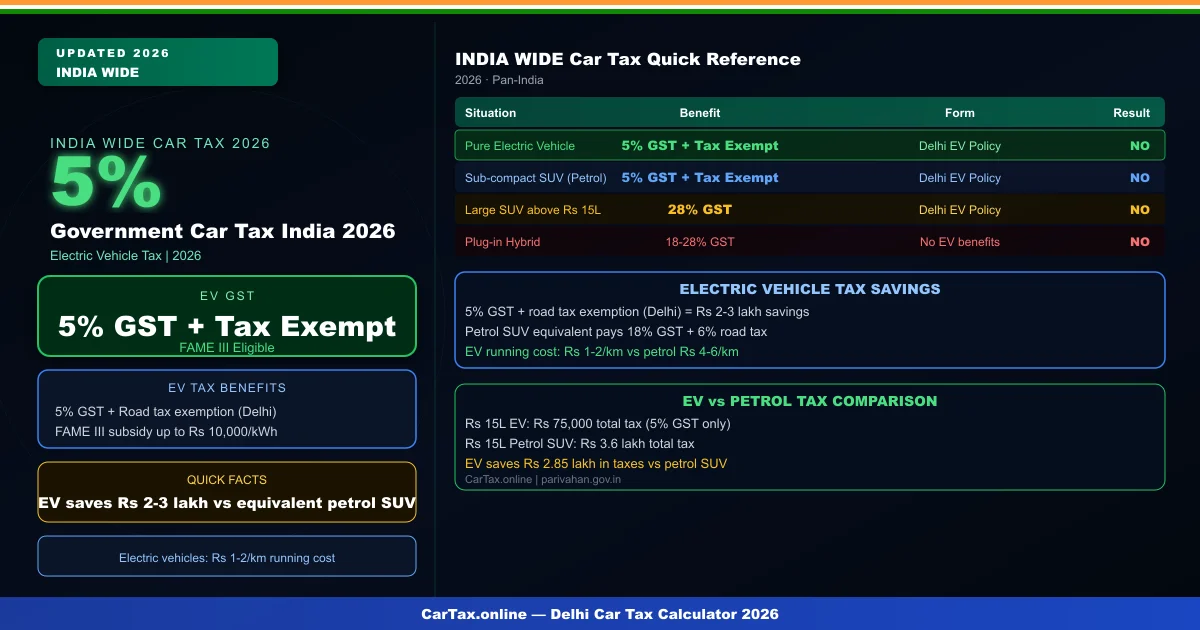
The central government taxes vehicles through the Goods and Services Tax (GST) which replaced multiple earlier taxes including excise duty, customs duty, and VAT. GST rates on vehicles are determined by the GST Council which includes representation from all states, ensuring that rate decisions have broad consensus. The current GST rates range from 5% for sub-4m petrol and electric vehicles to 18% for larger diesel vehicles and luxury cars.
State governments levy road tax independently of the central GST. Road tax rates and structures vary significantly between states as each state has the authority to set its own rates. Delhi uses engine-capacity-based slabs from 4% to 12%, Maharashtra uses a vehicle-length and category system at 6-14%, and states like West Bengal use a lifetime tax model at 8-12%. Some states offer exemptions for electric vehicles while others do not.
The GST Council decisions apply uniformly across all states meaning the central GST component is identical whether you buy a car in Tamil Nadu or Gujarat. However the state road tax component can differ by 10 or more percentage points between states for the same vehicle category. This creates a situation where the same car priced at Rs 10 lakh ex-showroom may cost Rs 14.5 lakh on-road in Delhi but Rs 15.5 lakh in Tamil Nadu purely due to different state road tax rates.
The revenue split between central and state governments from car taxation is approximately 60:40 for GST collections which states collect on behalf of the centre. Road tax revenue is entirely retained by states and forms part of their transportation budget used for road infrastructure, traffic management, and vehicle regulation.
Recent GST Council decisions have progressively reduced rates on smaller and more fuel-efficient vehicles as part of environmental policy. The April 2026 GST 2.0 revision lowered sub-4m petrol rates from 12% to 5% demonstrating the government's intent to promote compact fuel-efficient vehicles while maintaining higher taxation on larger diesel and luxury vehicles.
Frequently Asked Questions
1. How is car tax divided between central and state governments in India?
Cars are taxed by both central and state governments through two separate mechanisms. The central government levies GST (Goods and Services Tax) at rates from 5% to 28% depending on vehicle category. GST is collected by states on behalf of the central government with revenue split approximately 60:40 between centre and states. State road tax is entirely collected and retained by state governments at rates they independently set, typically 4-15% of ex-showroom price.
2. Can state governments change GST rates on cars?
No, state governments cannot independently change GST rates on vehicles. GST rates are set by the GST Council which is a constitutional body with representation from all states and the central government. Rate changes require consensus in the council. States can only influence GST rates through council decisions, not independently. However states have full autonomy over their own road tax rates which are separate from GST.
3. Which car tax component is higher — central GST or state road tax?
For most vehicles, central GST is higher than state road tax. A sub-4m petrol car in Delhi pays 5% GST and 5% state road tax (equal). A >4m diesel car in Maharashtra pays 18% GST but only 12% state road tax. Luxury cars with compensation cess can have central tax of 22-28% versus state road tax of 10-15%. Overall central government share is typically larger but both components are significant.
4. Why do car prices vary so much between Indian states?
Car on-road prices vary between states primarily due to different state road tax rates. While central GST (5-28%) is uniform across India, state road tax varies from 4% to 15% of ex-showroom price. For a Rs 10 lakh car, this state tax difference translates to Rs 40,000 to Rs 1,10,000 variation in on-road price. Registration and RTO fees also vary slightly between states contributing to the price differential.
5. Do both central and state taxes apply on used car purchases?
Yes, used car purchases involve both central and state level charges. Central GST or Income Tax TCS (1% above Rs 10 lakh purchases) applies at the central level while states charge transfer fees, stamp duty (2-7% of declared value), and potentially re-assessment of road tax for inter-state transfers. The total tax on used car purchases can be 3-8% of the vehicle value depending on the state and transaction type.
⚠ Financial & Legal Disclaimer
All information provided in this article is for educational and informational purposes only. The content is synthesized based on verbal communications, extensive internet research, and official government website data as of the date of publishing. Tax laws and insurance policies are subject to frequent changes by the authorities. We strive for accuracy, but we recommend that you consult a qualified professional (CA, CPA, or Tax Consultant) before making any financial decisions. For personalized assistance, you can also connect with our in-house experts through our Contact Us page.
Ready to calculate your car tax?
Use our free calculator to get an instant, accurate estimate for your country and state.
Open Car Tax Calculator →