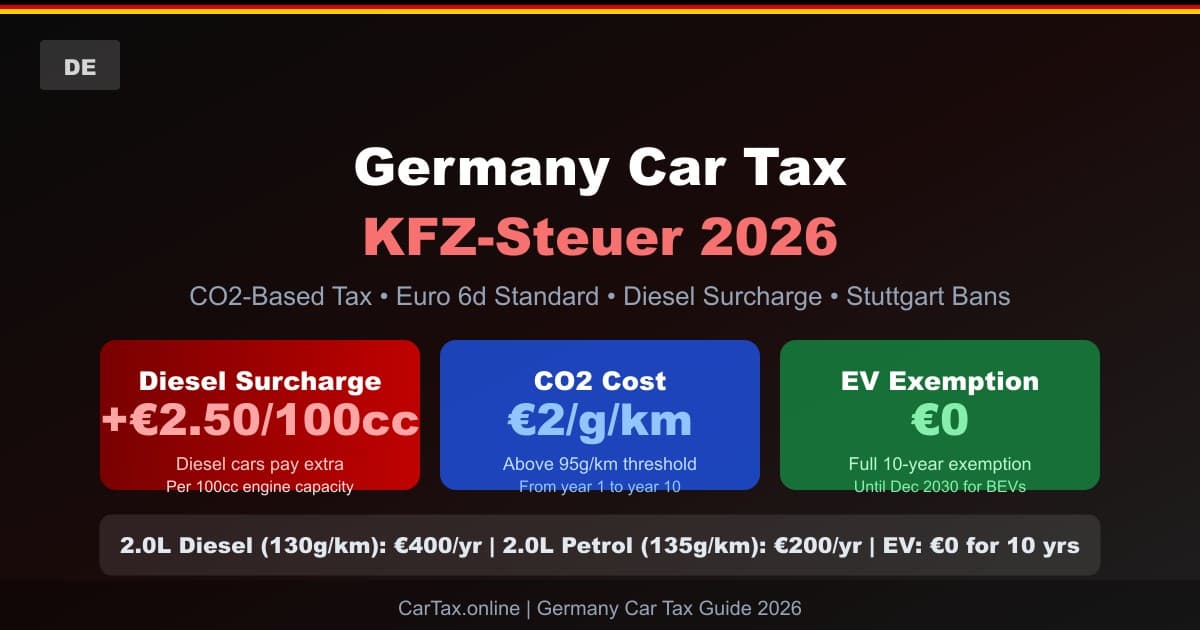
April 29, 2026 in Berlin, Germany — Germany's vehicle tax (KFZ-Steuer) is one of the most sophisticated in the world, combining engine displacement with CO2 emissions to create a truly carbon-based tax. With diesel cars facing significantly higher rates than petrol, and EVs getting a full 10-year exemption, understanding KFZ-Steuer is essential for any German car buyer in 2026.
How German Car Tax Works: The Two-Component System
Germany's KFZ-Steuer combines two separate tax components:
- Engine capacity tax: Based on engine size in cubic centimetres (cc)
- CO2 tax: Based on grams of CO2 emitted per kilometre above a threshold
The tax applies annually and is collected through the German customs authority (Zoll). The good news: German car tax is relatively transparent and calculable once you know the formula.
Engine Capacity Tax Rates
| Fuel Type | Rate per 100cc | 1.0L (1000cc) | 1.5L (1500cc) | 2.0L (2000cc) |
|---|---|---|---|---|
| Petrol | €2.00 | €20 | €30 | €40 |
| Diesel | €9.50 | €95 | €142.50 | €190 |
A diesel engine pays nearly 5x the engine-capacity tax of a petrol engine of the same size. This alone makes a 2.0L diesel cost €150/year more than a 2.0L petrol in engine-capacity tax.
CO2 Tax Component
All cars emitting over 95g/km of CO2 pay additional annual tax for the first 10 years of registration:
CO2 tax = (CO2 g/km - 95) x €2
| CO2 Emissions (g/km) | Excess over 95g | Annual CO2 Tax | Years Applied |
|---|---|---|---|
| 95 (threshold) | 0 | €0 | 10 |
| 120 | 25 | €50 | 10 |
| 140 | 45 | €90 | 10 |
| 160 | 65 | €130 | 10 |
| 180 | 85 | €170 | 10 |
| 200+ | 105+ | €210+ | 10 |
Total KFZ-Steuer by Engine Size and CO2
| Vehicle Type | Engine | CO2 | Engine Tax | CO2 Tax | Total/Year |
|---|---|---|---|---|---|
| Petrol hatchback | 1.4L | 120g | €28 | €50 | €78 |
| Petrol SUV | 2.0L | 155g | €40 | €120 | €160 |
| Diesel family car | 1.6L | 125g | €152 | €60 | €212 |
| Diesel SUV | 2.0L | 145g | €190 | €100 | €290 |
| Large diesel SUV | 3.0L | 175g | €285 | €160 | €445 |
Electric Vehicle Exemption
Battery electric vehicles (BEVs) registered by December 31, 2030 receive a full 10-year exemption from KFZ-Steuer. This means:
- New BEV registered in 2026: €0 tax until 2036
- BEV registered in 2029: €0 tax until 2039
- After exemption ends: EVs pay €0 engine-capacity tax (no fuel type), only CO2 component (which is €0 since EVs emit 0g/km)
In practice, EVs are permanently exempt from KFZ-Steuer because even after the 10-year exemption, the €0 CO2 component means zero annual tax.
Environmental Zones and Diesel Bans
Several German cities have introduced environmental zones that affect which vehicles can be driven:
| City | Low-Emission Zone | Diesel Ban | Fine for Violation |
|---|---|---|---|
| Stuttgart | Yes — green sticker required | Yes — older diesel restricted | €80+ |
| Frankfurt | Yes | Partial | €80+ |
| Berlin | Yes — green sticker required | No full ban | €80 |
| Hamburg | Yes | Yes — specific streets | €80+ |
| Munich | Yes — green sticker required | No full ban | €80 |
The Feinstaubplakette (particle sticker) system classifies vehicles by Euro emissions standard. Green stickers (Euro 4 and above for petrol, Euro 6 and above for diesel) allow access to all zones.
Germany vs Other EU Countries: Car Tax Comparison
| Country | Tax System | Typical Annual Tax | EV Policy |
|---|---|---|---|
| Germany | CC + CO2 | €80-€400 | 10-year exemption |
| France | CO2 malus/bonus | €0-€50,000 | Bonus écologique up to €7,000 |
| UK | CO2 first year, flat after | £190-£2,605 | £0 first year, then £190 |
| Netherlands | CO2-based BPM | €0-€4,000+ | EV exempt until 2025 |
| Sweden | CO2-based | SEK 360-50,000 | Car tax reduction |
How to Calculate Your KFZ-Steuer
Formula: Annual KFZ-Steuer = (cc / 100) x rate + max(0, (CO2 - 95) x €2)
Example 1 — 1.6L petrol, 130g/km: (1600/100) x €2 + (130-95) x €2 = €32 + €70 = €102/year
Example 2 — 2.0L diesel, 145g/km: (2000/100) x €9.50 + (145-95) x €2 = €190 + €100 = €290/year
Example 3 — BEV (any): €0 engine tax + €0 CO2 tax = €0/year (exempt until 2031+)
Conclusion
German KFZ-Steuer combines engine capacity and CO2 to create a genuinely eco-based vehicle tax. Diesel cars pay significantly more than petrol — a 2.0L diesel costs €290/year versus €160/year for a 2.0L petrol with similar emissions. EVs enjoy a 10-year exemption (until 2030 registration) and are permanently cheaper post-exemption due to 0g/km CO2. Use our Germany Car Tax Calculator to find your exact annual KFZ-Steuer.
Disclaimer: KFZ-Steuer rates based on Zoll (German Customs) data as of April 2026. Confirm rates at zollertrag.de before purchasing or registering a vehicle in Germany.
Official Resources: German Customs Zoll | Federal Finance Ministry | Federal Environment Agency