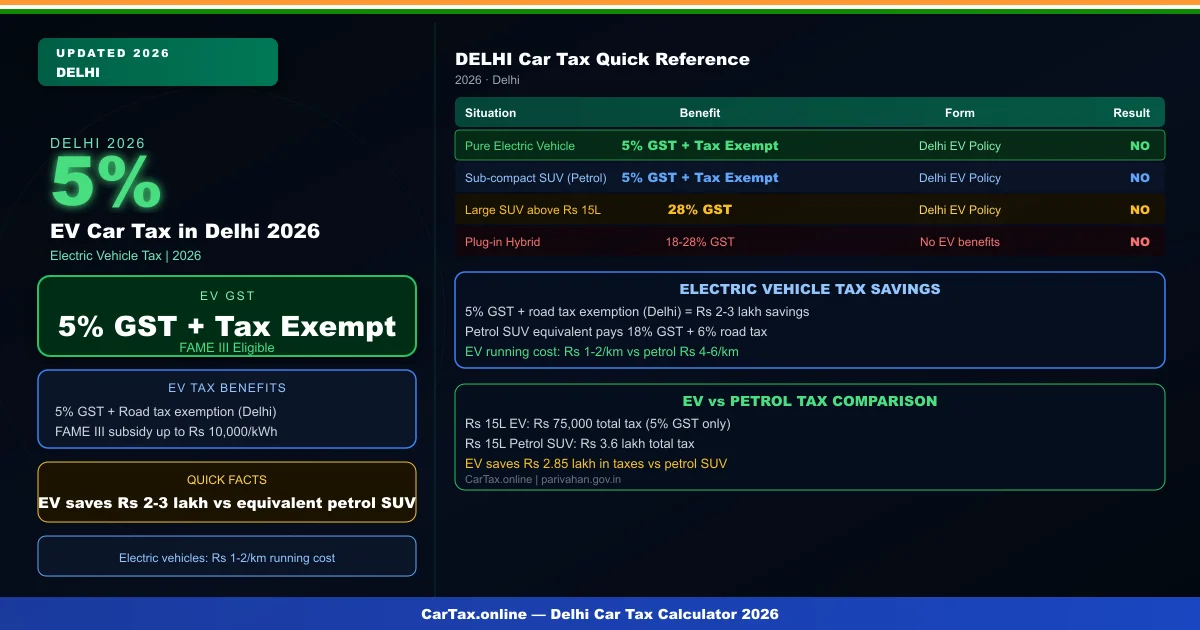
EV car tax in Delhi is the most favourable in India — and it is not close. Electric vehicles in the National Capital Territory enjoy a unique combination of the lowest GST rate (5%), full road tax exemption under the Delhi EV Policy 2024, and reduced registration fees. For buyers considering an electric vehicle in Delhi in 2026, the tax advantage translates to savings of ₹4-6 lakh compared to an equivalent petrol SUV — making EVs not just an environmentally conscious choice but also a financially intelligent one for high-mileage urban drivers.
The Delhi government's EV Policy 2024 represents a serious commitment to electric mobility, with purchase subsidies, free parking, and road tax exemptions designed to accelerate EV adoption in the NCR. Combined with the central government's 5% GST on all electric vehicles and the GST 2.0 reform that keeps EVs in the lowest tax bracket, Delhi has created the most EV-friendly tax environment in the country. For buyers who want to maximise their savings and reduce their carbon footprint simultaneously, the April 2026 EV tax landscape in Delhi is the best it has ever been.
Road Tax Exemption for EVs in Delhi
Electric vehicles in Delhi are 100% exempt from road tax under the Delhi EV Policy 2024. This exemption applies to all battery-operated vehicles — cars, scooters, and motorcycles — registered in the NCT of Delhi.
Road tax exemption value by vehicle price:
- ₹6 Lakh EV (e.g., Tiago EV): Saves ₹24,000-₹30,000 road tax (4-5% bracket)
- ₹14 Lakh EV (e.g., Nexon EV): Saves ₹70,000-₹84,000 road tax (5-6% bracket)
- ₹20 Lakh EV (e.g., Windsor EV): Saves ₹1,00,000-₹1,60,000 road tax (5-8% bracket)
- ₹30 Lakh EV (e.g., BMW iX1): Saves ₹2,40,000 road tax (8% bracket)
The road tax exemption alone saves ₹24,000 to ₹2.4 lakh compared to an equivalent petrol vehicle — real money that stays in your pocket at the time of purchase.
GST on Electric Vehicles in Delhi
All electric vehicles in India attract 5% GST — the lowest bracket in the Indian GST system. This rate applies regardless of vehicle size, type, or price, making EVs the most GST-efficient vehicle category in the country.
GST savings comparison on a ₹20 lakh vehicle:
- EV at 5% GST: ₹1,00,000 GST — the minimum possible
- Sub-Compact Petrol SUV at 18% GST: ₹3,60,000 GST — ₹2,60,000 more than EV
- Large Petrol SUV at 28% GST: ₹5,60,000 GST — ₹4,60,000 more than EV
On a ₹20 lakh car, the EV saves ₹2.6-4.6 lakh in GST alone versus comparable petrol vehicles.
Delhi EV Policy 2024: Complete Incentives Breakdown
The Delhi EV Policy 2024, launched in 2024, provides the following comprehensive incentives for EV buyers:
- Purchase Subsidy: Up to ₹1 lakh for the first 1,000 EV buyers. Applicable to electric cars priced up to ₹25 lakh ex-showroom. This is a direct subsidy paid to the buyer — not a tax benefit.
- Road Tax Exemption: 100% exemption from NCT road tax for all EVs. Saves ₹24,000 to ₹4 lakh depending on vehicle price bracket.
- Registration Fee Rebate: ₹200 for EV registration (vs ₹500-₹600 for petrol vehicles). Minimal in absolute terms but symbolic of the policy's intent.
- Free Parking: Free parking in MCD-controlled parking zones across Delhi. Annual value up to ₹10,000 for registered EVs — saves ₹8,000-₹10,000 per year.
- Home Charging: Reduced electricity tariffs for home EV charging. Contact Delhi DISCOM (BSES/RVUN) for EV-specific tariff plans.
- Income Tax Benefit: Under Section 80EEB, individuals can claim ₹1.5 lakh deduction on interest paid on EV loans — additional savings of up to ₹46,500 for taxpayers in the 30% bracket.
Total Tax Savings: EV vs Petrol SUV in Delhi
Comparing total tax on a ₹20 lakh vehicle in Delhi:
- Electric SUV (₹20L ex-showroom): GST 5% = ₹1,00,000 | Road Tax = ₹0 (exempt) | Total Tax: ₹1,00,000 | On-Road: approximately ₹21.5 lakh
- Petrol Sub-Compact SUV (₹20L ex-showroom): GST 18% = ₹3,60,000 | Road Tax 8% = ₹1,60,000 | Total Tax: ₹5,20,000 | On-Road: approximately ₹26.2 lakh
- Total Tax Savings with EV: ₹4,20,000 — the EV costs ₹4.7 lakh less in total tax
Over 5-7 years of ownership, the EV's lower running cost (electricity vs petrol at approximately ₹3-5/km saving) adds another ₹1-2 lakh in savings, making the total cost of ownership of an EV significantly lower than an equivalent petrol SUV.
Popular EVs Available in Delhi (April 2026) and On-Road Prices
- Tata Nexon EV: ₹14.5 lakh ex-showroom | GST ₹72,500 | Road Tax ₹0 | On-Road: ₹15.5-16 lakh. The bestselling electric SUV in India — ideal for urban families.
- MG Windsor EV: ₹14.99 lakh ex-showroom (excluding battery under BaaS model) | Battery rental ₹3,299/month | On-Road: ₹19.5-20 lakh including battery. Unique BaaS model lowers upfront cost significantly.
- Toyota Ebella: ₹24.95 lakh ex-showroom | GST ₹1.25 lakh | Road Tax ₹0 | On-Road: ₹27-27.5 lakh. Toyota's first electric SUV in India — targets the premium EV segment.
- Hyundai Creta EV (expected mid-2026): Estimated ₹19-22 lakh ex-showroom | On-Road: ₹20.5-23 lakh. Will compete with Ebella and Nexon EV in the mid-premium EV segment.
For EV on-road price calculations with April 2026 GST rates and Delhi EV policy incentives, use the CarTax.online EV tax calculator for Delhi — updated for all current EV models.
Frequently Asked Questions
How much road tax do electric cars pay in Delhi?
Electric cars in Delhi pay ₹0 road tax — they are 100% exempt under the Delhi EV Policy 2024. This exemption applies to all battery-operated vehicles registered in the NCT of Delhi, regardless of vehicle type or price. The exemption saves ₹24,000 on a ₹6 lakh EV to ₹4 lakh on a ₹50 lakh luxury EV.
What is the GST on electric cars in Delhi?
All electric vehicles in India attract 5% GST — the lowest bracket, regardless of size, type, or price. This is a significant reduction from the 18% GST on sub-compact SUVs and 28% GST on large SUVs. On a ₹20 lakh EV, GST is only ₹1 lakh versus ₹3.6-5.6 lakh for equivalent petrol/diesel vehicles — a saving of ₹2.6-4.6 lakh in GST alone.
What subsidies does the Delhi EV Policy 2024 offer?
Delhi EV Policy 2024 offers: (1) Purchase subsidy of up to ₹1 lakh for the first 1,000 EV buyers (cars up to ₹25 lakh ex-showroom); (2) 100% road tax exemption — saves ₹24K to ₹4L depending on vehicle price; (3) Registration fee of ₹200 (vs ₹500-₹600 for petrol); (4) Free parking in MCD-controlled zones (up to ₹10,000 annual value); (5) Reduced electricity tariffs for home EV charging.
What is the total on-road price for an EV in Delhi?
EV on-road price in Delhi is the lowest of any fuel type: Ex-showroom + 5% GST + ₹0 road tax + ₹200 registration + insurance. A Tata Nexon EV at ₹14.5 lakh ex-showroom costs approximately ₹15.5-16 lakh on-road. A ₹25 lakh Toyota Ebella costs approximately ₹27 lakh on-road. Compare this to an equivalent petrol SUV at ₹27-28 lakh on-road for the same ₹25 lakh ex-showroom price.
Are there any downsides to buying an EV in Delhi?
EV downsides in Delhi: (1) Higher upfront cost — EV purchase price is ₹1-3 lakh more than equivalent petrol model, though total tax savings (₹4-6 lakh) offset this; (2) Charging infrastructure — while improving, some areas lack fast chargers; (3) Range anxiety for long-distance travel; (4) Battery replacement after 8-10 years (₹2-5 lakh); (5) Limited model availability in certain segments. For urban drivers doing 30-50km daily, an EV is the most cost-effective choice over 4-6 years.
Official Resources: Delhi EV Policy 2024 | Parivahan Portal | India GST Portal