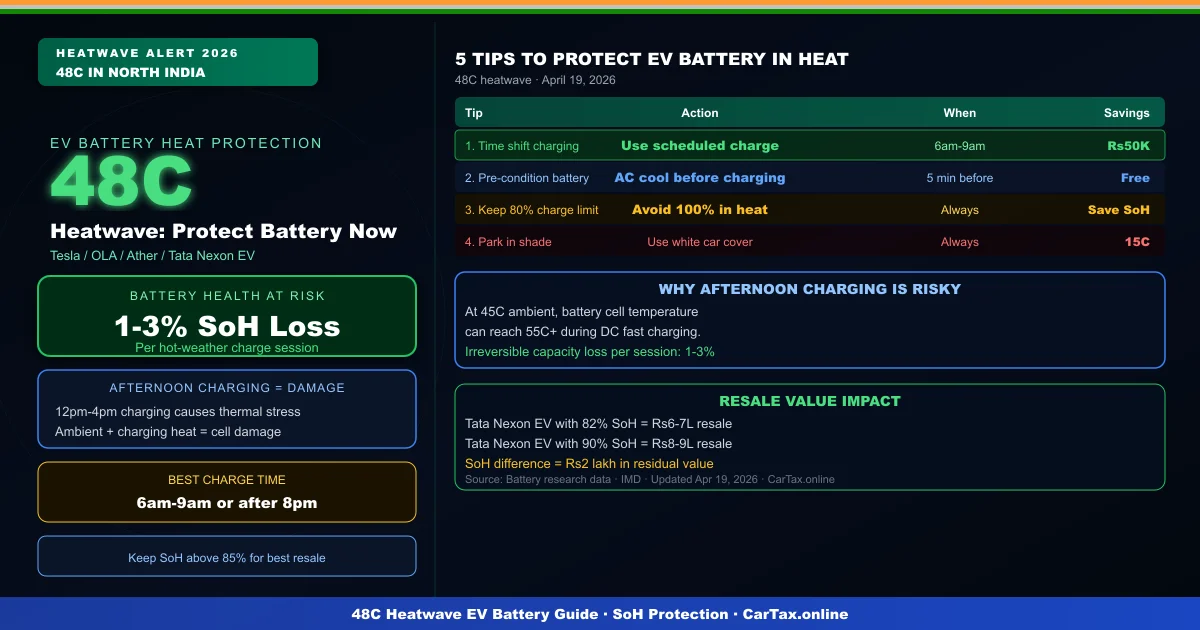
North India is enduring one of its most aggressive April heatwaves in recorded history. Delhi touched 48.2 degrees Celsius on April 18, and the India Meteorological Department has extended the red alert through April 21. For the growing community of EV owners in the National Capital Region, this is not just uncomfortable — it is financially dangerous. Every afternoon charging session in peak heat accelerates lithium-ion cell degradation in a way that is partially irreversible. And the market has started pricing State of Health (SoH) into resale values — which means your charging habits today could cost you Rs50,000 to Rs2 lakh when you sell your EV in three years.
This is not a hypothetical warning. EV battery packs are rated to operate between 15C and 35C for optimal longevity. At 48C ambient temperature, a vehicle parked in direct sunlight can reach interior temperatures of 60-65C. Charging in these conditions — especially DC fast charging — creates a thermal feedback loop that accelerates capacity loss by 15-20% annually versus optimal conditions. If you charge your EV between 12pm and 4pm today, you are not just incurring a minor inconvenience. You are permanently reducing your battery's maximum capacity.
Tip 1: Charge Between 6am and 9am — Never Between 12pm and 4pm
The single most important behavior change is the timing of your charging sessions. Schedule your alarm for 6:30am and plug in before you leave for work. The battery is coolest from the night's rest, and the charging session completes before ambient temperature peaks. If you cannot charge in the morning, the next window is after 8pm — when ambient temperature drops below 35C even during heatwaves. Every EV sold in India in 2025-26 supports scheduled charging through its app. Use it.
Afternoon charging during a heatwave is the single largest avoidable risk factor. A Tesla Model Y charged at 2pm during a 45C heatwave can reach battery cell temperatures of 55C+ during the DC fast charge session. Tesla's Battery Management System will throttle the charge speed as a protective measure — but the damage to cell chemistry from the high temperature is already done. Related: The 45°C Battery Test | 8th Pay Commission Sunday Analysis | 8th Pay Commission Analysis | BH-Series Registration.
Tip 2: Pre-Condition Your Battery Before Charging
Before plugging in during a heatwave — whether at home or at a public charger — run your climate control on battery mode for 5-10 minutes. This brings the battery pack temperature down by 3-5C before accepting charge, reducing the thermal stress during the charging event. All major EVs (Tesla, OLA, Ather, Tata) have this function accessible via their respective apps. The 3-5C reduction in pack temperature before charging meaningfully reduces the rate of capacity degradation.
Tip 3: Keep Your Charge Limit at 80% During Summer
The last 20% of a lithium-ion charge cycle generates the most heat inside the battery pack. Charging to 100% during a heatwave is significantly more damaging than charging to 80%. A Tata Nexon EV with a 40kWh pack charged to 80% provides approximately 280 km of real-world range — more than enough for daily urban use. The 120 km of range sacrificed at 80% versus 100% is a worthwhile trade for the long-term health of your battery and the preservation of your resale value.
If you have a long trip planned and need 100%, do it in the early morning or late evening — never in the afternoon heat. The battery management system works best when the pack temperature is below 30C.
Tip 4: Park in Shade and Use a White Car Cover
A vehicle parked in direct sunlight at 48C ambient reaches an interior temperature of 60C+ within 30 minutes. The battery pack — even when not charging — experiences elevated temperatures that accelerate degradation over time. A white reflective car cover reduces surface temperature by 15-20C, which meaningfully reduces battery pack temperature even before you drive. For EVs without active liquid cooling (OLA S1 Pro, Ather 450X, TVS iQube), this is especially important — these vehicles rely on passive cooling and are more sensitive to ambient temperature.
If you have a covered parking spot or garage, use it. The investment of a shaded parking space — whether at home or in your office building — is cheaper than a battery replacement or premature resale loss.
Tip 5: Use Slow AC Charging Over DC Fast Charging in Summer
DC fast chargers deliver high current that generates significant additional heat inside the battery pack. During a heatwave, the thermal headroom between ambient and safe charging temperature is already compromised. Switching to your home AC charger (3.3kW or 7.2kW) for daily top-ups keeps the charge rate low and the heat generation manageable. Reserve DC fast charging for genuine necessity — a 200km+ journey where you need the speed — not for convenient daily top-ups.
For OLA S1 Pro and Ather owners: the home charger delivered 5-6 hours overnight is your best friend during summer. The slow, gentle charge cycle is far less damaging to cell chemistry than a 20-minute DC fast charge in 45C heat.
The Resale Math: Why This Matters Financially
State of Health (SoH) is now being checked by EV dealers during resale negotiations. A 2023 Tata Nexon EV purchased at Rs14 lakh with 90% SoH in 2026 will sell for Rs8-9 lakh. The same vehicle with 82% SoH due to poor thermal management sells for Rs6-7 lakh. The Rs2 lakh difference is directly attributable to charging habits during summer months. Protect your battery today — it is a financial asset.
Official Resources: Parivahan Portal | Vahan Road Tax | India GST Portal | FAME-III Scheme
Frequently Asked Questions
Q: Is charging an EV during the afternoon in 48C heat dangerous?
Yes — charging at 45C+ ambient temperature accelerates battery degradation by 15-20% annually. Always charge between 6am-9am or after 8pm during heatwaves.
Q: Should I keep my EV charged at 80 percent during summer?
Yes — keeping your charge limit at 80% during summer reduces thermal stress. The last 20% of charging generates the most heat inside the battery pack.
Q: How much does SoH degradation reduce EV resale value in India?
A 10% SoH loss can reduce resale value by Rs40,000-2 lakh depending on the EV model and current market price.
Q: Which EVs are most vulnerable to heat damage without active cooling?
OLA S1 Pro, Ather 450X, and TVS iQube use passive cooling systems and are most sensitive to high-temperature charging. Tesla Model Y and Hyundai Ioniq 5 have active liquid cooling and are more resilient.
Q: Does parking in shade really help EV battery health?
Yes — a white car cover in shade can reduce battery pack temperature by 15-20C compared to direct sunlight, significantly reducing degradation rate during summer.