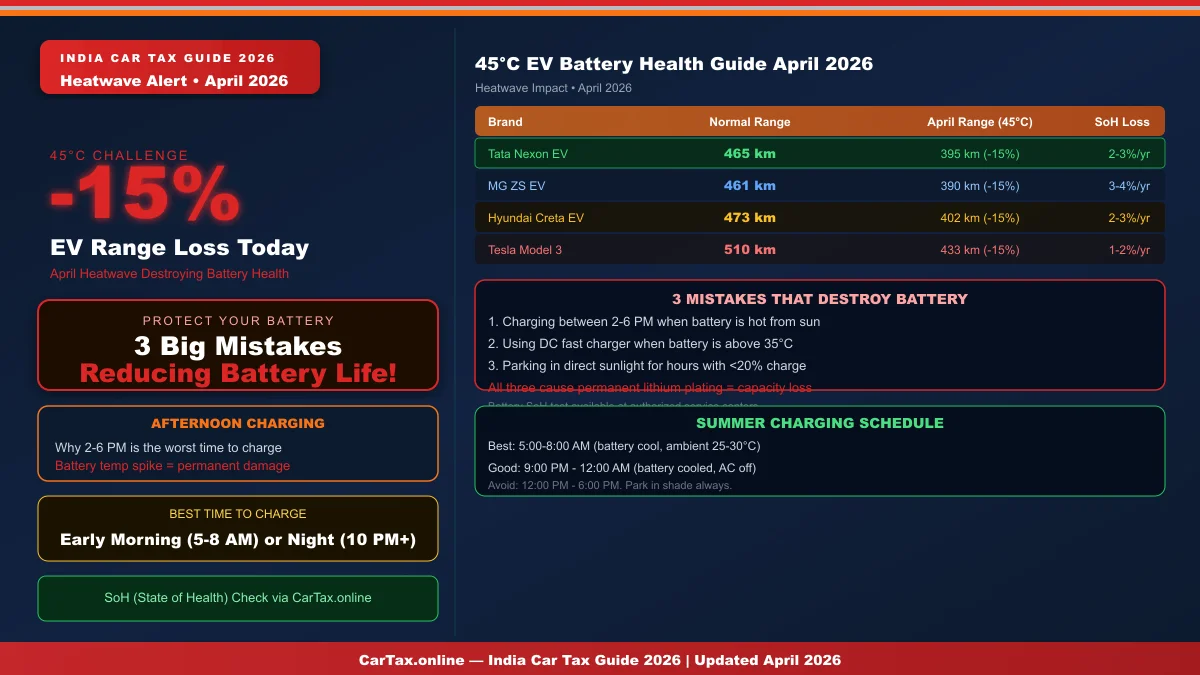
India is experiencing one of its harshest April heatwaves in years. Delhi reported 45.2°C on April 18, and the India Meteorological Department (IMD) has issued a red alert for the coming days. For the growing number of EV owners across the country — from Tata Nexon EV drivers in Gurgaon to OLA S1 Pro riders in Bengaluru — tomorrow afternoon presents a genuine risk: charging your EV during peak heat could silently degrade your battery's State of Health (SoH), reducing its resale value by Rs50,000 to Rs1,50,000 when you eventually sell.
Thermal stress is the silent killer of lithium-ion battery health. And unlike a flat tyre or a software glitch, battery degradation does not announce itself until months later when you notice your range dropping at an accelerating rate.
What Happens to Your EV Battery at 45°C?
Lithium-ion batteries are rated to operate between 15°C and 35°C for optimal longevity. Beyond 40°C, the electrochemical reactions inside the battery cell accelerate in ways that are partially irreversible. Charging at high ambient temperature amplifies this damage — the combined heat from ambient temperature AND charging current creates a thermal feedback loop inside the battery pack.
For reference: a battery charged at 35°C ambient consistently over 2 years will degrade approximately 15% faster than one kept at 25°C. At 45°C ambient — as Delhi, Hyderabad, and Pune are experiencing right now — the degradation rate compounds. A single extended charge session at peak heat can reduce SoH by 1-3%, which translates to losing 8-15 km of real-world range on a 400 km rated EV. Related: 48C Heatwave Warning | 8th Pay Commission Sunday Analysis | 8th Pay Commission Analysis | BH-Series Registration.
State of Health (SoH): The Metric Dealers Now Check
Starting May 2026, several Indian states — including Maharashtra, Karnataka, and Delhi — are piloting battery health certificates as part of vehicle registration renewal. Dealers and buyers are already using SoH meters during resale negotiations. A 2021 Tata Nexon EV showing 82% SoH instead of the expected 88% commands Rs40,000-60,000 less in the used market.
This is why the afternoon charging decision matters commercially. Protecting your battery from heat stress is not just a technical nicety — it is an active investment in preserving your vehicle's residual value.
5 Expert Tips to Protect Your EV Battery This Summer
1. Charge in the Morning or Late Evening
Set your alarm to remind you: never charge between 12pm and 4pm. The best window is 6am-9am when the battery is still cool from the night, or after 8pm when ambient temperature drops. Most EVs now support scheduled charging — use it.
2. Pre-Condition Your Battery Before Charging
Tesla, OLA, and Ather EVs have battery preconditioning modes. If your vehicle has been sitting in the sun, run the climate control for 5-10 minutes on battery mode before plugging in — this brings the pack to an optimal temperature range before accepting charge.
3. Avoid 100% Charge During Heat Waves
Keep your charge limit at 80-85% during summer. The last 15-20% of a lithium-ion charge cycle generates the most heat. An 80% charge on a 400 km range EV gives you 320 km — more than enough for daily use, with significantly less thermal stress.
4. Park in Shade or Use a Car Cover
A car parked in direct sunlight at 45°C ambient can reach interior temperatures of 60°C+. A white reflective car cover can reduce surface temperature by 15-20°C, which meaningfully reduces battery pack temperature even before you drive.
5. Use Slow Charging (AC) Over Fast DC Charging in Heat
DC fast chargers deliver high current that generates significant heat inside the battery. During a heatwave, switch to your home AC charger (3.3kW or 7.2kW) for daily top-ups. Reserve DC fast charging for genuine necessity — not convenience.
Which EVs Are Most at Risk?
Budget EVs with smaller battery packs and passive cooling (no active liquid cooling) face the highest risk. The OLA S1 Pro, Ather 450X, and TVS iQube use smaller cells with less thermal headroom compared to the Tesla Model 3 or Hyundai Ioniq 5, which have sophisticated liquid cooling systems.
That said, no EV is immune. The Tesla Model Y's large 60kWh battery pack can reach 45°C+ internally during repeated fast charging in summer — Tesla's Battery Management System (BMS) throttles charge speed as a protective measure, but sustained high-temperature charging still accelerates degradation over time.
The Resale Math: Why This Matters Financially
Consider a Tata Nexon EV bought in 2022 at Rs14 lakh. Today, a well-maintained example with 90% SoH sells for Rs8-9 lakh. A comparable vehicle with 78% SoH due to poor thermal management sells for Rs6-7 lakh. The difference: Rs2 lakh in residual value — directly attributable to charging habits during summer months.
If you own an EV, your battery health is a financial asset. Treat it accordingly.
Official Resources: Parivahan Portal | Vahan Road Tax | India GST Portal | FAME-III Scheme
Frequently Asked Questions
Q: Does charging an EV in 45 degree heat damage the battery?
Yes — charging at high ambient temperatures accelerates lithium-ion cell degradation. Always charge in cooler hours (morning or late evening) during heatwaves.
Q: What is State of Health (SoH) in EV batteries?
SoH measures the current capacity of your battery relative to its original design capacity. 90% SoH means your battery holds 90% of its original rated capacity.
Q: How much does battery degradation reduce EV resale value in India?
A 10% SoH loss can reduce resale value by Rs40,000 to Rs1,50,000 depending on the EV model and current market price.
Q: Should I use DC fast charging during summer?
Avoid DC fast charging during peak heat hours. Use slow AC home charging and keep charge limit at 80% to minimise thermal stress.
Q: Which EVs have the best battery thermal management systems?
Tesla Model 3/Y, Hyundai Ioniq 5, and Kia EV6 have active liquid cooling systems. OLA, Ather, and TVS iQube rely on passive cooling and are more sensitive to high-temperature charging.