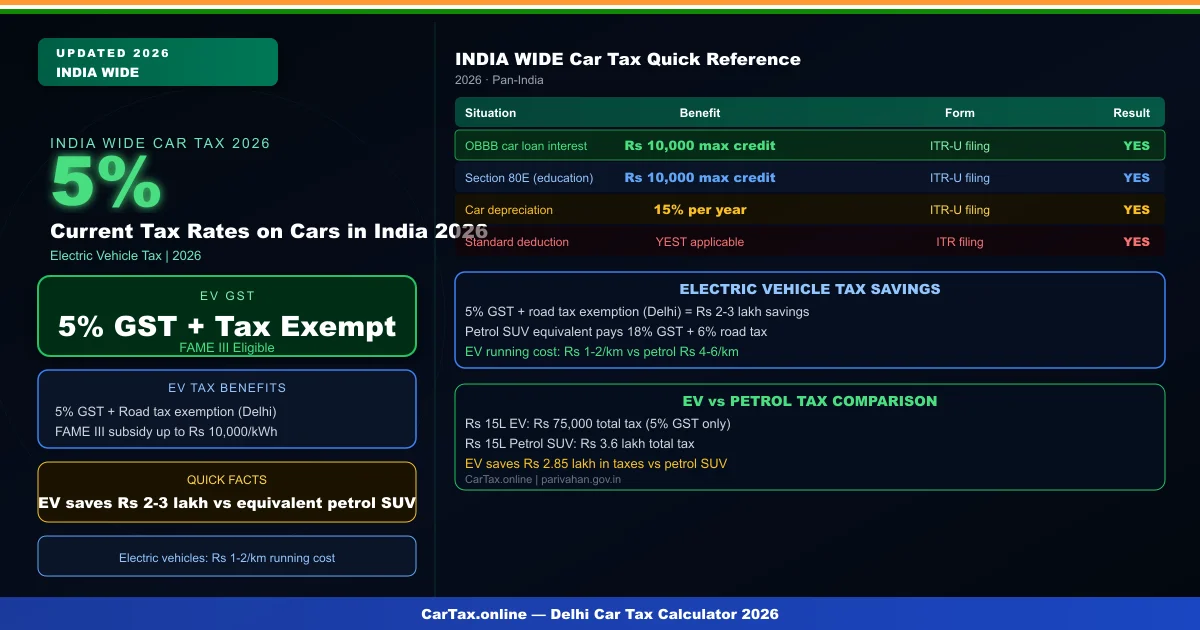
India's car taxation system involves both central GST and state road tax, with rates varying significantly based on vehicle type, engine capacity, length, and the state of registration. The April 2026 GST 2.0 revision brought changes to several vehicle categories making it the right time to understand current rates.
Central GST rates for passenger vehicles in 2026 range from 5% to 18%. Sub-4 metre petrol and strong hybrid cars attract the lowest 5% GST rate as an incentive for fuel-efficient vehicles. Normal diesel vehicles above 4 metres length pay 18% GST while fully electric vehicles enjoy 5% GST plus state government subsidies in many states.
State road tax is the second major component and is calculated as a percentage of the ex-showroom price. Delhi uses engine capacity slabs ranging from 4% for small petrol cars up to 12% for large diesel vehicles. Maharashtra employs a vehicle length and engine category based system with rates from 6% to 14%. Karnataka calculates road tax based on vehicle length with rates between 5% and 13%.
Several states use a one-time lifetime road tax system instead of annual tax. West Bengal, Odisha, Jharkhand and some northeastern states charge road tax as a lump sum at the time of first registration. West Bengal's lifetime tax for private cars ranges from 8% to 12% of the vehicle value depending on engine capacity. This system provides cost certainty for buyers as they pay only once at the time of purchase.
Combining GST and state road tax, the total tax burden on a new car ranges from approximately 18% of ex-showroom for a small petrol sub-4m car in a low-tax state to over 35% for a large diesel vehicle in states like Tamil Nadu. Electric vehicles enjoy the lowest total taxation due to GST reduction and state-specific incentives.
Luxury cars above Rs 20 lakh attract 18% GST plus compensation cess that can push effective GST to 22% or higher. State road tax on luxury cars is also higher at 10-15% in most states. For a Rs 1 crore luxury car the total tax component can exceed Rs 35 lakh making India among the highest-taxed markets for premium vehicles globally.
Frequently Asked Questions
1. What is the current GST rate on different types of cars in India?
Current GST rates on cars in India 2026: sub-4m petrol and strong hybrid vehicles 5% (lowest rate after April 2026 GST 2.0 revision), fully electric vehicles 5% with state subsidies, diesel vehicles above 4m length 18%, and luxury cars above Rs 20 lakh 18% plus additional compensation cess of 15-25% of GST amount. These rates apply to the ex-showroom price declared by the manufacturer.
2. Which state has the lowest road tax for cars in India?
Gujarat, Rajasthan and Karnataka generally have among the lowest road tax rates for private cars in India. Gujarat charges 4-10% based on engine capacity, Rajasthan offers competitive rates at 5-11%, and Karnataka charges 5-13% based on vehicle length. Delhi at 4-12% is also competitive for smaller vehicles. However rates change periodically as state governments revise their tax schedules.
3. Which Indian state has the highest road tax for cars?
Tamil Nadu, Andhra Pradesh, and West Bengal have some of the highest road tax rates for private cars. Tamil Nadu charges 8-15% depending on vehicle age and engine size, Andhra Pradesh 7-13%, and West Bengal 8-12% as a lifetime tax. These rates combined with GST can push total taxation above 30% of the ex-showroom price for standard vehicles.
4. Are electric cars taxed differently in India?
Yes, electric vehicles enjoy preferential tax treatment in India. The central GST rate is 5% (lowest slab) compared to 18-28% for conventional vehicles. Many state governments offer additional incentives including road tax exemptions, registration fee waivers, and direct purchase subsidies. States like Delhi, Maharashtra, Karnataka and Gujarat have EV-specific policies with full or partial road tax exemption for electric cars.
5. How do I calculate total tax on a new car purchase?
Total car tax calculation: Step 1: Take ex-showroom price. Step 2: Apply applicable GST rate (5% for sub-4m petrol/hybrid/EV, 18% for diesel/luxury). Step 3: Add state road tax percentage of ex-showroom price (varies 4-15% by state). Step 4: Add fixed charges: registration fee (Rs 600), smart card fee (Rs 200), and number plate (Rs 150-400). The sum gives you the total tax and government charges component of the on-road price.
⚠ Financial & Legal Disclaimer
All information provided in this article is for educational and informational purposes only. The content is synthesized based on verbal communications, extensive internet research, and official government website data as of the date of publishing. Tax laws and insurance policies are subject to frequent changes by the authorities. We strive for accuracy, but we recommend that you consult a qualified professional (CA, CPA, or Tax Consultant) before making any financial decisions. For personalized assistance, you can also connect with our in-house experts through our Contact Us page.
⚠ वित्तीय एवं कानूनी डिस्क्लेमर
इस लेख में दी गई सभी जानकारी केवल शिक्षा और सूचना के उद्देश्य से है। यह कंटेंट इंटरनेट रिसर्च, सरकारी वेबसाइटों के आंकड़ों और मौखिक चर्चाओं पर आधारित है। टैक्स नियम और इंश्योरेंस पॉलिसियां सरकार द्वारा समय-समय पर बदली जा सकती हैं। हालांकि हम सटीकता का पूरा ध्यान रखते हैं, फिर भी हम सलाह देते हैं कि कोई भी वित्तीय निर्णय लेने से पहले आप किसी योग्य विशेषज्ञ (CA, CPA या टैक्स सलाहकार) से परामर्श जरूर लें। व्यक्तिगत सहायता के लिए आप हमारे विशेषज्ञों से हमारे संपर्क करें (Contact Us) पेज के माध्यम से भी जुड़ सकते हैं।
Ready to calculate your car tax?
Use our free calculator to get an instant, accurate estimate for your country and state.
Open Car Tax Calculator →