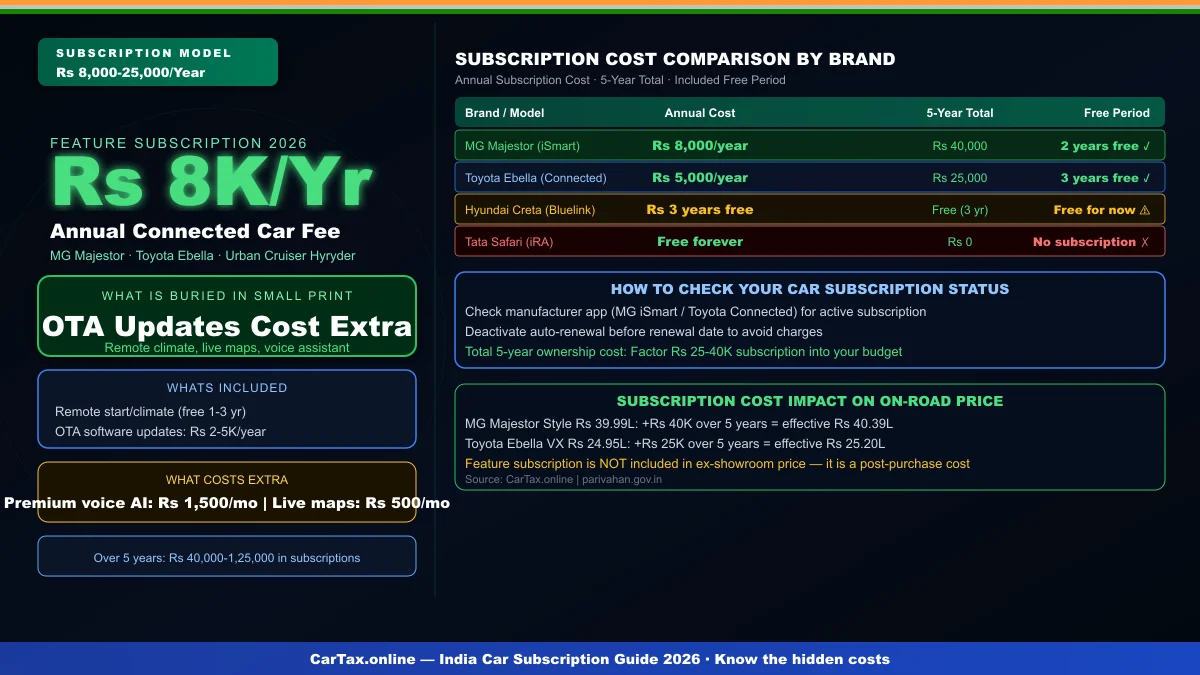
The era of "all features included" in your car purchase price is quietly ending. In 2026, MG Majestor and Toyota Ebella buyers across India are discovering a new line item in their ownership cost: the connected feature subscription. What was once a complimentary add-on — remote climate control on a hot summer day, live traffic updates navigating you around a Mumbai traffic jam, over-the-air software updates that add new driving modes — now carries an annual price tag of Rs 5,000-25,000 per year. For buyers who spent months comparing ex-showroom prices, GST rates, and road taxes, this discovery often comes after the purchase, in the fine print of the connected services terms. Understanding the connected feature tax is now as important as comparing GST slabs when buying a new vehicle.
The connected feature subscription model follows a familiar pattern from the smartphone industry: sell the hardware at a competitive price to win the purchase decision, then monetise the software and services relationship over the vehicle's 7-10 year lifespan. For MG Motor India and Toyota Kirloskar Motor, the connected services subscription represents a recurring revenue stream that offsets the competitive pricing pressure in a crowded SUV market. For buyers, it means the Rs 18-40 lakh on-road price you budgeted for is not the complete picture — the subscription adds Rs 25,000-40,000 over the first 5 years of ownership.
What Connected Feature Subscriptions Actually Cover
The connected feature subscription covers a range of digital services that modern cars increasingly depend on. Understanding what is included and what is excluded is essential for making an informed purchase decision.
Included in most connected subscriptions (MG, Toyota, Hyundai, Kia):
- Remote Climate Control: Start your air conditioning 10 minutes before you reach the car, pre-set the cabin temperature. Particularly valuable in India's summer heat — and only accessible through the connected app when you have an active subscription.
- Over-the-Air (OTA) Updates: Software improvements that add new features, improve performance, or fix bugs — delivered wirelessly without visiting a service centre. Critical safety updates are mandated to be free; feature enhancements are typically subscription-gated.
- Live Traffic and Navigation: Real-time traffic data overlaid on your navigation system, automatically rerouting you around congestion. Without subscription, your navigation uses static map data only.
- Vehicle Health Report: Monthly report on battery health (for EVs), brake pad wear, tyre pressure, and fluid levels — sent to your phone and dealership.
- Find My Car and Trip History: Locate your vehicle in a crowded parking lot, review your driving history and routes.
What remains free even without subscription:
- Physical controls: all buttons, knobs, and physical switches work without subscription
- Bluetooth audio: phone pairing for music and calls works without subscription
- CarPlay/Android Auto: smartphone integration works without subscription (though live traffic within these apps may require data)
- Emergency SOS: automatic crash notification is mandated to be free by law
Brand-by-Brand Subscription Cost Comparison 2026
The annual connected feature subscription cost varies significantly between brands. Here is the complete picture for popular 2026 models:
- MG Majestor (iSmart): Rs 8,000/year after 2-year free period. 5-year cost: Rs 40,000. Best value tier for tech-forward buyers.
- MG Windsor EV (iSmart): Rs 5,000/year after 2-year free period. 5-year cost: Rs 25,000.
- Toyota Ebella (Toyota Connected): Rs 5,000/year after industry-leading 3-year free period. 5-year cost: Rs 25,000. Toyota leads on complimentary period.
- Toyota Urban Cruiser Hyryder (Toyota Connected): Rs 4,000/year after 3-year free period.
- Hyundai Creta/Sonet (Bluelink): Currently free for lifetime — but Hyundai has announced a paid subscription model from 2027. Budget Rs 3,000-5,000/year from Year 4 onwards.
- Kia Seltos/Carnival (Kia Connect): Rs 6,000/year after 3-year free period. 5-year cost: Rs 25,000.
- Tata Safari/Nexon EV (iRA): Free for lifetime — no subscription required. Tata's approach prioritises customer retention over recurring revenue.
The OTA Update Battle: Free Safety vs Paid Features
One of the most contentious aspects of the connected subscription model is the distinction between free safety updates and paid feature updates. Regulatory pressure from the Ministry of Road Transport and Highways (MoRTH) has mandated that critical safety-related software updates — including fixes to ADAS systems, airbag deployment logic, and brake assist calibration — must be provided free of charge to all vehicle owners regardless of subscription status. This means that if your lane departure warning system has a software bug that causes it to give false alerts, the fix must be provided free.
However, feature enhancements fall outside this mandate. Examples of subscription-only OTA features include: new voice assistant commands, additional driving modes (sport, eco, snow), custom ambient lighting patterns (for vehicles with RGB ambient lighting), enhanced battery preconditioning algorithms (for EVs), and new infotainment widgets and apps. For MG Majestor buyers specifically, the OTA updates for the Level-2 ADAS system improvements are expected to be free for the first 2 years, with future ADAS enhancements potentially behind the subscription paywall.
How to Budget for the Connected Feature Subscription
When calculating the total cost of ownership for your new vehicle purchase, add the connected feature subscription as a recurring annual cost:
- MG Majestor Style (Rs 39.99 lakh): Add Rs 8,000/year = Rs 40,000 over 5 years. Effective price: Rs 40.39 lakh.
- Toyota Ebella VX (Rs 24.95 lakh): Add Rs 5,000/year from Year 4 onwards = Rs 25,000 over 5 years. Effective price: Rs 25.20 lakh.
- Hyundai Creta SX (Rs 17.5 lakh): Budget Rs 3,000/year from 2027 = Rs 15,000 over 5 years (if paid model launches as announced).
- Tata Nexon EV (Rs 14.5 lakh): Rs 0 subscription. Effective price: Rs 14.5 lakh — making the total cost of ownership significantly lower.
For buyers comparing vehicles in the same price range, the subscription cost difference of Rs 15,000-40,000 over 5 years may tip the balance towards brands like Tata that offer free connected services for life.
How to Avoid Unexpected Subscription Charges
Before purchasing any new vehicle in 2026, ask the dealer specifically about the connected services subscription terms:
- Ask for the subscription renewal price in writing — not just the complimentary period but the annual renewal cost after the free period expires.
- Check if auto-renewal is enabled by default — many connected apps enable auto-renewal when you first pair your phone. Disable it immediately if you want to control when you start paying.
- Understand which features are free without subscription — basic Bluetooth, physical controls, and SOS emergency calls should never require a subscription.
- Consider a multi-year subscription if you keep the car — most brands offer a 20-30% discount on 2-3 year prepaid plans versus annual renewal. If you plan to keep the car for 5+ years, a 3-year upfront payment saves money.
For a complete total cost of ownership calculation that includes connected feature subscriptions, GST, road tax, insurance, and fuel/charging costs, use the CarTax.online car ownership cost calculator — updated with April 2026 subscription pricing for all major car brands in India.
Official Resources: MG Motor India | Toyota India | Hyundai India | Tata Motors