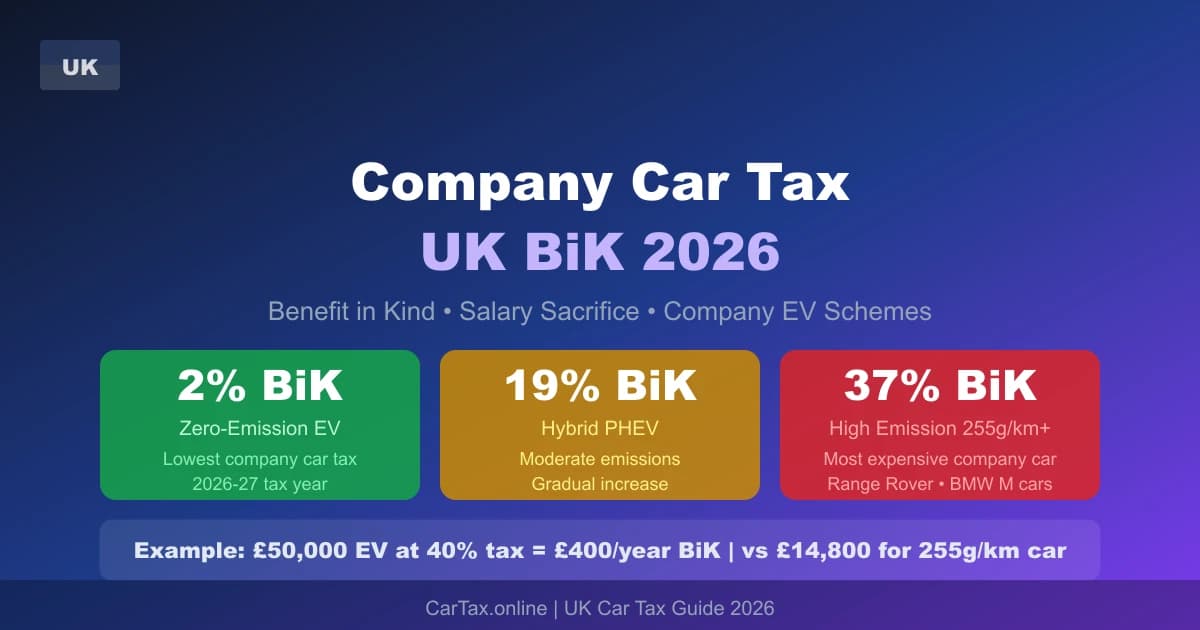
April 27, 2026 in London, United Kingdom — Company cars remain one of the most valuable employment benefits available in the UK, but the tax treatment varies dramatically depending on what you drive. A zero-emission electric vehicle attracts a Benefit in Kind (BiK) rate of just 2% — while a high-emission Range Rover or BMW M car can attract rates up to 37%. Understanding these rates is essential for both employers offering company car schemes and employees considering their options.
What Is Benefit in Kind (BiK) Tax?
Benefit in Kind is a tax applied to non-cash employment benefits. For company cars, BiK is calculated based on the vehicle's P11D value — the manufacturer's list price including VAT, delivery charges, and any optional extras. The BiK rate is determined by the vehicle's CO2 emissions.
Your personal BiK tax liability = P11D Value × BiK Rate × Your Marginal Income Tax Rate
BiK Rates for 2026-27 Tax Year
| CO2 Emissions (g/km) | BiK Rate 2026-27 | Example Vehicle |
|---|---|---|
| 0 (Electric) | 2% | Tesla Model 3, BMW i4, Mercedes EQC |
| 1–50 (PHEV, >130 miles) | 5% | BMW 330e, Mercedes A250e |
| 1–50 (PHEV, 70-129 miles) | 8% | Volkswagen Golf GTE |
| 1–50 (PHEV, 40-69 miles) | 12% | Older PHEVs |
| 1–50 (PHEV, <40 miles) | 14% | Basic PHEVs |
| 51–54 | 15% | Low-emission conventional hybrids |
| 55–59 | 16% | Eco-friendly petrol/diesel |
| 60–64 | 17% | Fuel-efficient conventional |
| 65–69 | 18% | Average family cars |
| 70–74 | 19% | Standard petrol |
| 75–79 | 20% | Standard petrol/diesel |
| ... | ... | ... |
| 180-184 | 35% | Performance cars |
| 185-189 | 36% | High-performance |
| 255+ | 37% | Super-cars, heavy SUVs |
Real Examples: BiK Tax for Different Vehicles
Example 1: Tesla Model 3 RWD (£38,990)
- P11D value: £38,990
- BiK rate: 2%
- Annual BiK value: £38,990 × 2% = £779.80
- Tax at 20% (basic rate): £155.96/year
- Tax at 40% (higher rate): £311.92/year
Example 2: BMW 330e Plug-in Hybrid (£48,000)
- P11D value: £48,000
- BiK rate: 5%
- Annual BiK value: £48,000 × 5% = £2,400
- Tax at 20%: £480/year
- Tax at 40%: £960/year
Example 3: BMW M3 Competition (£74,000)
- P11D value: £74,000
- BiK rate: 37%
- Annual BiK value: £74,000 × 37% = £27,380
- Tax at 20%: £5,476/year
- Tax at 40%: £10,952/year
Example 4: Range Rover Sport D300 (£75,000, 218g/km)
- P11D value: £75,000
- BiK rate: 37%
- Annual BiK value: £75,000 × 37% = £27,750
- Tax at 20%: £5,550/year
- Tax at 40%: £11,100/year
The True Cost of a Company Car vs. Personal Purchase
One of the key advantages of a company car is that the employer typically covers:
- Road tax (VED)
- Insurance
- Maintenance and servicing
- Roadside assistance
These costs must be factored in when comparing company car schemes to personal vehicle ownership.
Salary Sacrifice: Maximising Company Car Value
Salary sacrifice schemes allow employees to exchange part of their gross salary for a company car. This reduces:
- Income tax (you pay tax on a lower salary)
- National Insurance contributions
- Student loan repayments
- Pension contributions
Example: £10,000 salary sacrifice for a £50,000 EV company car:
- Income tax saved (40% rate): £4,000
- NIC saved (2% rate): £200
- Total annual saving: £4,200
This makes salary sacrifice particularly powerful for high earners in the 40% tax bracket.
Employer Costs: Class 1A National Insurance
Employers also pay Class 1A National Insurance on the BiK value of company cars:
- Rate: 13.8% of BiK value
- Example: £50,000 EV at 2% = £1,000 BiK value × 13.8% = £138/year employer cost
- Compare: £75,000 Range Rover at 37% = £27,750 BiK value × 13.8% = £3,829.50/year employer cost
This employer NIC cost is one reason many companies actively restrict employees from selecting high-emission vehicles — it is simply too expensive for the business.
VANs and Light Commercial Vehicles
Vans and pick-up trucks used for business purposes have a different BiK calculation:
- Standard Van BiK: £3,960 (2026-27)
- Zero-emission Van: £nil (2026-27)
- Pick-up trucks: taxed as cars if they have passenger seats
The 2030 Company Car Deadline
From 2030, the sale of new petrol and diesel cars will end in the UK. This means company car fleets must be fully electric by 2030. Many employers are already accelerating their EV transitions:
- Fleet emission targets are being introduced by major corporations
- EV salary sacrifice schemes are becoming standard
- Home charging infrastructure is being supported by employers
Conclusion
Company car BiK tax in 2026-27 offers a compelling financial case for electric vehicles. At just 2% BiK rate, a £50,000 EV costs a 40% taxpayer only £400/year in personal tax — versus £11,100/year for a comparable Range Rover. Use our Car Tax Calculator to compare your options.
Disclaimer: BiK rates are HMRC confirmed figures for 2026-27 tax year. Always consult a tax advisor for your specific situation.
Official Resources: HMRC Company Car Tax | VED Information