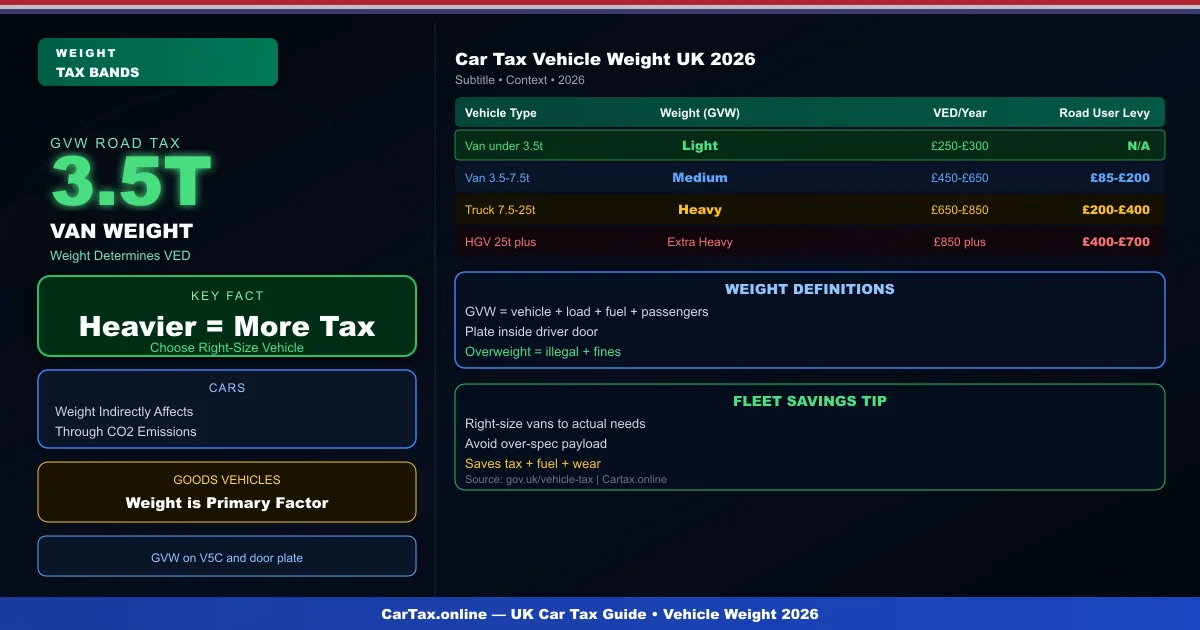
Vehicle weight is a critical factor in road tax calculations — particularly for goods vehicles, vans, and larger passenger vehicles. Understanding how gross vehicle weight interacts with VED bands helps you calculate the correct tax and identify potential savings.
Weight and VED for Cars
For standard passenger cars, weight does not directly affect road tax. VED is calculated purely on CO2 emissions and list price. However, weight affects CO2 indirectly — heavier vehicles typically have higher CO2 emissions due to the additional energy required to move them. A heavy 4x4 with a large engine will emit more CO2 than a light city car, meaning the heavier vehicle pays more road tax. Weight is not a direct input to the VED calculation, but it shapes the CO2 figure that is.
Weight Bands for Vans and Goods Vehicles
For goods vehicles — vans, trucks, and commercial vehicles — weight is the primary determinant of road tax. VED for goods vehicles is calculated in bands based on the vehicle's gross vehicle weight (GVW). Lighter vans under 3.5 tonnes pay less than heavier commercial vehicles. The rates increase in steps, with the heaviest multi-axle HGVs paying the highest rates. This creates significant variation in road tax costs across the commercial vehicle sector.
Understanding Gross Vehicle Weight
Gross vehicle weight is the maximum permitted weight of the vehicle including its own mass, fuel, passengers, and load. It is recorded on the vehicle's V5C and is the figure DVLA uses for VED classification. You can find the GVW on the vehicle's weight plate, usually inside the driver's door frame. The plated weight is the maximum — exceeding this in practice is illegal and can result in fines and vehicle seizure. Related: Car Tax and Vehicle Weight UK 2026 | Motorhome Road Tax UK 2026 | Motorhome Road Tax UK 2026 | Motorhome Road Tax UK 2026.
Lightweight Vans and Tax Savings
Choosing a lightweight van can significantly reduce road tax costs. A van under 3.5 tonnes GVW in the lightest band pays around £250-£300 per year. A van in the 3.5-7.5 tonne band pays significantly more. For businesses running multiple vans, the weight-based tax structure means that choosing the right-sized van for the job — not over-specifying on payload — reduces both road tax and fuel costs.
Weight and the Additional Rate
One little-known interaction between weight and road tax is the additional rate for vehicles with a list price over £40,000. This additional rate of £355 per year applies to all vehicles — including vans and heavier goods vehicles — if their list price exceeds the threshold. This means a high-specification van or a luxury 4x4 can incur the additional rate regardless of its CO2 emissions or weight, simply because of its purchase price.
Reducing Road Tax Through Vehicle Choice
The most effective way to use weight as a tax-planning factor is to select vehicles that are appropriately sized for their purpose. A business that needs to carry occasional heavy loads should choose a van with a gross weight just above what it actually needs — not a much higher specification. The weight-based tax savings on a well-specified fleet can be substantial over the vehicle's lifetime.
Official Resources: GOV.UK Check Vehicle Tax | GOV.UK Vehicle Tax | DVLA Online | MOT Check
Frequently Asked Questions
Q: How much is car tax (VED) in the UK 2026?
Car tax rates in the UK depend on your vehicle's CO2 emissions and list price. Standard rates start from £190 per year for petrol and diesel cars, with zero-rated VED for EVs. First-year rates vary from £0 to £2,605 depending on emissions. Additional premiums apply for vehicles over £40,000.
Q: How do I check if my car is taxed online?
You can check your vehicle's tax status for free on the Gov.uk website at gov.uk/check-vehicle-tax. You'll need your vehicle's registration number (number plate). You can also check via the Motor Insurance Database to verify road tax and insurance status simultaneously.
Q: Can I get a refund on car tax if I sell my vehicle?
Yes — if you sell or scrap your vehicle, you can claim a refund on any full months of remaining road tax. Contact DVLA with the V11 reminder letter or apply online at gov.uk. Refunds are usually processed within 4-6 weeks.
Q: Is road tax refund available when transferring ownership?
No — road tax does not transfer with the vehicle. When you sell your car, the tax is automatically cancelled and any remaining months are refunded to you by DVLA. The new owner must tax the vehicle immediately. As a buyer, always verify the vehicle's tax status before purchasing.
Q: What is the luxury car tax threshold in the UK 2026?
The additional rate for vehicles over £40,000 (list price) adds £410 per year to standard VED rates for years 2-6 of registration. This surcharge brings the annual cost for high-emission vehicles over £40,000 to around £600-690 per year. Pure EVs under £40,000 pay zero VED.