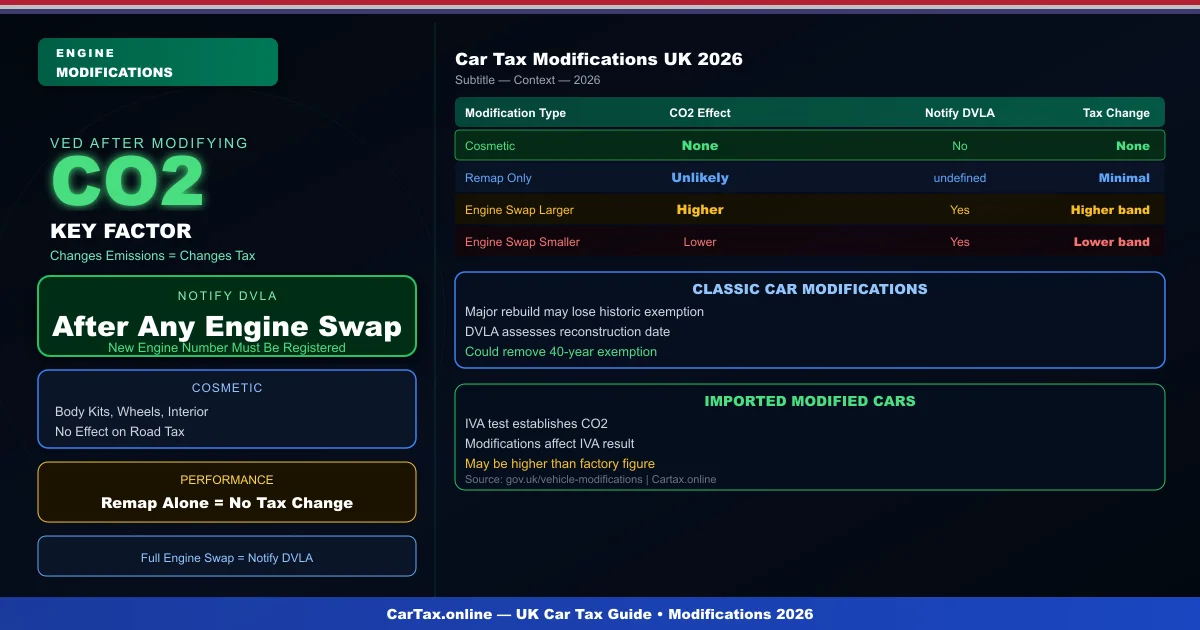
Modifying your car can have unexpected consequences for road tax. Understanding which modifications change your VED band — and which do not — prevents surprises when you renew your tax.
Modifications That Can Change Your Road Tax
Any modification that changes your vehicle's CO2 emissions figure can change your road tax band. This is most relevant for engine swaps — fitting a more powerful engine that produces higher CO2 emissions moves the vehicle into a higher VED band. Fitting a smaller or more efficient engine reduces CO2 and potentially the tax band. These changes must be notified to DVLA, and the new CO2 figure must be established.
Performance Modifications and Road Tax
Performance modifications — turbocharging, remapping, exhaust upgrades — can theoretically change CO2 emissions, but the official figure on the V5C remains the measurement from the original type approval test. DVLA does not typically reassess CO2 for performance modifications unless the engine is replaced or extensively modified. However, if your modified vehicle is involved in an MOT emissions failure, DVLA may investigate further.
Cosmetic Modifications
Cosmetic modifications — body kits, alloy wheels, interior changes, tinted windows — do not affect road tax in any way. These changes fall outside the scope of VED calculation, which is based solely on CO2 emissions and list price. The exception is if a modification makes the vehicle non-compliant with its type approval — in which case the vehicle may fail IVA and cannot be legally driven. Related: Car Tax and Vehicle Modifications UK 2026 | Car Modification Tax Uk | Car Tax vs Motorcycle Tax UK 2026 | Car Tax vs Motorcycle Tax UK 2026.
Notifying DVLA of Modifications
You must notify DVLA of any modification that changes the vehicle's identity — including engine number, body type, or intended use. For engine swaps, the new engine number must be registered with DVLA. If the modification changes the vehicle's type (for example, from a van to a pickup truck), the classification may change and with it the tax basis. Failing to notify DVLA is an offence — the vehicle records must accurately reflect the actual vehicle.
Imported Modified Vehicles
Modified imported vehicles face additional scrutiny. A Japanese performance car imported with modifications may need to have its CO2 emissions formally established under UK testing. The IVA test measures real-world CO2, not just the factory figure. Any modifications that increased emissions beyond the original factory figure will be reflected in the UK-assigned CO2, potentially placing the vehicle in a higher VED band.
Classic Car Modifications
Modifying a classic car can affect its historic vehicle exemption. Vehicles substantially modified from original specification may be reassessed by DVLA for type approval purposes. A heavily modified vehicle that no longer resembles its original form may be classified as a reconstruction — with the VED based on the reconstruction date rather than the original chassis date. This can be very significant in tax terms, potentially removing the historic exemption.
Official Resources: Parivahan Portal | Vahan Road Tax | India GST Portal | FAME-III Scheme
Frequently Asked Questions
Q: What is the current road tax rate for cars in India 2026?
Road tax rates in India vary by state and vehicle category. For new cars, GST is charged at 5% for EVs, 18% for hybrids under 1,200cc, and up to 28% for petrol/diesel SUVs. State road tax is charged separately and varies from Rs3,000-15,000 annually depending on the state's slab system. Check your specific state's RTO website for current rates.
Q: How do I calculate my car road tax online in India?
You can calculate your car road tax using online calculators available on state RTO portals and CarTax.online. The calculation considers your vehicle's ex-showroom price, fuel type, engine capacity, and state of registration. Road tax is payable annually or for the vehicle's lifetime depending on your state's rules.
Q: Is GST included in the road tax for new cars in India?
No — GST and road tax are separate charges. GST is a central tax charged by the vehicle manufacturer at the time of purchase. State road tax is a separate annual or one-time charge levied by your state's transport department. Both apply at the time of first registration, and annual road tax continues for subsequent years.
Q: Do electric vehicles get tax benefits in India 2026?
Yes — electric vehicles in India qualify for a reduced GST rate of 5% (down from 28% for petrol cars). Under FAME-III subsidies, EVs may also qualify for additional state-level incentives, reduced road tax, and free registration in many states. The exact benefits vary by state.
Q: What happens if I don't pay my car road tax on time?
If you don't pay road tax, your vehicle's registration can be flagged in the Vahan database, preventing renewal of fitness certificates and creating legal liability during police checks. Penalties range from Rs200-500 per day of default in most states. Road tax is a legal requirement under the Motor Vehicles Act.