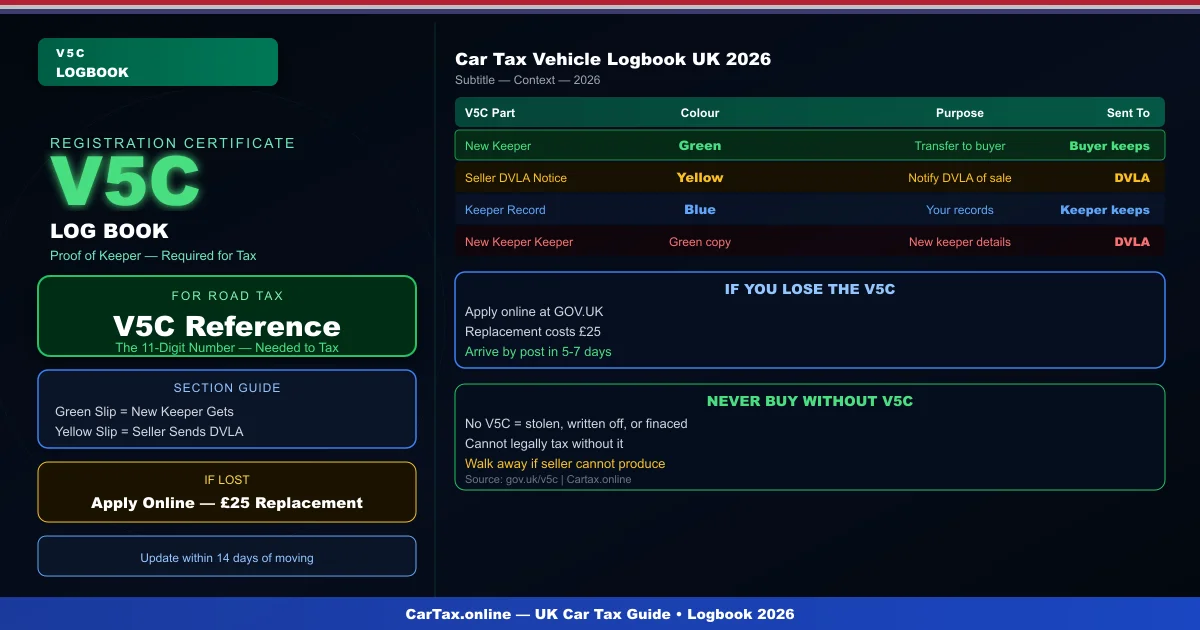
The V5C registration certificate — commonly called the logbook — is one of the most important documents for road tax purposes. Understanding how to use it correctly prevents problems with DVLA and ensures your vehicle's tax status is accurate.
What Is the V5C?
The V5C is the vehicle's registration certificate issued by DVLA. It proves who is the registered keeper of the vehicle and records key vehicle details including the make, model, engine size, CO2 emissions figure, first registration date, and vehicle identification number. The V5C is not proof of ownership — the actual owner may be a finance company if there is outstanding finance on the vehicle.
The V5C Sections
The V5C is divided into several sections. Section 1 contains your vehicle details. Section 2 is the keeper's details. The green slip (V5C part 1) is given to the new keeper when you sell. The yellow slip (V5C part 2) is sent to DVLA by the seller to notify the sale. The white slip (V5C part 1A) is for keeper transfer notification. The blue slip (V5C part 2) is the seller's notification of sale.
Using the V5C for Road Tax
To tax your vehicle at GOV.UK or the Post Office, you need the V5C reference number — the 11-digit number on the front of the V5C, top right. You do not need to have the physical V5C in your possession to tax, but DVLA must have your name registered as keeper for you to tax the vehicle. If the V5C is with the finance company, you may need to contact them. Related: Car Tax and Vehicle Logbook UK 2026 | Car Tax V5C Logbook UK 2026 | V5C Logbook Explained UK 2026 | V5C Logbook Explained UK 2026.
Updating the V5C
You must update the V5C if you change your address — within 14 days. You must also update it if you make modifications to the vehicle that change its description — for example, changing the engine. DVLA can fine you up to £1,000 for failing to update your address. The updated V5C arrives by post within a week of applying — or you can apply online at GOV.UK.
If You Lose the V5C
If you lose your V5C, you can apply for a replacement online at GOV.UK for £25. DVLA will send a new V5C with a new V5C reference number. If the vehicle is subject to outstanding finance, the replacement V5C is sent to the finance company, not you. Always check with your insurer and any finance company before applying, to ensure the vehicle details on the replacement V5C are correct.
V5C and Tax Refunds
When a vehicle changes keeper, the previous keeper's road tax is refunded for any full remaining months. DVLA processes this refund automatically when the sale is notified. The refund is calculated from the start of the month following the month the sale was notified. If you sell and do not notify DVLA, you continue to be liable for road tax — and the refund does not happen.
Buying a Vehicle Without a V5C
You should never buy a vehicle without a V5C. The absence of a V5C suggests the vehicle may have been written off, stolen, or has outstanding finance. Ask the seller to apply for a replacement V5C before proceeding — or walk away. A vehicle without a V5C cannot be legally taxed in your name, and you cannot register as the keeper.
Official Resources: GOV.UK Check Vehicle Tax | GOV.UK Vehicle Tax | DVLA Online | MOT Check
Frequently Asked Questions
Q: How much is car tax (VED) in the UK 2026?
Car tax rates in the UK depend on your vehicle's CO2 emissions and list price. Standard rates start from £190 per year for petrol and diesel cars, with zero-rated VED for EVs. First-year rates vary from £0 to £2,605 depending on emissions. Additional premiums apply for vehicles over £40,000.
Q: How do I check if my car is taxed online?
You can check your vehicle's tax status for free on the Gov.uk website at gov.uk/check-vehicle-tax. You'll need your vehicle's registration number (number plate). You can also check via the Motor Insurance Database to verify road tax and insurance status simultaneously.
Q: Can I get a refund on car tax if I sell my vehicle?
Yes — if you sell or scrap your vehicle, you can claim a refund on any full months of remaining road tax. Contact DVLA with the V11 reminder letter or apply online at gov.uk. Refunds are usually processed within 4-6 weeks.
Q: Is road tax refund available when transferring ownership?
No — road tax does not transfer with the vehicle. When you sell your car, the tax is automatically cancelled and any remaining months are refunded to you by DVLA. The new owner must tax the vehicle immediately. As a buyer, always verify the vehicle's tax status before purchasing.
Q: What is the luxury car tax threshold in the UK 2026?
The additional rate for vehicles over £40,000 (list price) adds £410 per year to standard VED rates for years 2-6 of registration. This surcharge brings the annual cost for high-emission vehicles over £40,000 to around £600-690 per year. Pure EVs under £40,000 pay zero VED.