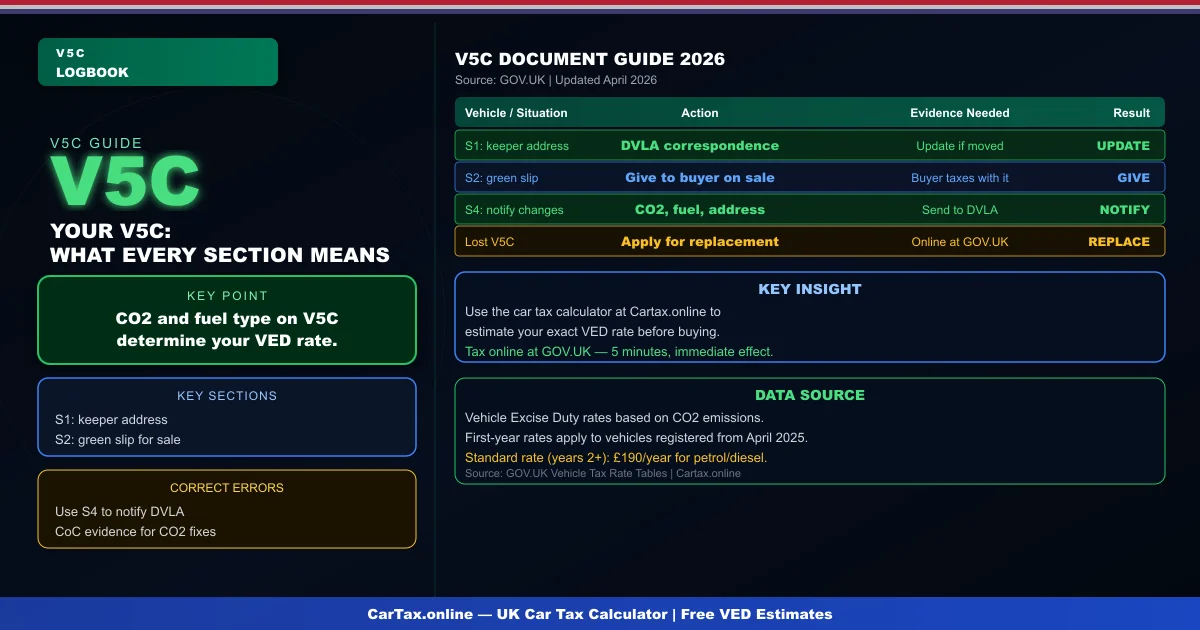
The V5C — also called the vehicle registration certificate or logbook — is one of the most important documents associated with your vehicle. Understanding it fully helps you manage road tax and other vehicle administration.
What the V5C Contains
The V5C records all key vehicle details: the vehicle identification number (VIN), registration mark, make and model, first registration date, CO2 emissions figure, fuel type, engine size, year of manufacture, colour, and the registered keeper's name and address. These details determine your VED rate. Keep the V5C safe — it is your proof of ownership and your key to taxing and selling the vehicle.
Section 1: Your Details
Section 1 of the V5C shows the registered keeper's name and address. This is the address DVLA uses for all correspondence including tax reminders and refunds. If this address is wrong, update it immediately at GOV.UK. The address on the V5C must match your driving licence address if you are the registered keeper.
Section 2: The Green Slip
Section 2 — the green slip — is the part you give to the buyer when selling your vehicle. It is their proof that you have transferred the vehicle to them. If you sell and do not have the green slip, you cannot transfer ownership. The buyer uses section 2 to tax the vehicle in their name. Keep a copy of the green slip before giving it to the buyer. Related: Car Tax V5C Logbook UK 2026 | V5C Logbook Explained UK 2026 | Car Tax V5C Logbook UK 2026 | Car Tax and Vehicle Logbook UK 2026.
Section 4: Changes and Corrections
Section 4 of the V5C is used to notify DVLA of changes — such as a change of address, alteration to the vehicle, or correction of details on the V5C. If your CO2 figure is wrong, use section 4 to notify DVLA with supporting evidence such as a Certificate of Conformity.
Losing Your V5C
If you lose your V5C, you can apply for a replacement V5C online via GOV.UK. There is a fee for the replacement. You cannot tax the vehicle without the V5C reference number — if you have lost it and need to tax urgently, contact DVLA's phone service. Replacement V5Cs are posted within 5 working days.
Buying a Car Without a V5C
Never buy a vehicle without the V5C — or without the seller committing to provide it. Without the V5C, you cannot tax the vehicle, prove ownership, or notify DVLA. If a seller says they have lost the V5C, they must apply for a replacement before the sale can proceed legitimately. Walk away from any deal where the seller cannot or will not provide the V5C.
Frequently Asked Questions
Q: How much is car tax (VED) in the UK 2026?
Car tax rates in the UK depend on your vehicle's CO2 emissions and list price. Standard rates start from £190 per year for petrol and diesel cars, with zero-rated VED for EVs. First-year rates vary from £0 to £2,605 depending on emissions. Additional premiums apply for vehicles over £40,000.
Q: How do I check if my car is taxed online?
You can check your vehicle's tax status for free on the Gov.uk website at gov.uk/check-vehicle-tax. You'll need your vehicle's registration number (number plate). You can also check via the Motor Insurance Database to verify road tax and insurance status simultaneously.
Q: Can I get a refund on car tax if I sell my vehicle?
Yes — if you sell or scrap your vehicle, you can claim a refund on any full months of remaining road tax. Contact DVLA with the V11 reminder letter or apply online at gov.uk. Refunds are usually processed within 4-6 weeks.
Q: Is road tax refund available when transferring ownership?
No — road tax does not transfer with the vehicle. When you sell your car, the tax is automatically cancelled and any remaining months are refunded to you by DVLA. The new owner must tax the vehicle immediately. As a buyer, always verify the vehicle's tax status before purchasing.
Q: What is the luxury car tax threshold in the UK 2026?
The additional rate for vehicles over £40,000 (list price) adds £410 per year to standard VED rates for years 2-6 of registration. This surcharge brings the annual cost for high-emission vehicles over £40,000 to around £600-690 per year. Pure EVs under £40,000 pay zero VED.