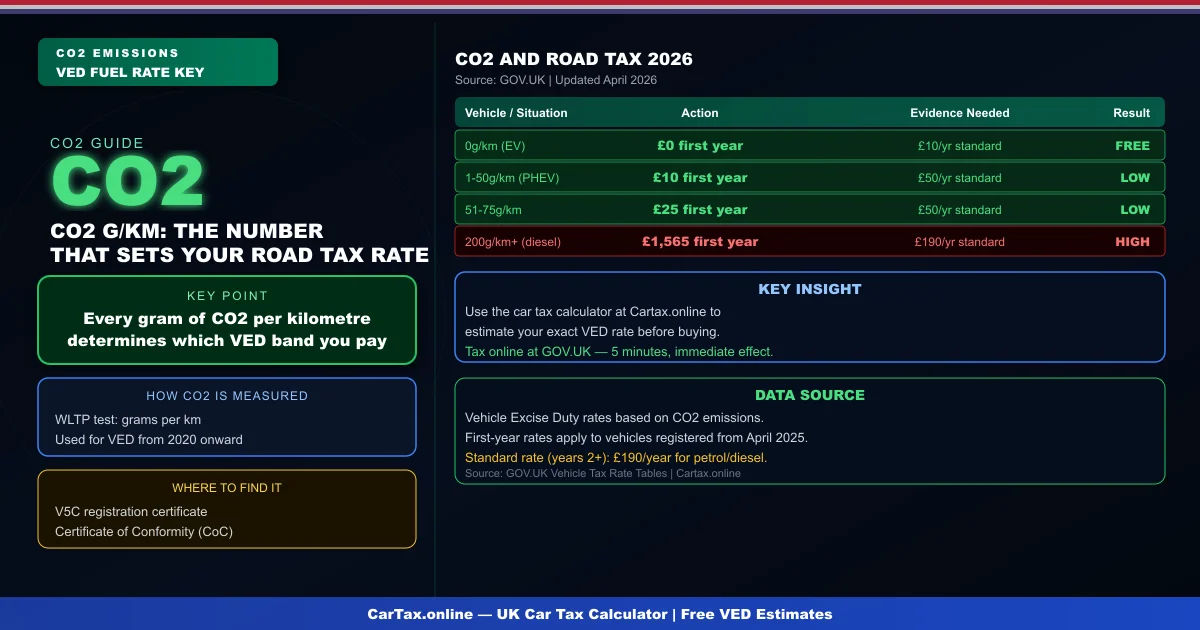
Understanding CO2 emissions UK — carbon dioxide (CO2) is the primary factor determining your road tax. Here is everything you need to know about vehicle CO2 and how it works in 2026.
What Is CO2 and Why Does It Matter for Road Tax?
CO2 is the greenhouse gas produced when fuel is burned in an engine. The UK government uses CO2 emissions as a proxy for environmental impact, linking it to Vehicle Excise Duty. The more CO2 your vehicle produces, the more you pay in road tax. This creates a financial incentive to choose lower-emission vehicles.
How Is CO2 Measured?
CO2 is measured in grams per kilometre (g/km) through standardised laboratory testing on a rolling road. The vehicle is tested through a specific drive cycle that simulates urban, rural, and motorway driving. The result is a combined figure — not separate urban/motorway figures.
WLTP vs NEDC: Why Your CO2 May Have Changed
Since 2018, all new vehicles are tested under the WLTP (Worldwide Harmonised Light Vehicle Test Procedure), which is more realistic than the previous NEDC test. WLTP figures are typically 15-30% higher than NEDC figures for the same vehicle. This means a car registered from 2018 onwards may have a higher official CO2 figure than pre-2018 equivalents. Related: Understanding CO2 Emissions UK 2026 | Car Tax CO2 Emissions UK 2026 | Car Tax CO2 Emissions UK 2026 | UK Car Tax Bands 2026.
Real-World CO2 vs Official Figures
Official WLTP CO2 figures are laboratory results. Real-world driving typically produces 10-20% higher CO2 than the WLTP figure due to variables like空调使用, passengers, luggage, driving style, and weather. This gap is acknowledged by the EU and UK governments and forms part of the argument for real-driving emissions (RDE) testing.
How to Reduce Your Vehicle is CO2 Footprint
- Choose a hybrid or EV: Zero or very low CO2 emissions
- Drive efficiently: Gentle acceleration and braking reduces fuel consumption and CO2
- Reduce unnecessary weight: Remove roof racks and excess luggage
- Maintain your vehicle: Well-maintained engines run more efficiently
- Plan journeys: Combining trips reduces total miles and CO2
Conclusion
Understanding CO2 emissions UK: measured in g/km, determined by lab testing, affects VED directly. Lower CO2 = lower road tax. Use our car tax calculator to see your VED based on your CO2.
Official Resources: GOV.UK Check Vehicle Tax | GOV.UK Vehicle Tax | DVLA Online | MOT Check
Frequently Asked Questions
Q: How much is car tax (VED) in the UK 2026?
Car tax rates in the UK depend on your vehicle's CO2 emissions and list price. Standard rates start from £190 per year for petrol and diesel cars, with zero-rated VED for EVs. First-year rates vary from £0 to £2,605 depending on emissions. Additional premiums apply for vehicles over £40,000.
Q: How do I check if my car is taxed online?
You can check your vehicle's tax status for free on the Gov.uk website at gov.uk/check-vehicle-tax. You'll need your vehicle's registration number (number plate). You can also check via the Motor Insurance Database to verify road tax and insurance status simultaneously.
Q: Can I get a refund on car tax if I sell my vehicle?
Yes — if you sell or scrap your vehicle, you can claim a refund on any full months of remaining road tax. Contact DVLA with the V11 reminder letter or apply online at gov.uk. Refunds are usually processed within 4-6 weeks.
Q: Is road tax refund available when transferring ownership?
No — road tax does not transfer with the vehicle. When you sell your car, the tax is automatically cancelled and any remaining months are refunded to you by DVLA. The new owner must tax the vehicle immediately. As a buyer, always verify the vehicle's tax status before purchasing.
Q: What is the luxury car tax threshold in the UK 2026?
The additional rate for vehicles over £40,000 (list price) adds £410 per year to standard VED rates for years 2-6 of registration. This surcharge brings the annual cost for high-emission vehicles over £40,000 to around £600-690 per year. Pure EVs under £40,000 pay zero VED.